/)
The Coloplast Titan is a three-piece inflatable penile prosthesis, one of two implant families that prosthetic urologists reach for when erectile dysfunction has stopped responding to everything less invasive. It is built for men who want a firm, reliable erection they control, without the loss of spontaneity that comes with injections or a vacuum pump. Because Bangkok combines high-volume implant surgeons with pricing well below US and UK levels, a steady number of men now travel to Thailand specifically for this operation.
This guide is written for that decision. It covers what the Titan actually is and how it differs from a malleable rod, transparent Bangkok pricing in both baht and dollars with a savings comparison, who is and is not a candidate, the operation and recovery step by step, what the published outcome data really show, the risks worth understanding, and how to vet a clinic so you do not end up paying for a counterfeit device or an inexperienced surgeon. Placing an implant is a permanent step that requires an in-person urology consultation and prescription, so treat this as background for that conversation rather than a substitute for it.
What the Coloplast Titan is
A penile implant, or penile prosthesis, is a device a surgeon places inside the penis to produce an erection. There are two broad types. A malleable (semi-rigid) implant is a pair of bendable rods that keep the penis permanently firm; you bend it up for sex and down the rest of the time. An inflatable implant, by contrast, stays soft until you want an erection, then firms up on demand and returns to flaccid afterward, which most men find closer to natural function. The Cleveland Clinic's overview of surgical penile implants explains both families in plain terms.
The Coloplast Titan is the inflatable, three-piece variety. Three components sit hidden inside the body:
Two cylinders placed inside the erectile chambers (the corpora cavernosa) of the penis.
A pump and release valve tucked into the scrotum, which you squeeze to move fluid.
A fluid reservoir placed behind the abdominal wall or in the pelvis.
To get an erection, you squeeze the scrotal pump a number of times; fluid moves from the reservoir into the cylinders and the penis becomes rigid. To go flaccid, you press the release valve and the fluid drains back. Nothing is visible from the outside, and the device is silent in use. The Titan's cylinders are built from a Bioflex biopolymer engineered for high column strength, which is why surgeons often favour it for men who want maximum rigidity or who have Peyronie's disease, where scar tissue inside the penis causes curvature. If you are weighing the Titan against other functional devices, our overview of penile implant surgery options and the dedicated pages on the AMS 700 LGX and malleable implants lay out the trade-offs.
One important distinction: the Titan treats erectile dysfunction. It is not a cosmetic enlargement device like Penuma or Himplant. It restores the ability to have a firm erection; it does not set out to lengthen a flaccid penis, and as we explain below, most men should not expect a length gain.
Coloplast Titan cost in Bangkok (THB and USD)
Pricing for an inflatable implant is driven largely by the device itself, which is a significant share of the total, plus surgeon fees, anaesthesia, the hospital, and aftercare. The figures below reflect typical all-inclusive Bangkok packages for a first-time (virgin) Titan implant as of 2026. They are indicative and should be confirmed at consultation, because the final quote depends on the exact cylinder configuration, the hospital tier, and whether any extra correction (such as straightening for Peyronie's) is needed.
Item | Bangkok (THB) | Bangkok (USD approx.) | What it usually covers |
Coloplast Titan, all-inclusive package | THB 480,000 – 950,000 | USD 13,000 – 26,000 | Device, surgeon, anaesthesia, hospital, 1–2 night stay, follow-ups, activation teaching |
Lower end (standard hospital, standard cylinders) | THB 480,000 – 650,000 | USD 13,000 – 18,000 | As above, standard configuration |
Higher end (premium hospital, complex case) | THB 700,000 – 950,000+ | USD 19,000 – 26,000+ | As above, plus added complexity or premium facility |
Bangkok packages for implant surgery can be advertised lower still, sometimes from around USD 8,000 to 10,000, but those entry prices usually reflect a malleable device or a basic configuration. A genuine three-piece Coloplast Titan, with its premium device cost, generally sits in the band above; a quote far below it for a "Titan" is a reason to verify exactly what device and configuration are included.
How that compares to the US and UK
Country | Typical inflatable implant cost | Versus Bangkok |
Thailand (Bangkok) | THB 480,000 – 950,000 (USD 13,000 – 26,000) | Baseline |
United States | USD 20,000 – 35,000+ self-pay (up to ~USD 50,000 in some centres) | Bangkok is roughly 35–60% lower |
United Kingdom (private) | GBP 12,000 – 30,000+ | Bangkok is roughly 30–55% lower |
Independent medical-travel listings put inflatable-implant surgery in Thailand at a fraction of US self-pay pricing, with one Bangkok clinic's Titan Touch package widely quoted around USD 14,000. The savings come from lower facility and surgeon costs in Thailand, not from a cheaper device; a genuine Coloplast Titan costs broadly the same wherever it is bought. That last point matters: a quote far below the ranges above is a reason to ask hard questions, not to celebrate. For context on lower-cost ED treatments that may be worth trying first, see our guides to ED medication costs in Bangkok and shockwave therapy.
What drives the final price
Device configuration. Cylinder length and girth, and reservoir type, are chosen to fit your anatomy and can shift the cost.
Surgeon experience. High-volume prosthetic urologists command higher fees, and the data consistently link surgeon volume to lower complication rates, so this is rarely the place to economise.
Hospital tier. Premium private hospitals carry higher operating-room and anaesthesia charges than mid-tier facilities.
First-time versus revision. Replacing or revising an existing implant is technically harder and usually costs more than a virgin implant.
Added procedures. Intra-operative straightening for Peyronie's, or scar-tissue management in a previously operated or heavily fibrosed penis, adds time and cost.
Who is a candidate, and who is not
The American Urological Association's erectile dysfunction guideline-guideline) recommends that all men with erectile dysfunction be informed about penile prosthesis implantation as a treatment option, with an honest discussion of its benefits and its risks and burdens. In other words, the guideline frames the implant as a choice every man with ED deserves to know about, rather than a last resort hidden until everything else has failed. In day-to-day practice, surgeons still tend to reserve the operation for men whose ED is moderate to severe and who have found tablets, injections or a vacuum device either ineffective or unacceptable, because it is a permanent step. Good candidates often include:
Men with ED that no longer responds adequately to PDE5 inhibitor tablets, injections or a vacuum erection device, or who find those options unacceptable.
Men with ED after prostate cancer surgery, or related to diabetes or vascular disease, where the underlying mechanism is unlikely to recover.
Men with Peyronie's disease and significant ED, where an implant can both straighten and restore rigidity. Our page on Peyronie's disease surgery goes into the curvature side in more detail.
Men who want a permanent, on-demand solution and accept that the natural erection mechanism will be removed.
It is equally important to know who should pause or look elsewhere. The decision deserves a careful work-up, because some situations make surgery unsafe or unwise:
Active infection. The AUA guideline is explicit that prosthetic surgery should not be done in the presence of a systemic, skin or urinary tract infection. Any infection must be cleared first.
Poorly controlled diabetes or other medical instability. High blood sugar raises infection risk; clinicians usually want it optimised before operating.
Unrealistic expectations, especially about length. An implant restores firmness, not size. A man chasing a longer flaccid penis is likely to be disappointed and may be better suited to a different conversation.
Untreated psychological or relationship factors, or ED that has a reversible cause that has not yet been addressed. It is worth being sure the problem is genuinely erectile dysfunction rather than low desire; our explainer on low libido versus erectile dysfunction can help separate the two.
Men not ready for a permanent, irreversible step. Once the implant is placed, natural and medication-assisted erections are no longer possible, because the spongy erectile tissue is replaced by the cylinders.
A proper consultation includes a medical history, an examination, blood work where indicated, and an honest discussion of expectations. Documenting the stretched penile length beforehand, as the AUA guideline suggests, helps set realistic expectations about what the penis will look like afterward.
The procedure, step by step
Titan implant surgery is a well-established operation, usually done under general or spinal anaesthesia and taking, in most cases, around one to two hours, in line with the Cleveland Clinic's stated range. The broad sequence is:
Anaesthesia and preparation. You are anaesthetised, and the genital area is shaved, cleaned and draped under strict sterile conditions. Antibiotics are given to reduce infection risk.
Incision. The surgeon makes a small incision, commonly where the base of the penis meets the scrotum, or in the lower abdomen. It is positioned to stay discreet once healed.
Preparing the chambers. The erectile chambers are gently dilated and measured so the cylinders fit your anatomy precisely. In Peyronie's cases, the penis may be straightened at this stage.
Placing the components. The two cylinders go into the chambers, the pump is positioned in the scrotum, and the reservoir is placed behind the abdominal wall or in the pelvis. The device is tested by inflating and deflating it on the table.
Closure. The incision is closed, usually with dissolvable sutures, and a light dressing is applied. Many men go home the same day or after one night; some packages include a second night.
The implant is typically left deflated for the first several weeks while tissues heal, then activated and you are taught to use the pump at a follow-up visit.
Recovery timeline
Healing is gradual, and rushing it is the most common avoidable mistake. The general pattern, which your surgeon will tailor to you:
First 1–2 weeks. Expect swelling, bruising and soreness in the penis and scrotum, managed with prescribed pain relief. Keep the area clean, take it easy, and avoid strenuous activity and heavy lifting.
Weeks 2–4. Swelling settles and discomfort eases. Many men return to desk-based work within a week or two. The device generally stays deflated during this window.
Around weeks 4–6. At a follow-up, the surgeon checks healing and usually activates the implant, then teaches you how to inflate and deflate it. Practising builds confidence and helps the surrounding tissue accommodate the device.
From about 6 weeks. Most men are cleared to resume sexual activity around the six-week mark, consistent with Cleveland Clinic guidance, though some surgeons advise waiting a little longer. Full comfort and ease of use typically arrive over the following weeks as you get used to the pump.
Attending every follow-up and reporting anything that seems off, especially fever, spreading redness or worsening pain, is the best protection against problems.
What results to expect
The honest picture is that inflatable implants have some of the highest satisfaction rates of any ED treatment, provided expectations are set correctly. Published figures worth knowing:
Satisfaction. Contemporary studies summarised in a 2017 review on preoperative counseling for inflatable penile prosthesis report patient satisfaction roughly in the 78 to 96 percent range across cohorts. A two-year prospective study of the Coloplast Titan, published in the Asian Journal of Andrology, found 96.5 percent of men satisfied with overall implant function at two years.
Mechanical reliability. The same review cites five-year mechanical survival of about 89.9 percent for the Coloplast Titan, with a large modern cohort showing a re-operation rate of only 3.9 percent at a median follow-up of roughly eight years. The Cleveland Clinic notes that devices often last on the order of twenty years before replacement is needed, though individual results vary.
On length. This is where managing expectations matters most. The 2017 review notes that over 70 percent of men perceive some loss of length after the operation even when no measurable loss exists, which is why surgeons counsel that an implant restores rigidity rather than adding length. In the Titan study above, about 67.8 percent of men were satisfied with their length at two years.
Put simply: a well-placed Titan reliably gives a firm erection you control, and most men and their partners are happy with how it works. It will not make the penis larger, and it is wise to go in expecting restored function rather than enhancement.
Risks and complications
Every surgery carries risk, and an implant is no exception. Most men recover without serious problems, but you should understand both the common, manageable issues and the red flags that need urgent attention. Drawing on the Cleveland Clinic's stated complication list:
More common, usually manageable:
Swelling, bruising and pain in the first weeks.
Temporary changes in penile sensation.
A short period of getting used to operating the pump.
Less common but serious:
Infection of the device, which is the complication surgeons work hardest to prevent and which may require removing the implant.
Mechanical failure of a component over time, which may need revision surgery.
Erosion, where part of the device wears against or through tissue.
Reservoir or pump migration from its intended position.
Persistent pain or excessive scar tissue.
Seek urgent medical care if you notice:
Fever, chills, or spreading redness, warmth or pus around the incision (possible infection).
Severe or worsening pain not controlled by your prescribed medication.
A wound that opens, or part of the device becoming visible or palpable through the skin.
Inability to deflate an erection, or a painful erection that will not subside.
Choosing a high-volume surgeon, completing the full course of antibiotics, and following wound-care and activity instructions are the most effective ways to keep these risks low.
Have a question about your treatment?
Message our Bangkok clinic on WhatsApp and a doctor replies within minutes during clinic hours.
How to choose a safe clinic in Bangkok
The quality of the surgeon and the authenticity of the device matter more here than in almost any other cosmetic or functional procedure. Use these checks:
A board-certified urologist who specialises in prosthetics. Ask how many Titan implants the surgeon places each year and request their qualifications. In Thailand, you can ask for the doctor's name and medical-license number, which reputable clinics will provide.
A genuine, sealed device. Insist on a new, sealed Coloplast Titan with a verifiable serial number, and ask to see the documentation. This is the single best defence against counterfeit or grey-market implants.
An accredited surgical facility with a dedicated urology team and strict infection-control protocols, since infection is the complication that most often forces device removal.
Clear, itemised pricing that spells out what the package includes (device, surgeon, anaesthesia, hospital nights, follow-ups, activation teaching), so you can compare like with like.
A real aftercare plan, including wound checks, device activation and training, and a clear route to emergency support if something goes wrong.
Red flags that should give you pause:
A price far below the ranges in this guide, which can signal a counterfeit device, an unqualified surgeon, or hidden exclusions.
Refusal to name the surgeon or confirm their credentials.
No verifiable serial number or device documentation.
No structured follow-up or activation support.
Pressure to decide on the spot, or vague answers about what is included.
How the Titan compares to other options
Option | Type | Best suited to | Spontaneity | Reversible | Indicative Bangkok cost |
Coloplast Titan | 3-piece inflatable | ED needing maximum rigidity; Peyronie's | High (soft until inflated) | No (permanent) | THB 480,000 – 950,000 |
AMS 700 series | 3-piece inflatable | ED wanting a natural feel; some length-girth expansion | High | No (permanent) | Similar range |
Malleable (semi-rigid) implant | Bendable rods | ED with limited hand dexterity; simpler, lower cost | Lower (always firm) | No (permanent) | Lower than inflatable |
Shockwave or PRP therapy | Non-surgical | Milder, vascular ED; men avoiding surgery | Natural | Yes (non-permanent) | Far lower |
ED medication (PDE5 inhibitors) | Non-surgical | First-line for most ED | Natural | Yes | Lowest |
For most men the practical question is inflatable versus malleable, and inflatable versus trying non-surgical options first. If you have not yet exhausted less invasive routes, it is reasonable to discuss penile implants versus shockwave and PRP before committing to a permanent device.
Considering a Titan implant at Menscape Bangkok
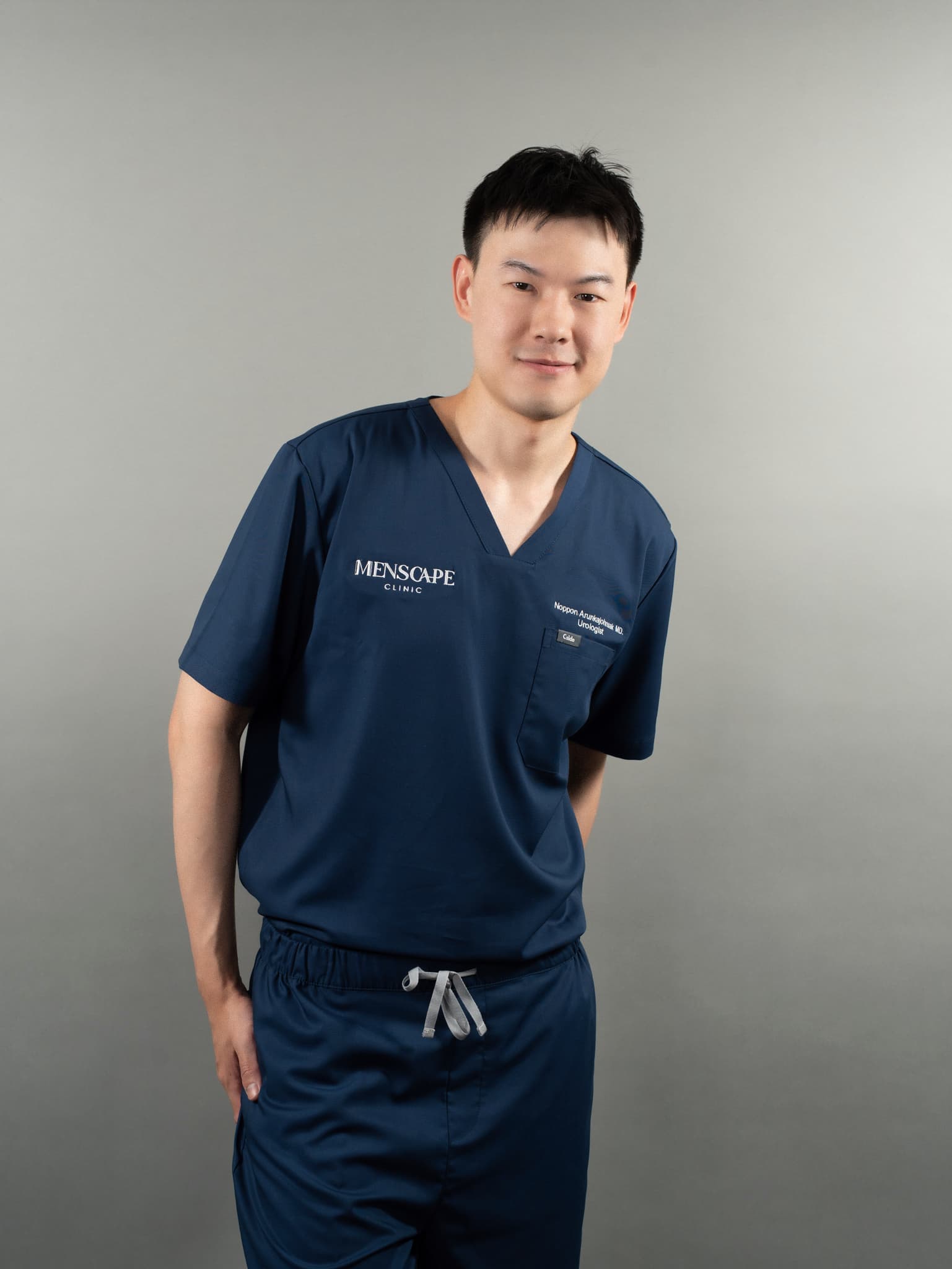
A Titan implant is a permanent solution to erectile dysfunction, not a first step, so it deserves an unhurried consultation with a urologist who does this work regularly. At Menscape in Bangkok, that means a confidential assessment of whether an implant is right for you, an honest discussion of expectations and alternatives, a genuine sealed device, transparent pricing, and structured aftercare including activation training. Because implant surgery requires a medical consultation and prescription, the next step is simply a conversation, not a commitment. If you would like a personalised assessment, you can book a private consultation to talk it through.
Frequently Asked Questions
Is the Coloplast Titan firmer than other inflatable implants?
The Titan's cylinders use a Bioflex biopolymer built for high column strength, and surgeons often choose it when maximum rigidity is the priority or when a man has Peyronie's disease. Other inflatable devices such as the AMS 700 are also highly rated, and the best choice depends on your anatomy and goals. A prosthetic urologist can advise on which suits you at consultation.
Can anyone tell I have a penile implant?
No. All three components, the cylinders, the scrotal pump and the reservoir, sit entirely inside the body. Nothing is visible from the outside, and the device is silent. When deflated the penis looks and feels soft, and when you inflate it for sex it becomes firm.
How soon after surgery can I have sex?
Most men are cleared to resume sexual activity around six weeks after surgery, in line with general guidance from sources such as the Cleveland Clinic, although some surgeons prefer you wait a little longer. The implant is usually activated and you are taught to use the pump at a follow-up visit around four to six weeks, with full comfort developing over the following weeks.
Will the Titan make my penis bigger?
It is not designed to. An inflatable implant restores firmness, not size. Research shows that many men actually perceive a slight loss of length after surgery even when none is measurable, which is why surgeons counsel that the goal is rigidity rather than enlargement. If your main aim is a larger flaccid penis, an implant is the wrong procedure and a different consultation is more appropriate.
How long does a Coloplast Titan implant last?
Inflatable implants are durable. Published data cite roughly 90 percent mechanical survival at five years for the Coloplast Titan, and the Cleveland Clinic notes devices often last on the order of twenty years before replacement is needed. Individual longevity varies, and a small percentage of men need revision surgery over time.
Can the Titan correct penile curvature from Peyronie's disease?
Often, yes. In men with both significant erectile dysfunction and Peyronie's disease, the implant can restore rigidity while the penis is straightened during the operation. The degree of correction depends on the severity of the curvature, so it should be assessed individually. Our Peyronie's disease surgery page covers the curvature side in more detail.
How much does a Coloplast Titan implant cost in Bangkok?
As of 2026, an all-inclusive Titan package in Bangkok typically runs about THB 480,000 to 950,000, roughly USD 13,000 to 26,000, depending on the hospital tier, the cylinder configuration and case complexity. That is commonly 35 to 60 percent less than comparable private surgery in the US or UK. These figures are indicative and should be confirmed at consultation.
Is the implant reversible if I change my mind?
No. Placing the implant removes the natural erection mechanism, because the cylinders replace the spongy erectile tissue, so natural and medication-assisted erections are no longer possible afterward. The device can be removed or replaced surgically, but the natural mechanism does not return. This is why it is reserved for men who have tried or ruled out less invasive options and accept a permanent step.
What are the main risks of Titan implant surgery?
The most serious risk is infection of the device, which may require removing it, which is why surgeons use strict sterile technique and antibiotics. Other less common risks include mechanical failure over time, erosion, migration of the pump or reservoir, and persistent pain. Most men recover without serious problems. Choosing a high-volume surgeon and following aftercare instructions keeps risks low.
Do I need a consultation and prescription before surgery?
Yes. A penile implant is a prescription medical procedure that requires an in-person urology consultation, examination and, where needed, blood tests, to confirm you are a suitable candidate and that no contraindications such as active infection are present. There is no way to skip this step, and any clinic willing to operate without a proper work-up should be avoided.
/)
/)
/)
/)
/)