/)
If erectile dysfunction has stopped responding to tablets, injections, or a vacuum device, a penile implant becomes the next realistic option, and the Coloplast Genesis is one of the most straightforward implants available. It is a malleable, or semi-rigid, device: two slim silicone rods placed inside the erection chambers of the penis. There is no pump, no reservoir, and nothing to inflate. You bend the penis up when you want sex and down the rest of the time. That simplicity is the whole point, and for a particular group of men it is exactly the right trade-off.
This guide walks through what the Genesis actually is, who it suits and who it does not, transparent Bangkok pricing in both THB and USD with a comparison to US and UK costs, the surgery and recovery week by week, the results you can reasonably expect, the risks worth taking seriously, and how to choose a clinic safely. A penile implant is a permanent procedure that changes your anatomy in ways that cannot be undone, so it is worth understanding properly before you book a consultation.
To be clear from the outset: implant surgery is prescription-only and requires an in-person assessment with a urologist. Nothing here replaces that consultation. Prices are indicative and should be confirmed in writing for your specific case.
What the Coloplast Genesis implant is
The Genesis is a two-rod malleable prosthesis made by Coloplast, a Danish medical-device company. Each rod is a silicone-covered core that you can bend into position and that stays where you put it. Because the rods are always inside the penis, it is firm enough for penetration at all times, which is why some men describe it as being permanently "ready." When not in use, you bend it downward against the body so it sits discreetly under clothing.
A few design details matter for how it performs over time. The Genesis carries a hydrophilic surface coating that absorbs whatever antibiotic solution the surgeon dips it in before insertion, which is intended to lower the early infection risk. It has no internal springs, cables, or moving parts, which is the main reason malleable implants tend to fail mechanically less often than pump-driven inflatable devices. A published 2023 device review in *Therapeutic Advances in Urology* describes the Genesis as having no internal moving components and notes generally favorable clinical outcomes, while also observing that the larger-diameter version was linked to more complications without better satisfaction, which is a useful reminder that bigger is not automatically better here. (Chung & Wang, 2023)
It helps to place the Genesis against the alternative. The other main category is the inflatable implant, where fluid is moved from a reservoir into cylinders using a small pump hidden in the scrotum, producing an erection that is closer to natural in rigidity and a flaccid state that is more natural at rest. Inflatable devices such as the Coloplast Titan or AMS 700 give a more lifelike result but are mechanically more complex, cost more, and ask more of the user. The Genesis sits at the simpler, more affordable, more durable end of the same spectrum. Neither is "better" in the abstract; they answer different priorities.
Coloplast Genesis cost in Bangkok (THB and USD)
Cost is usually the first practical question, and it is also where men shopping internationally find the biggest difference. Malleable implants are the least expensive prosthesis category because the device itself is simpler than a three-piece inflatable system and the operation is shorter. In Bangkok, a Genesis procedure generally falls in the range below. Treat these as indicative and confirm the exact figure at consultation, because the final price depends on the hospital, the surgeon, and how complex your individual case is.
Item | Bangkok (THB) | Bangkok (USD approx.) |
Coloplast Genesis (malleable), all-in surgical package | 250,000 – 400,000 | 7,000 – 11,500 |
Inflatable implant (Titan / AMS 700) for comparison | 550,000 – 850,000 | 15,500 – 24,000 |
An all-in Bangkok package for the Genesis usually covers the genuine Coloplast device, the surgeon's and anaesthetist's fees, operating-room and short hospital-stay costs, take-home medications, and the early follow-up visits. Always ask for an itemised quote so you can see exactly what is and is not included.
The reason men travel for this becomes obvious when you compare regions. The table below uses widely reported price ranges for an equivalent malleable implant procedure, including facility and anaesthesia costs.
Region | Typical malleable implant cost (USD) | Versus Bangkok |
Bangkok, Thailand | 7,000 – 11,500 | Baseline |
United States | 15,000 – 25,000 | Bangkok roughly 50% lower |
United Kingdom (private) | 14,000 – 20,000 | Bangkok roughly 40–55% lower |
Medical-tourism aggregators consistently report Thailand penile-implant pricing at around 50 to 70 percent below US levels, which lines up with the figures above. The saving comes from lower facility and labour costs, not from a cheaper device or a lesser standard of care at reputable clinics. For context on the wider menu of ED treatments and where surgery sits relative to medication, see our overview of ED medication costs in Bangkok.
What drives the cost up or down
Several factors move the number within and beyond these ranges:
Surgeon experience. High-volume prosthetic urologists generally command higher fees, and the case for paying for experience is strong here because surgeon volume is one of the better-studied predictors of fewer complications.
Hospital tier. A premium international hospital carries higher operating-room and room-rate charges than a smaller specialist facility.
Case complexity. Significant scarring inside the erection chambers (corporal fibrosis), a previous implant that needs removing, or severe Peyronie's curvature all add surgical time and can raise the price.
Device configuration. Rod length and diameter are sized to your anatomy and can shift the device cost modestly.
Aftercare scope. A package with structured follow-up, wound review, and positioning guidance may cost more upfront but tends to protect the result.
Who is a candidate, and who is not
The Genesis is not a first-line treatment, and a responsible clinic will say so. It is considered when erectile dysfunction is established and has not responded adequately to the reversible options. Cleveland Clinic frames the typical candidate as someone with ED or Peyronie's disease that has not improved with conservative treatments such as oral medication or a vacuum device. (Cleveland Clinic)
You may be a reasonable candidate for the Genesis specifically if you:
Have moderate to severe ED that no longer responds to PDE5 tablets (sildenafil, tadalafil), injections such as Trimix or alprostadil, or a vacuum erection device.
Want a simple, dependable, maintenance-free device and are comfortable with a permanently firm penis that bends for concealment.
Have limited hand strength, arthritis, poor manual dexterity, or a neurological condition (for example, after a spinal cord injury) that would make operating an inflatable pump difficult. This is one of the clearest situations where a malleable device can be the more practical choice.
Have realistic expectations and understand the trade-offs, including the loss of any natural erection.
The Genesis is usually not the right choice, or surgery should be deferred, if you:
Have not yet tried the reversible treatments. Implant surgery is a one-way door and is not a shortcut past tablets, injections, shockwave therapy, or other options.
Particularly value a natural flaccid appearance and a close-to-natural erection, in which case an inflatable implant is generally the better fit.
Are primarily seeking cosmetic length or girth gain rather than treating ED. The Genesis treats erectile function; it is not a cosmetic enlargement device, and confusing the two leads to disappointment. If enlargement is your goal, that is a different conversation, covered in penile lengthening in Bangkok.
Contraindications and red flags for surgery
Some situations make implant surgery unsafe or unwise until they are addressed. These include an active infection anywhere in the body, an active urinary or genital infection, poorly controlled diabetes (which raises the infection risk), untreated significant heart or anaesthetic risk, and certain bleeding disorders or unmanaged blood-thinning medication. Diabetes, obesity, and smoking have been identified in the literature as factors that increase the risk of implant infection, so a careful clinic will want these optimised first. (Patel et al., 2024) Men who cannot commit to the early aftercare, or who hold expectations the device cannot meet, are also poorly served by proceeding.
The surgery, step by step
Genesis placement is a relatively contained operation, generally shorter than inflatable-implant surgery because there is no pump or reservoir to position. Cleveland Clinic puts implant surgery broadly at one to two hours; a malleable case often sits at the shorter end of that. (Cleveland Clinic)
A typical sequence looks like this:
Anaesthesia. The procedure is done under general or spinal anaesthesia. Your anaesthetist confirms the plan and your fitness on the day.
Preparation. The surgical site is cleaned thoroughly, and antibiotics are given to reduce infection risk. Infection prevention is taken seriously because an infected implant usually has to be removed.
Incision. The surgeon makes a small incision, commonly at the base of the penis or in the area between the scrotum and the penis.
Sizing and placement. The erection chambers (the corpora cavernosa) are gently dilated and measured, and the two malleable rods are sized and inserted, one into each chamber.
Closure. The incision is closed with sutures and dressed. Because there are no extra components, this is simpler than closing an inflatable case.
Most men stay one night, sometimes two, depending on the hospital and how they recover from anaesthesia.
Recovery, week by week
Recovery from a malleable implant tends to be quicker and less uncomfortable than from an inflatable device, though everyone heals at their own pace. The single most important rule is the one men most want to break: no sexual activity until your surgeon clears you, which is usually around six weeks.
Days 0 to 7. Expect swelling, bruising, and tenderness, managed with prescribed pain relief and antibiotics. Keep the area clean and follow the dressing instructions. Light walking is fine; avoid strain.
Weeks 1 to 2. Swelling settles. Many men return to desk-based work within about a week, in line with general guidance that sedentary work can resume after roughly a week. (Cleveland Clinic)
Weeks 2 to 4. Physically demanding work and heavier activity can usually resume in this window, depending on your job and how you are healing. Tenderness continues to fade.
Weeks 4 to 6. Residual tenderness resolves for most men. Your surgeon checks healing and, when satisfied, clears you for sex. Cleveland Clinic notes that most people resume sexual activity about six weeks after a penile implant. (Cleveland Clinic)
On travel: many men feel able to fly home a few days after surgery, but flying carries a clot risk after any operation, so confirm timing with your surgeon, plan a buffer of several days in Bangkok for the first wound check, and do not book tight connections.
Results you can reasonably expect
The honest framing is that the Genesis reliably solves the mechanical problem, restoring the ability to have penetrative sex on demand without medication, injections, or a device to operate beforehand. What it does not do is recreate a natural-feeling erection; the penis is firm because rods are holding it firm, and the rigidity and feel differ from a hydraulic implant or a natural erection.
On the numbers, published evidence on malleable prostheses is reasonably encouraging while not uniform. A 2021 narrative review reported overall malleable-implant patient satisfaction ranging from roughly 69 to 87 percent depending on the model studied. (Polchert et al., 2021) The 2023 device review found no meaningful satisfaction gap between the Genesis and a comparable malleable device (roughly 77 percent versus 76 percent). (Chung & Wang, 2023) Across the literature, malleable implants are consistently associated with low mechanical failure relative to inflatable devices, which is their main durability advantage. Importantly, sensation and orgasm are not driven by the erection chambers, so an implant does not remove the ability to feel pleasure or to climax; those typically remain. Ejaculation, where present, is generally preserved.
Two caveats keep expectations grounded. Satisfaction depends heavily on proper patient selection and counselling, so the men who do best are the ones who understood the trade-offs going in. And a malleable device produces slightly less rigidity at the very base of the penis than an inflatable one, which is part of why some men ultimately prefer the inflatable route despite the higher cost and complexity.
Have a question about your treatment?
Message our Bangkok clinic on WhatsApp and a doctor replies within minutes during clinic hours.
Risks and complications
Penile implant surgery is generally safe in experienced hands, but it is still surgery on an implanted device, and the risks deserve plain description rather than reassurance.
The more common considerations include:
Infection. The most serious routine risk. Reported infection rates for prostheses vary, broadly in the low single digits up to around 8 percent in some series, and higher in revision cases. An infected implant almost always has to be removed. (Polchert et al., 2021) Diabetes, obesity, and smoking raise the risk. (Patel et al., 2024)
Erosion. The rod can, uncommonly, press against or through tissue over time, reported in a small percentage of cases.
Mechanical issues. Less common with malleable than inflatable devices, but not zero.
Pain and swelling in the early weeks, which is expected and usually self-limiting.
Change in penile length or sensation, which some men notice and should be discussed beforehand.
The result feeling different from expectations, especially around rigidity and concealment.
Seek urgent medical care, ideally from your surgical team, if after surgery you develop any of the following red-flag signs:
Fever, spreading redness, increasing warmth, or pus or discharge from the wound, which can signal infection.
Severe or escalating pain not controlled by your prescribed medication.
Significant or expanding bleeding or a rapidly enlarging swelling.
The implant rod becoming exposed or pressing through the skin.
Difficulty or inability to pass urine.
Acting early on these protects both you and the implant.
Choosing a clinic safely in Bangkok
Outcomes in prosthetic surgery track closely with the surgeon and the setting, so this is not a decision to make on price alone. Use the following as a practical checklist.
Look for:
A board-certified urologist with genuine prosthetic experience, not a general practitioner. In Thailand you can verify a doctor's Thai medical-license number, and a credible clinic will share their surgeon's credentials and rough case volume on request.
A genuine, documented Coloplast Genesis device. Ask to see the serial number and that the packaging is sealed and authentic. Counterfeit or non-certified implants are a real concern in cut-price markets.
An accredited hospital or surgical facility with proper operating-room standards, strong infection control, and an experienced anaesthesia team, given that infection is the main serious risk.
A clear, written, itemised quote so you know exactly what the package covers.
Structured follow-up including wound checks, medication guidance, and hands-on instruction in positioning the device.
Treat these as warning signs and walk away if you encounter them: no named surgeon or no verifiable credentials, surgery offered by someone who is not a urologist, prices that look implausibly low, unbranded or unverifiable devices, pressure to decide quickly, or a refusal to provide proper post-operative care. A consultation that does not first explore whether you have exhausted reversible treatments is itself a flag, because a good prosthetic surgeon does not rush a permanent, irreversible procedure.
How the Genesis compares to other implants
The clearest way to decide is to set the Genesis beside its main alternative, an inflatable implant such as the Coloplast Titan or AMS 700. The table summarises the practical differences.
Feature | Coloplast Genesis (malleable) | Inflatable (Titan / AMS 700) |
Mechanism | Bendable rods, always firm | Pump and reservoir, inflated on demand |
Erection feel | Firm but constant; less natural at rest | Closer to natural when inflated and deflated |
Concealment | Bend down; reasonable, not perfect | More natural flaccid state |
Ease of use | Very simple, no pump | Requires operating a pump |
Surgery and recovery | Shorter operation, often quicker recovery | Longer operation, generally longer recovery |
Mechanical durability | High; very few moving parts | Good, but more components that can fail |
Suits limited dexterity | Yes, a key advantage | Harder if hand strength is poor |
Bangkok cost (indicative) | 250,000 – 400,000 THB | 550,000 – 850,000 THB |
In short, choose the Genesis when simplicity, durability, lower cost, and ease of handling matter most, and lean toward an inflatable device when a natural look and feel are the priority and you are comfortable with a pump and a higher price. For a fuller side-by-side of every option, see our guide to penile implant surgery options and the detail on malleable penile implants.
Talking to a urologist
A penile implant is one of the few ED treatments that is genuinely permanent, and the Coloplast Genesis is among the simplest and most reliable ways to restore the mechanics of an erection for the right candidate. For many men, particularly those who want a low-maintenance device or who find a pump impractical, it is a sensible and durable solution. For others, an inflatable implant or a reversible treatment is the better path. The only way to know which group you are in is a proper assessment.
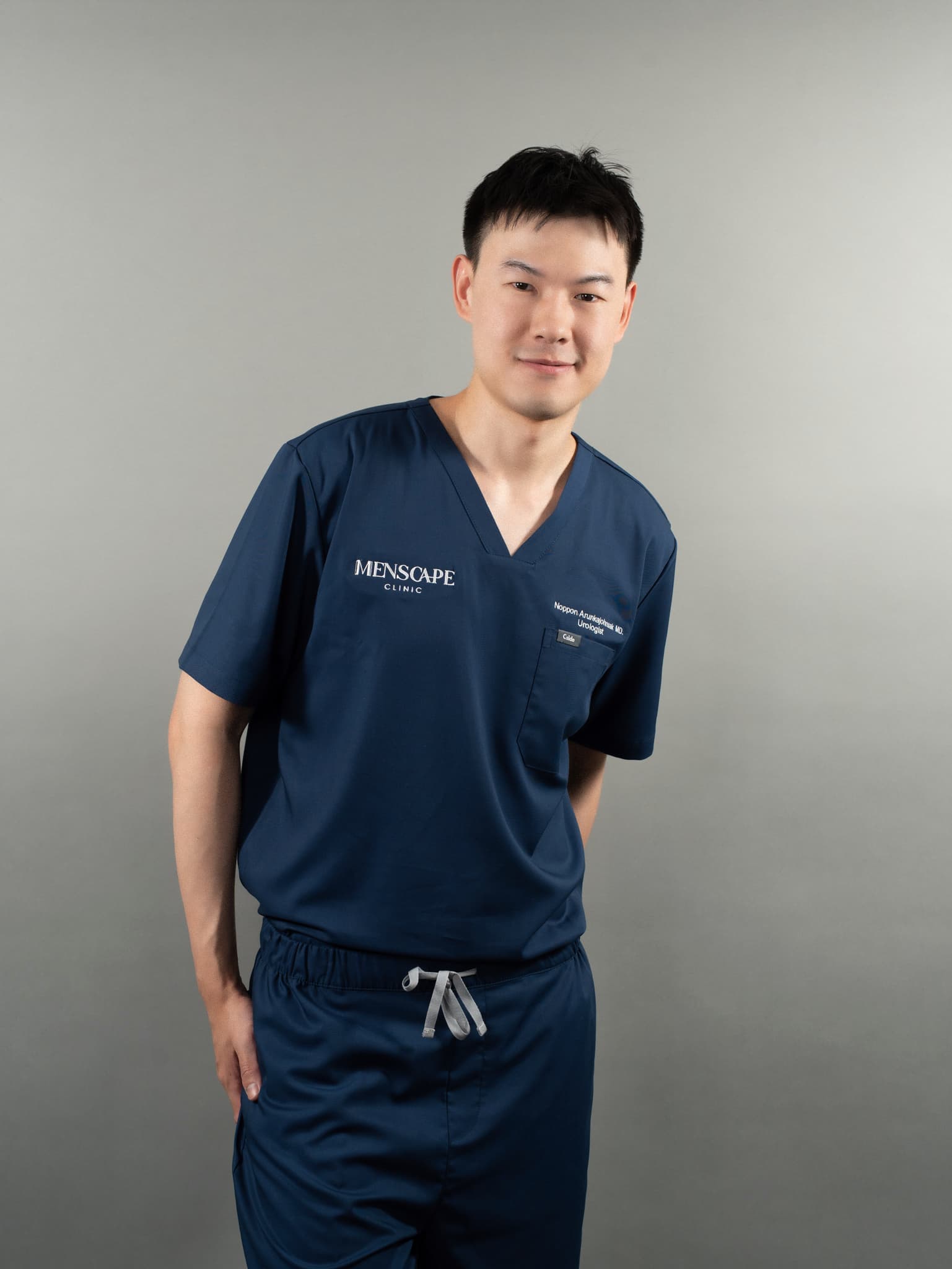
If you are considering the Genesis, the next step is an in-person consultation with a prosthetic urologist who can examine you, review what you have already tried, and give you an honest, itemised recommendation. Implant surgery is prescription-only and is decided case by case after that assessment. You can book a private, men-only consultation at Menscape Bangkok to talk it through and receive a plan and quote specific to you.
Frequently Asked Questions
How much does a Coloplast Genesis implant cost in Bangkok?
In Bangkok, a Genesis (malleable) procedure typically runs around 250,000 to 400,000 THB, roughly 7,000 to 11,500 USD, for an all-in surgical package. That is commonly 50 to 70 percent below comparable US pricing. Figures are indicative and depend on the hospital, surgeon, and complexity of your case, so confirm an itemised quote at consultation.
Is the Coloplast Genesis always firm?
Yes. Because the rods sit permanently inside the erection chambers, the penis is firm enough for sex at all times. You bend it upward for intercourse and downward against the body for concealment when not in use. There is nothing to inflate or pump.
Will the implant affect sensation or orgasm?
Generally no. Sensation and orgasm are not produced by the erection chambers where the implant sits, so the ability to feel pleasure and to climax is typically preserved, and ejaculation where present usually continues. The implant restores rigidity, not feeling.
How does the Genesis compare to an inflatable implant?
The Genesis is simpler, more durable, less expensive, and easier to handle, with no pump to operate. An inflatable implant such as the Titan or AMS 700 gives a more natural look and feel but costs more, involves a longer operation and recovery, and requires using a pump. The right choice depends on whether you prioritise simplicity and cost or a more natural result.
Is recovery easier than with an inflatable implant?
For most men, yes. A malleable implant involves a shorter operation and tends to be less uncomfortable, with many men returning to desk work within about a week. However, sexual activity should wait until your surgeon clears you, which is usually around six weeks, the same as for an inflatable device.
How long does the Genesis implant last?
Malleable implants are durable because they have very few moving parts, which is their main advantage over inflatable devices. Many men keep a malleable implant for well over a decade. As with any implanted device, it can occasionally need revision or replacement, but mechanical failure is relatively uncommon.
Can I travel or fly home soon after surgery?
Many men feel able to fly a few days after surgery, but flying carries a clot risk after any operation. Plan to stay in Bangkok for the first wound check, leave a buffer of several days, and confirm your specific travel timing with your surgeon rather than booking tight connections.
Is the Coloplast Genesis reversible?
No. Placing the implant requires dilating the erection chambers, which destroys the natural erection mechanism. If the implant is later removed, natural erections do not return. This is why implant surgery is reserved for men who have exhausted reversible treatments such as tablets, injections, and vacuum devices.
Do I need a consultation and prescription for a penile implant?
Yes. Penile implant surgery is prescription-only and requires an in-person assessment with a urologist, who will examine you, review what you have already tried, and confirm candidacy before any surgery is planned. No reputable clinic provides an implant without this evaluation.
/)
/)
/)
/)
/)