/)
A varicocele is a tangle of enlarged veins inside the scrotum, a bit like varicose veins in the leg. They are common, often harmless, and frequently go unnoticed for years. But for some men they sit behind a frustrating problem: a fertility workup that keeps coming back abnormal, a dull ache that worsens by the end of the day, or one testicle that has slowly become smaller than the other. When a varicocele is causing a measurable problem, surgery to tie off or block the affected veins (varicocelectomy) is one of the few procedures in male reproductive medicine with a solid track record of improving the underlying numbers.
If you are researching this in Bangkok, cost is usually the trigger for the search, and the honest answer is that prices vary widely depending on technique, whether one or both sides need repair, the hospital tier, and the surgeon. This guide gives you realistic THB and USD ranges, explains what actually drives the bill, walks through the surgical options and recovery week by week, and is candid about who should not rush into this operation. Pricing here is indicative and meant for orientation; your exact quote depends on your scan, your semen results, and the plan your urologist recommends at consultation.
What a varicocele is, and why it matters for men
The veins draining each testicle carry blood back up toward the heart. When the small one-way valves in these veins fail, blood pools and the veins swell. Around 15% to 20% of all men have a varicocele, roughly one in five, and they show up far more often on the left side because of how the left testicular vein drains at a sharper angle into the renal vein (Cleveland Clinic).
Most men with a varicocele never have a problem and never need treatment. The reason varicoceles get clinical attention is their link to fertility: they are found in a large share of men being evaluated for infertility, and Cleveland Clinic notes they can contribute to roughly 40% of male infertility cases. The leading theory is that pooled blood raises the temperature inside the scrotum and exposes the testicle to a backflow of metabolites, both of which can impair sperm production over time.
Three things bring men to a urologist about a varicocele:
Fertility. Abnormal semen analysis (low count, poor motility, abnormal shape) in a man trying to conceive, with a varicocele found on exam.
Pain. A dull, dragging or aching discomfort, usually worse with standing, exertion, or heat, and relieved by lying down.
Testicular shrinkage (atrophy). A measurable size difference between the two testicles, especially relevant in younger men and teenagers, where it can signal that the testicle is being affected.
A smaller group of men also pursue repair because a varicocele is associated with lower testosterone, particularly when their levels are already below normal. More on that below.
Surgical and non-surgical options
Not every varicocele is fixed the same way. The main approaches differ in how the veins are reached and sealed, and that difference shows up in recurrence rates, complications, and price.
Microsurgical varicocelectomy (subinguinal or inguinal)
This is widely regarded as the reference standard. The surgeon makes a small incision low in the groin and uses an operating microscope to magnify the spermatic cord. Under magnification, the swollen veins can be tied off one by one while the testicular artery, the lymphatic channels, and the vas deferens are identified and preserved. Sparing the artery and lymphatics is what keeps two key complications low: recurrence (veins coming back) and hydrocele (a fluid collection around the testicle).
The payoff is in the numbers. A large series of 2,000 microsurgical repairs reported a recurrence rate of about 0.3%, against a historical microsurgical average closer to 1% (PMC). A separate 100-case study of microscopic subinguinal repair found recurrence in 3 of 100 cases (about 2-3%) and clinically insignificant hydrocele, and concluded the technique should be the gold standard, contrasting it with conventional (non-microscopic) surgery where recurrence can run 5-20% and hydrocele 3-33% (PMC).
Laparoscopic varicocelectomy
Here the veins are clipped higher up, inside the abdomen, through keyhole ports. It is faster in the operating room and avoids a groin incision, but it ties off the vessels above the point where the artery and lymphatics are easiest to separate, so the trade-offs are worse. A systematic review and meta-analysis comparing the two techniques found that laparoscopic repair increased the recurrence rate by roughly 7-fold and the risk of hydrocele by roughly 3-fold versus microsurgery, and concluded laparoscopic repair is "inferior to microsurgical varicocelectomy in terms of efficacy and safety" (Urology Annals via PMC).
Percutaneous embolization
This is the non-surgical option, done by an interventional radiologist rather than a urologist. A thin catheter is threaded through a vein (usually at the groin or neck) up to the testicular vein, and tiny coils or a sclerosing agent are deployed to block the faulty vein from the inside. There is no scrotal or groin incision and recovery is quick. The catches: it is technically demanding, it has a higher failure-to-access and recurrence rate than microsurgery in many series, and not every varicocele is anatomically suitable. It can be a good choice for recurrent varicoceles after prior surgery, or for men who want to avoid an operation.
Watchful waiting
Doing nothing is a legitimate plan for many men. A symptomless varicocele in a man who is not trying to conceive, and who has no testicular shrinkage, generally needs monitoring rather than surgery.
Varicocelectomy cost in Bangkok (THB and USD)
The table below reflects realistic self-pay ranges seen in Bangkok private hospitals and men's-health clinics in 2026. Figures are indicative and bundle surgeon, anesthesia, facility, and routine post-op medication for a single side unless noted. Bilateral (both-side) repair adds roughly 30-50% because of the extra operating time. Always confirm the exact inclusions at consultation.
Procedure | Bangkok (THB) | Bangkok (USD approx.) | Typical US self-pay | Indicative saving vs US |
Microsurgical varicocelectomy (one side) | 90,000-180,000 | 2,750-5,500 | 5,000-10,000+ | ~45-55% |
Microsurgical, bilateral | 130,000-230,000 | 4,000-7,000 | 8,000-15,000+ | ~50-55% |
Laparoscopic varicocelectomy | 110,000-200,000 | 3,400-6,200 | 6,000-12,000 | ~45-50% |
Percutaneous embolization | 130,000-230,000 | 4,000-7,000 | 7,000-12,000 | ~40-50% |
Diagnostic workup (scrotal ultrasound + semen analysis +/- hormones) | 4,000-12,000 | 120-370 | 400-1,200 | ~60-70% |
USD conversions use an approximate rate near 32-33 THB to 1 USD and will shift with the exchange rate. US self-pay figures are drawn from published 2026 cost guides, where microsurgical repair commonly runs USD 4,000-8,000 and hospital-based surgery USD 8,000-15,000+; UK private varicocele surgery typically starts around GBP 3,900-4,000. The savings column is the practical reason medical travellers look at Bangkok: comparable microsurgical work, JCI-accredited facilities, at roughly half of US list prices.
What drives the price up or down
Technique and microscope use. True microsurgery with an operating microscope costs more than non-microscopic surgery, and it is worth paying for. The added cost typically buys lower recurrence and fewer hydroceles.
One side or both. Bilateral repair means more time under anesthesia and a higher fee.
Surgeon experience and case volume. High-volume microsurgeons command higher fees and tend to deliver better outcomes.
Hospital tier. A flagship international hospital charges more than a focused men's-health clinic or a mid-tier private hospital for the same operation.
Anesthesia. Local plus sedation is usually cheaper than general anesthesia; the right choice depends on the approach and on you.
Diagnostics and follow-up. Ultrasound, semen analysis, and a follow-up semen test at three months may be billed separately. Ask whether they are bundled.
Who is a candidate, and who is not
This is where a lot of marketing falls silent, so it is worth being direct. Varicocele repair helps a specific group of men. For others it offers no benefit and exposes them to surgical risk for nothing.
Repair is generally reasonable to consider if you have a varicocele your doctor can feel on examination (a "clinical" or palpable varicocele) plus at least one of:
Abnormal semen parameters while trying to conceive
Persistent scrotal pain that fits the varicocele pattern and has not settled with conservative measures
A measurable, progressive size difference between the testicles, especially in adolescents and young men
Documented low testosterone with symptoms, in a man who understands the evidence here is mixed
Surgery is usually NOT the answer if:
The varicocele cannot be felt and was found only on ultrasound (a "subclinical" varicocele). Treating these rarely helps fertility.
You have no symptoms, normal semen results, and are not trying to conceive.
Your fertility problem has a clear separate cause that surgery will not fix.
You expect varicocele repair alone to guarantee a pregnancy. It improves the odds and the semen numbers; it is not a guarantee, and some couples will still need assisted reproduction.
Contraindications and cautions. Active scrotal or groin infection should be treated first. Bleeding disorders or blood thinners need management before any surgery. Embolization specifically may be unsuitable if the venous anatomy does not allow safe catheter access or if you have a contrast allergy that cannot be managed. None of this can be sorted out from a webpage. A varicocelectomy is a prescription-only surgical procedure that requires an in-person consultation, a scrotal examination, and a diagnostic workup before anyone can responsibly recommend it.
What the surgery and recovery actually look like
The procedure, step by step
For a typical microsurgical repair:
Anesthesia. Usually general anesthesia, or local plus sedation, depending on the plan.
Incision. A small cut (often 2-3 cm) low in the groin, in the natural crease, where it heals discreetly.
Isolating the cord. The spermatic cord is gently lifted and placed under the operating microscope.
Dissection under magnification. The surgeon identifies and preserves the testicular artery, the lymphatic vessels, and the vas deferens, then ties off the dilated veins individually.
Closure. The small incision is closed, usually with dissolving stitches. The whole operation commonly takes about 45-90 minutes per side.
Most men go home the same day. This is generally a day-case procedure, not an overnight admission.
Staged recovery timeline
Stage | What to expect |
Days 0-2 | Mild to moderate ache and swelling. Ice packs, scrotal support, and simple pain relief. Rest. |
Days 3-7 | Discomfort settles. Many men return to desk work within 2-7 days. Keep the wound dry and clean. |
Week 2 | Most normal daily activity resumes. Avoid heavy lifting and strenuous exercise. Bruising fades. |
Weeks 3-4 | Gradual return to the gym and sport as comfort allows. Most men feel essentially back to normal by around 6 weeks (Cleveland Clinic). |
Sex | Typically resume after about 1-2 weeks once comfortable, on your surgeon's advice (earlier than the older "4-6 weeks" rule for many men). |
3-month review | Repeat semen analysis to measure the effect. This is the key follow-up if fertility was the goal. |
What results to actually expect
The honest framing is that varicocele repair improves averages, not certainties. The most reliable gains are in the semen numbers.
Sperm concentration and motility. Meta-analyses summarized in a large microsurgical series report mean increases of roughly 9.7 to 12.3 million sperm per mL in concentration and about 9.9% to 10.9% in motility after microsurgical repair (PMC).
Pregnancy. The same evidence base found varicocele treatment improved pregnancy rates (odds ratio about 1.55), with the biggest benefit in men who had a palpable varicocele plus poor semen parameters to begin with (PMC).
Testosterone. A meta-analysis of nine studies (814 men) reported a mean rise in total testosterone of about 97 ng/dL after repair, but the gain was concentrated in men whose testosterone was low before surgery; men with normal baseline levels saw little change (PMC).
Pain. Most men with varicocele-pattern pain get lasting relief, though a minority do not, and pain relief is harder to promise than the lab improvements.
Time frame. Sperm production runs on a roughly 3-month cycle, so semen parameters typically improve over 3 to 6 months, not overnight. Visible veins shrink gradually over weeks.
Have a question about your treatment?
Message our Bangkok clinic on WhatsApp and a doctor replies within minutes during clinic hours.
Risks and side effects
Varicocelectomy is generally safe, especially in microsurgical hands, but no surgery is risk-free.
Common and usually self-limiting:
Bruising, swelling, and aching around the incision and scrotum
Temporary skin numbness near the wound
Mild fluid build-up that settles on its own
Less common:
Hydrocele (fluid collection around the testicle). Rare with microsurgery, more likely with non-microscopic and laparoscopic techniques.
Recurrence of the varicocele, low after microsurgery (around 1-2% in good series) and several-fold higher after laparoscopic repair (PMC).
Testicular artery injury, uncommon when the artery is identified and spared under the microscope.
Wound infection.
Seek urgent medical care if you notice:
A rapidly enlarging, very painful, or hard swollen scrotum
Fever, spreading redness, or pus from the wound
A sudden severe testicular pain that is different from the expected post-op ache
Heavy bleeding from the incision
These are red flags for infection, a bleed, or a problem with the testicular blood supply, and they need same-day assessment rather than waiting for a follow-up appointment.
How to choose a safe clinic in Bangkok
Bangkok has genuinely excellent urology and microsurgery, but quality varies, and microsurgery in particular is operator-dependent. A few things separate a good choice from a risky one.
Green flags:
A board-certified urologist (not a general surgeon) doing the operation
Genuine use of an operating microscope for microsurgical cases, confirmed in writing
A proper workup before surgery: scrotal ultrasound plus semen analysis, and hormones where relevant
A clear follow-up plan, including a repeat semen analysis at around 3 months if fertility is the goal
Transparent, itemized pricing with inclusions and exclusions spelled out
Willingness to quote case volume and to discuss recurrence and hydrocele rates honestly
Red flags to walk away from:
A price that looks too good to be true, often a sign the "microsurgery" is not done under a microscope
A recommendation for surgery on a varicocele that cannot be felt and was seen only on ultrasound
No ultrasound or semen analysis offered before booking surgery
A general surgeon rather than a urologist performing the repair
No before/after semen testing and no structured follow-up
Vague, all-in pricing with no breakdown
Comparing the main options
Microsurgical | Laparoscopic | Embolization | |
Who performs it | Urologist (microsurgeon) | Urologist | Interventional radiologist |
Incision | Small groin incision | Keyhole abdominal ports | Catheter, no incision |
Recurrence | Lowest (~0.3-2%) | Higher (several-fold vs micro) | Higher than micro |
Hydrocele risk | Lowest | Higher | Very low |
Anesthesia | General or local+sedation | General | Local +/- sedation |
Best suited to | Most men, fertility-focused | Bilateral cases, surgeon preference | Recurrence, surgery avoidance |
Bangkok price (indicative) | THB 90,000-180,000 | THB 110,000-200,000 | THB 130,000-230,000 |
For most men, especially those operating for fertility, the evidence points to microsurgery as the first choice. Embolization earns its place mainly for recurrent varicoceles or men who want to avoid an operation. Laparoscopic repair is reasonable in selected cases but carries higher recurrence and hydrocele rates than microsurgery.
Booking a consultation at Menscape
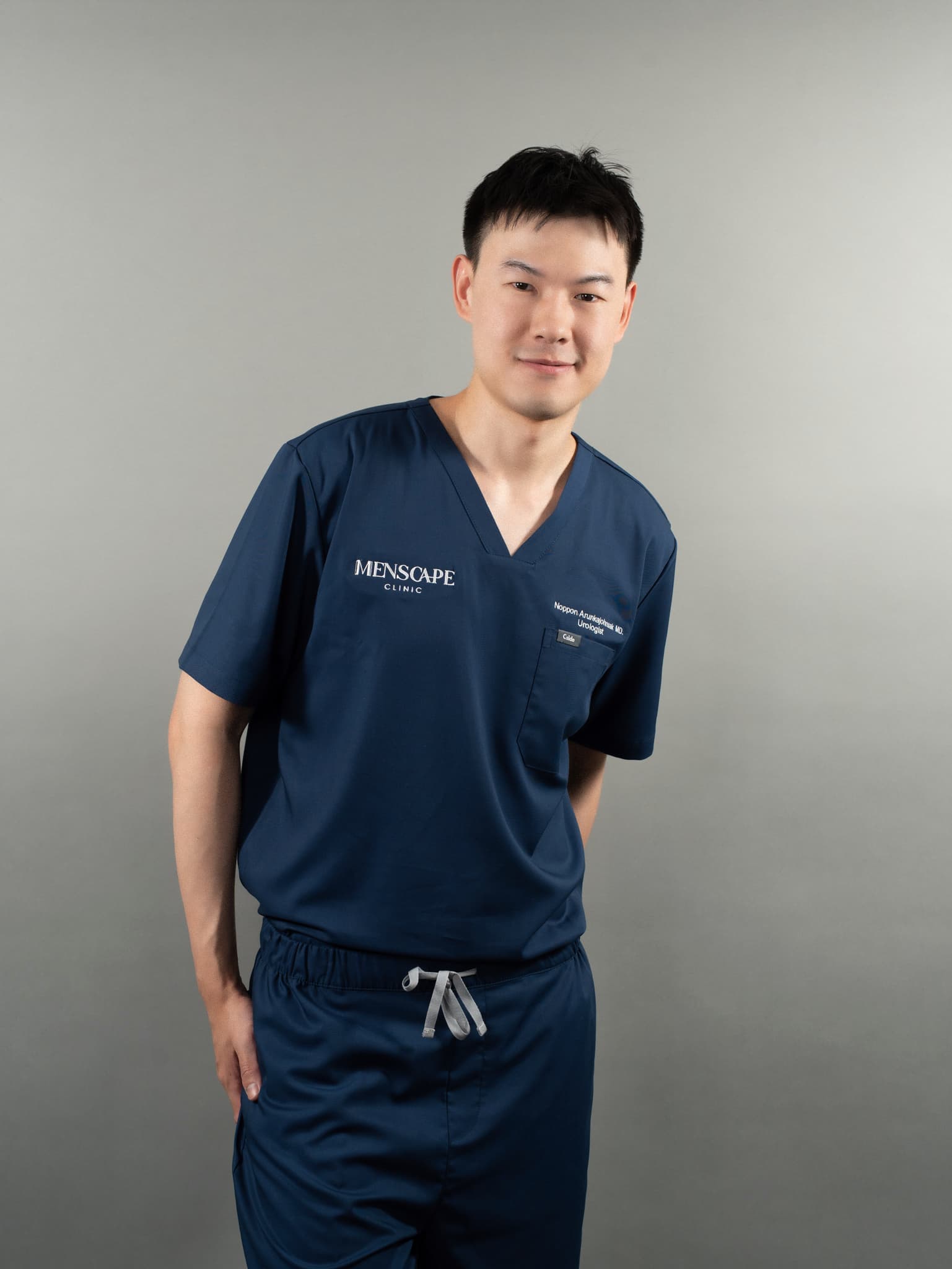
If you have a varicocele alongside fertility concerns, ongoing scrotal pain, or a noticeable size difference between your testicles, the next step is a proper assessment rather than a decision made from a search result. At Menscape in Bangkok, a urology consultation covers an examination, a scrotal ultrasound and semen analysis where indicated, and a frank conversation about whether surgery is likely to help you specifically, what it would cost, and what it would not change. You can also read our related guides on male fertility and semen analysis and the costs of other men's urology procedures.
Varicocelectomy is a medical procedure that requires an in-person consultation, examination, and diagnostic workup, and it is recommended on a case-by-case basis. Nothing here is a substitute for that assessment. To find out whether repair makes sense for you, book a private consultation with our team.
Frequently Asked Questions
How much does varicocelectomy cost in Bangkok?
Indicatively, microsurgical varicocelectomy for one side runs about THB 90,000-180,000 (roughly USD 2,750-5,500), with bilateral repair adding around 30-50%. Laparoscopic surgery and embolization tend to sit a little higher. Diagnostics like ultrasound and semen analysis may be billed separately. These are orientation ranges; confirm your exact quote and inclusions at consultation.
Is varicocele surgery cheaper in Bangkok than in the US or UK?
Generally yes. Comparable microsurgical repair in the US often costs USD 5,000-10,000 or more, and UK private surgery typically starts around GBP 3,900-4,000. Bangkok pricing at JCI-accredited hospitals is frequently 45-55% lower for similar work, which is the main draw for medical travellers.
Does varicocelectomy improve fertility and sperm count?
For the right candidate, it improves the averages. Meta-analyses report mean increases of roughly 9.7-12.3 million per mL in sperm concentration and about 10% in motility after microsurgical repair, and improved pregnancy rates (odds ratio around 1.55). The benefit is largest in men with a palpable varicocele plus abnormal semen results. It improves the odds rather than guaranteeing pregnancy.
Will varicocele repair raise my testosterone?
Sometimes, mainly if your testosterone is low to begin with. A meta-analysis of 814 men found an average rise of about 97 ng/dL after repair, concentrated in men with low baseline levels. Men with normal testosterone usually see little change, so low testosterone alone is a debated reason to operate.
Which technique is best, microsurgery, laparoscopic, or embolization?
For most men, microsurgical varicocelectomy is the reference standard because it has the lowest recurrence (around 0.3-2%) and the lowest hydrocele rate. Laparoscopic repair carries several-fold higher recurrence and hydrocele risk. Embolization, done by a radiologist with no incision, is most useful for recurrent varicoceles or men who want to avoid surgery.
How long is recovery after varicocelectomy?
It is usually a day-case procedure. Most men return to desk work within 2-7 days, resume normal daily activity by around week 2, and feel essentially back to normal by about 6 weeks. Sex is typically fine after 1-2 weeks once comfortable. A follow-up semen analysis at around 3 months measures the fertility effect.
When should I worry after surgery?
Seek same-day care for a rapidly enlarging, very painful or hard scrotum, fever or spreading redness, pus or heavy bleeding from the wound, or sudden severe testicular pain unlike the expected ache. These can signal infection, a bleed, or a blood-supply problem and should not wait for a routine follow-up.
Do I need surgery if I have no symptoms?
Usually not. A varicocele with no symptoms, normal semen results, and no testicular shrinkage is typically monitored rather than operated on. Surgery on a varicocele that cannot be felt and was found only on ultrasound rarely helps fertility. The decision should follow an examination and workup, not a scan alone.
)
/)
/)
/)
/)
/)