/)
If you are a man who plans your day around the nearest toilet, wakes several times a night to urinate, or has had leaks before you could get there, you already know how much an overactive bladder can shrink your world. For most men, the first steps are bladder training, cutting back on caffeine and alcohol, and a course of tablets. When those do not work well enough, or the medication side effects are not worth it, bladder Botox is one of the established next options.
This guide explains what the procedure actually involves for men, how well it works, what it costs in Bangkok in 2026, who is and is not a good candidate, and the one risk that affects men more than women. It is written to help you arrive at a consultation with the right questions rather than to replace that consultation.
A quick but important note before we go further: bladder Botox is a prescription medical procedure. It requires a urology assessment, and in most cases some bladder testing, before anyone can tell you whether it is appropriate for you. Nothing here is a substitute for that.
What bladder Botox actually is
Bladder Botox is the everyday name for an intradetrusor injection of onabotulinumtoxinA, the same botulinum toxin type A used in cosmetic and other medical settings, placed into the muscular wall of the bladder. The medical term you may see on paperwork is "intravesical" or "intradetrusor" onabotulinumtoxinA.
The bladder is essentially a muscular bag. The muscle that squeezes it to pass urine is called the detrusor. In overactive bladder (OAB), this muscle contracts when it should be relaxed and filling, which creates the sudden, hard-to-defer urge to go, the frequency, the night-time trips, and sometimes leakage before you reach the toilet. Botox works by partly blocking the nerve signals that trigger those unwanted contractions, so the bladder relaxes and can hold more before signalling urgency.
It is a targeted treatment. Because the medication is placed directly into the bladder wall, it acts locally rather than circulating through the body the way a daily tablet does. That is part of the appeal for men who did not tolerate the dry mouth, constipation, or fuzzy thinking that anticholinergic OAB tablets can cause.
Importantly, this is not a permanent fix and it is not a cure for OAB. The effect wears off over months as the nerve endings recover, and the injection is repeated when symptoms return.
Where it sits among OAB treatments
Professional guidance places bladder Botox as a third-line option. The 2024 American Urological Association and SUFU guideline on idiopathic overactive bladder lists onabotulinumtoxinA alongside sacral neuromodulation and percutaneous tibial nerve stimulation as third-line treatments, with no fixed ranking between them, to be chosen through shared decision-making after first-line behavioural therapy and second-line medication have been tried. [1] In plain terms: it is offered when the simpler steps have genuinely been given a fair trial and have not delivered.
How the procedure works, step by step
The whole appointment is usually short, and in most men it is done awake in a clinic or day-surgery room rather than under general anaesthetic.
Preparation and a urine check. A urine sample is tested first, because injecting into an actively infected bladder is avoided. You may be given a single dose of antibiotic around the procedure to lower infection risk.
Local anaesthetic. Anaesthetic gel is instilled into the urethra, and in many protocols a numbing solution is also held inside the bladder for a period before injection to reduce discomfort. Some clinics offer light sedation for anxious patients or those with a sensitive urethra, which is worth asking about.
Cystoscopy. A thin telescope called a cystoscope is passed along the urethra into the bladder. Men have a longer urethra than women, so this step is where most of the sensation is felt, usually as pressure rather than sharp pain.
The injections. A fine needle is passed through the cystoscope and the toxin is delivered in roughly 20 small injections spread across the bladder wall. For idiopathic OAB the standard starting dose is 100 units of onabotulinumtoxinA. [2]
Finishing up. The scope is removed, the bladder is usually emptied, and you are watched briefly to confirm you can pass urine before going home.
Most men are in and out within an hour of arriving, with the injection portion itself taking around 15-20 minutes. You can normally walk out and, for desk-based work, often return the next day.
What it costs in Bangkok (THB and USD)
Therapeutic bladder Botox is priced differently from a few units of cosmetic Botox for frown lines. The cost reflects the cystoscopy, the procedure room, the urologist's time, the local anaesthetic, and a full 100-unit (sometimes 200-unit) vial of genuine product, plus follow-up. Because the dose is far higher than a cosmetic treatment, the medication alone is a meaningful part of the bill.
The figures below are indicative ranges drawn from Bangkok private-sector pricing patterns and the cost components above. Always confirm an exact quote at consultation, because the final number depends on the hospital tier, the dose, whether sedation is used, and your individual bladder findings.
Item | Bangkok (indicative THB) | Bangkok (indicative USD) | Typical US/UK private | Indicative saving in Bangkok |
Bladder Botox session, private clinic (100 U, awake) | 35,000-60,000 THB | ~1,000-1,650 USD | US ~7,000-12,000+ USD; UK ~3,500-6,000 GBP | Often 60-85% lower |
Bladder Botox session, premium/JCI hospital | 60,000-90,000 THB | ~1,650-2,500 USD | As above | Still well below |
Consultation + urinalysis | 1,000-3,500 THB | ~30-100 USD | US ~150-400 USD | Lower |
Urodynamic / bladder testing (if advised) | 6,000-15,000 THB | ~165-415 USD | US ~500-2,000 USD | Lower |
Currency conversions use an approximate rate near 36 THB to 1 USD as of 2026 and will move with the exchange rate. US and UK comparison figures are broad private-pay ranges; insured patients abroad may pay far less out of pocket, while self-pay patients often pay considerably more than the Bangkok range. Treat all of the above as a planning guide, not a quote.
What drives the cost up or down
Dose. 100 units is standard for idiopathic OAB; some men with neurogenic bladders receive 200 units, which costs more in product.
Setting. A urology clinic awake procedure is cheaper than the same injection done in a premium hospital theatre with sedation.
Sedation or anaesthesia. Adding sedation or a general anaesthetic increases room, monitoring, and anaesthetist fees.
Workup. If your urologist wants urodynamic testing or a cystoscopy to rule out other causes first, that is an added but worthwhile cost.
Product and authenticity. Genuine, Thai-FDA-registered onabotulinumtoxinA costs more than discounted or unverified product. For a bladder injection you want the real thing, properly stored, and you are entitled to ask to see the vial and its registration.
Who is a good candidate, and who is not
Bladder Botox suits a specific situation rather than every man with urinary symptoms.
You may be a good candidate if you:
have overactive bladder symptoms (urgency, frequency, waking at night, urge leakage) that genuinely disrupt your life;
have tried bladder training and at least one OAB medication (an anticholinergic, a beta-3 agonist such as mirabegron, or both) for a reasonable period without enough benefit, or could not tolerate them;
have had other causes of your symptoms looked into; and
are willing and able to perform clean intermittent self-catheterisation if your bladder does not empty well after the injection.
That last point is not a formality. Guidelines specifically state that candidates should be able and willing to self-catheterise if needed and should accept that possibility before going ahead. [1]
Who it is not for, and contraindications
Bladder Botox is generally not appropriate, or must be delayed, if you:
have a current, untreated urinary tract infection (this is treated first);
are not willing or physically able to self-catheterise should retention occur;
already empty your bladder poorly or have a high post-void residual at baseline, which raises the retention risk further;
have known allergy or prior reaction to botulinum toxin or its components;
have a neuromuscular disorder such as myasthenia gravis, Lambert-Eaton syndrome, or amyotrophic lateral sclerosis, where botulinum toxin can be unsafe;
are taking medication or have a condition that meaningfully affects clotting, which should be reviewed before any bladder injection.
A crucial men-specific caveat: in older men, urinary symptoms are often driven partly or wholly by the prostate (benign prostatic enlargement causing bladder outflow obstruction) rather than by an overactive detrusor alone. Putting Botox into the bladder of a man whose real problem is a blocked outflow can tip him into retention. This is exactly why a proper urological assessment, often including flow testing and a check of how well you empty, comes before the injection.
How well it works, with numbers
The evidence base for the 100-unit dose in OAB is solid and comes from large randomised trials. One point of context worth keeping in mind: these key efficacy trials enrolled both sexes but were predominantly female, so the strongest male-specific evidence is for the safety and retention signal that this article foregrounds, rather than for the headline efficacy figures.
In a key phase 3, double-blind, placebo-controlled trial, onabotulinumtoxinA 100 U reduced daily urinary incontinence episodes by about 2.95 per day at week 12, compared with about 1.03 per day for placebo. Roughly 62.8% of treated patients reported a positive response on a treatment-benefit measure, versus 26.8% on placebo, and all OAB symptoms and quality-of-life scores improved significantly. [2] A separate dose-ranging trial found that 100 U strikes the best balance between symptom relief and the risk of incomplete emptying, with higher doses adding little benefit while increasing retention. [3] A later systematic review and meta-analysis reached the same broad conclusion: onabotulinumtoxinA significantly reduces urge incontinence, frequency, and urgency versus placebo, at the cost of more urinary tract infections and some retention. [4]
On timing, most men notice a change within the first one to two weeks, with the full effect by around four to six weeks. The benefit then typically lasts on the order of 6-9 months before symptoms gradually return and a repeat injection is considered. Re-injection can be performed once the effect fades, and effectiveness is generally maintained with repeat treatments.
It is honest to say that response varies. Some men get dramatic, life-changing relief; others get useful but partial improvement; a minority do not respond well and move on to other third-line options such as sacral neuromodulation.
Recovery, stage by stage
Recovery is usually straightforward, but knowing the timeline helps you plan.
Day 0 (procedure day). You go home the same day once you have passed urine. Mild stinging when you pee and some pink-tinged urine are common for a day or two. Drinking plenty of water helps flush the bladder and eases the burning.
Days 1-3. Any burning or urinary frequency from the cystoscopy itself settles. Light office work is usually fine the next day; avoid heavy lifting or strenuous exercise for a couple of days if you feel sore.
Week 1-2. The Botox starts to take effect and urgency and leakage begin to ease.
Week 4-6. Peak benefit is usually reached. This is also the window when your clinic will often check how well you are emptying your bladder, sometimes with a quick bladder scan, because retention, if it happens, tends to show up in these early weeks.
Month 6-9. The effect gradually wears off. When your symptoms return to a level that bothers you, you book a repeat injection.
Throughout, the single most useful thing you can do is report any difficulty passing urine promptly rather than waiting it out.
Risks and side effects
Bladder Botox is generally well tolerated, but it has real, specific risks that you should understand before consenting, and one of them is more common in men.
Common and expected
Mild burning or stinging when urinating for a day or two after the procedure.
Blood-tinged urine briefly after the injections.
Urinary tract infection. This is the most frequently reported adverse event. In the 100-unit OAB trials, UTIs occurred in a meaningful minority of patients and more often than with placebo, which is why a urine check beforehand and sometimes antibiotic cover are used. [4] A man's own history matters here: in a multi-institution study, a prior history of UTI was the strongest predictor of infection afterwards. [5]
Have a question about your treatment?
Message our Bangkok clinic on WhatsApp and a doctor replies within minutes during clinic hours.
The retention issue men should pay attention to
The trade-off for relaxing the bladder is that some men relax it too much and cannot fully empty. This is called incomplete bladder emptying or, at the extreme, urinary retention, and it may require temporary clean intermittent self-catheterisation until the effect settles.
This matters more for men than women. In the key trial, about 6.9% of treated patients started self-catheterisation. [2] But sex makes a clear difference: in a multi-institutional SUFU research-network study, 35.4% of men developed incomplete emptying within six months compared with 17.0% of women, and 27.1% of men needed catheterisation versus 13.9% of women. Male sex was the only independent predictor, with men having about 2.4 times the odds of incomplete emptying. [5] A men-only systematic review similarly found that emptying problems and the need for catheterisation are among the most relevant adverse events to counsel male patients about. [6]
The practical takeaway is not that men should avoid the procedure. It is that men should go in with eyes open, be taught self-catheterisation in advance so it is not a crisis if it happens, and choose a urologist who screens carefully for an underlying prostate or outflow problem first.
Red-flag symptoms: seek urgent care
Contact your clinic or seek urgent medical care if, after the procedure, you experience any of the following:
you cannot pass urine at all, or feel a painfully full bladder that will not empty;
fever, chills, or worsening lower-abdominal or back pain (possible serious infection);
heavy or persistent blood in the urine, or passing clots;
generalised muscle weakness, drooping eyelids, double vision, difficulty swallowing or speaking, or shortness of breath. These can be signs that the toxin has spread beyond the bladder. This is rare with bladder dosing, but it is a recognised warning that warrants immediate attention.
Choosing a safe clinic in Bangkok
Bangkok has excellent urology care, but the quality of providers offering bladder Botox varies. Use these criteria.
Green flags:
A licensed urologist, not a general aesthetic practitioner, performing the procedure. Bladder injection is a urological procedure done through a cystoscope.
Willingness to assess you properly first, including ruling out a prostate or outflow cause of your symptoms, before recommending the injection.
Genuine, Thai-FDA-registered onabotulinumtoxinA, with the vial and registration available for you to see.
Clear, upfront teaching about self-catheterisation and a plan for what happens if you cannot empty.
A transparent, itemised written quote covering the procedure, product, and follow-up.
Red flags:
Pressure to proceed the same day with no urine test and no discussion of your medication history or prostate.
Vague or evasive answers when you ask which product is used, the dose, or to see the vial.
Suspiciously low pricing that does not add up for a genuine 100-unit vial plus cystoscopy.
No mention of the retention risk or self-catheterisation, which suggests incomplete consent.
Cosmetic-clinic settings with no urologist on site.
Bladder Botox compared with other options
Treatment | What it is | Onset | Typical durability | Main downside | Where it fits |
Bladder training + lifestyle | Timed voiding, fluid and caffeine changes, pelvic floor work | Weeks | Ongoing if maintained | Needs discipline; may be insufficient alone | First line |
OAB medication (anticholinergic / beta-3) | Daily tablet relaxing the bladder | Days to weeks | While taken | Dry mouth, constipation, cognition concerns (anticholinergics); cost | Second line |
Bladder Botox (onabotulinumtoxinA 100 U) | Injection into bladder wall via cystoscope | 1-2 weeks | ~6-9 months, then repeat | UTI; incomplete emptying, higher risk in men | Third line |
Percutaneous tibial nerve stimulation (PTNS) | Nerve stimulation via the ankle, repeated sessions | Several weeks | Needs maintenance sessions | Time commitment of repeat visits | Third line |
Sacral neuromodulation (SNM) | Implanted device that modulates bladder nerves | Test phase then implant | Long-term with the device | Implant procedure; device cost | Third line |
No single option is best for everyone. The right choice depends on how your symptoms behave, what you have already tried, your tolerance for the retention trade-off, and your preferences, which is the whole point of the shared-decision-making approach the guidelines recommend. [1]
Booking a consultation in Bangkok
If overactive bladder is controlling your routine and tablets have let you down, a urology consultation is the sensible next step. At that visit, a urologist can confirm whether your symptoms are coming from the bladder itself or from the prostate, check how well you empty, and tell you honestly whether bladder Botox is a good fit or whether another third-line option suits you better.
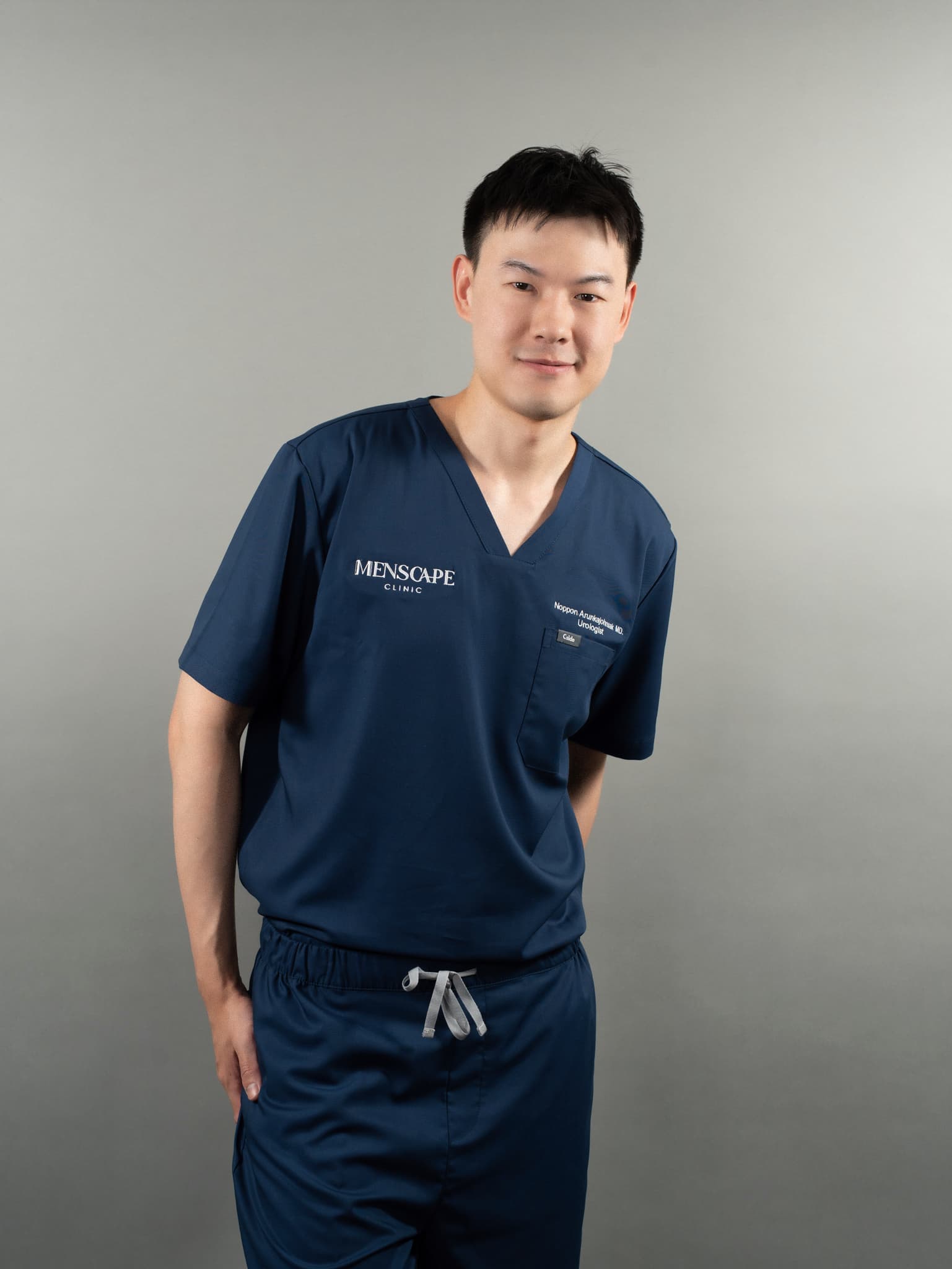
To book a bladder Botox consultation at Menscape in Bangkok, bring a list of the medications you have tried and for how long, and any notes on your symptoms. You will get an assessment, a clear explanation of the risks including the retention point men need to weigh, and an itemised quote before you decide anything.
As a final reminder: bladder Botox is a prescription procedure that can only be provided after a medical consultation and appropriate assessment. It is not something to buy off a price list.
Frequently Asked Questions
Is bladder Botox painful for men?
Most men describe it as uncomfortable rather than painful. Anaesthetic gel numbs the urethra and a numbing solution is often held in the bladder beforehand. The main sensation is pressure as the cystoscope passes along the urethra, which is longer in men. Light sedation can be offered for those who are anxious or have a sensitive urethra, so it is worth asking your clinic in advance.
How long does bladder Botox last?
The benefit usually begins within one to two weeks, peaks by four to six weeks, and lasts on the order of 6-9 months before symptoms gradually return. At that point a repeat injection can be performed. Durability varies between individuals, and effectiveness is generally maintained over repeated treatments.
Will I need to use a catheter after bladder Botox?
Possibly, and this is more likely in men. Some men cannot fully empty the bladder afterwards and need temporary clean intermittent self-catheterisation until the effect settles. In a large study, about 35% of men had incomplete emptying within six months and around 27% needed catheterisation, compared with lower rates in women. For that reason you should be taught self-catheterisation before the procedure and be willing to do it if needed.
Why is bladder Botox riskier for men than women?
Two reasons. First, men are simply more prone to incomplete bladder emptying after the injection, with roughly 2.4 times the odds compared with women in research. Second, older men often have urinary symptoms driven partly by the prostate and bladder outflow obstruction rather than an overactive bladder muscle alone, and Botox in that setting can worsen emptying. A careful urological assessment that checks the prostate and how well you empty lowers this risk considerably.
How much does bladder Botox cost in Bangkok?
As an indicative guide, expect roughly 35,000-60,000 THB (about 1,000-1,650 USD) for an awake session at a private urology clinic, and up to about 60,000-90,000 THB (about 1,650-2,500 USD) at a premium or JCI-accredited hospital, plus consultation and any bladder testing. This is typically well below US and UK private prices. The final figure depends on dose, setting, sedation, and your individual findings, so always confirm an itemised quote at consultation.
Is bladder Botox the same as cosmetic Botox?
It is the same active medication, botulinum toxin type A (onabotulinumtoxinA), but used very differently. A cosmetic treatment uses a few units in facial muscles. A bladder treatment for overactive bladder uses about 100 units placed across the bladder wall through a cystoscope, in roughly 20 small injections, and is a urological procedure that requires a prescription and assessment.
Do I have to try medication before bladder Botox?
In almost all cases, yes. Professional guidelines place bladder Botox as a third-line option, offered after bladder training and at least one OAB medication have been given a fair trial without enough benefit, or could not be tolerated. Your urologist will confirm what you have tried and decide whether you have reached the point where Botox is appropriate.
What happens if bladder Botox does not work for me?
Not everyone responds fully. If bladder Botox gives too little benefit, other third-line options exist, including percutaneous tibial nerve stimulation and sacral neuromodulation. Guidelines treat these three as equal third-line choices with no fixed ranking, so your urologist can discuss switching based on your response and preferences.
Can I drive and work the day after bladder Botox?
Usually yes for desk-based work. Most men go home the same day and return to light activities the next day. Expect mild stinging when urinating and possibly pink urine for a day or two, and avoid heavy lifting or strenuous exercise for a couple of days if you feel sore. If you had sedation, you should not drive immediately afterwards.
)
/)
/)
/)
/)
/)