/)
Overactive bladder is one of those problems men tend to live with quietly for years. The sudden, hard-to-defer urge to pass urine, going too often during the day, waking several times at night, and sometimes leaking before reaching the toilet all chip away at sleep, work, and confidence. When lifestyle changes, bladder retraining, and oral medication have not done enough, a bladder Botox injection is one of the more effective next steps, and it is widely available in Bangkok at a fraction of Western prices.
This guide focuses on cost first, because that is usually what brings men to this page. It then explains how the treatment actually works, who it suits, who should avoid it, what recovery looks like, and how to pick a clinic you can trust. Prices here are indicative ranges based on current Bangkok market rates; your exact quote depends on the dose you need and the clinic, so treat the figures as a planning tool and confirm at consultation.
One point up front: bladder Botox is a prescription medical procedure, not a walk-in cosmetic treatment. It can only be carried out after a urologist has assessed you, checked your urine, and confirmed you are a suitable candidate.
What bladder Botox actually is
"Bladder Botox" is the everyday name for an injection of onabotulinumtoxinA (the same active drug used cosmetically, but used here for a medical purpose) into the muscle wall of the bladder. In an overactive bladder, the detrusor (the muscle that squeezes the bladder to empty it) contracts when it should be relaxing, which creates that urgent, can't-wait sensation. The toxin partially and temporarily blocks the nerve signals that trigger those unwanted contractions, so the bladder calms down, holds more, and signals less aggressively.
It is delivered through a cystoscope, a thin telescope passed up the urethra into the bladder. The urologist then makes a series of small injections spread across the bladder wall. For the standard overactive bladder dose the drug is given across about 20 sites; the higher neurogenic dose is given across around 30 sites (FDA prescribing information). The whole injection part typically takes around 15 minutes, and most men have it done awake with only local anaesthetic gel, as a day case (Cleveland Clinic; BAUS patient leaflet).
The US Food and Drug Administration approved onabotulinumtoxinA for overactive bladder with urge incontinence, urgency, and frequency in adults who have not responded to or cannot tolerate an anticholinergic medication, at a dose of 100 units. A higher 200-unit dose is approved separately for urinary incontinence caused by a neurological condition such as multiple sclerosis or spinal cord injury (FDA prescribing information). For most men reading this with ordinary (non-neurological) overactive bladder, the 100-unit dose is the relevant one, and that matters for cost because the drug is the single biggest line item.
Bladder Botox cost in Bangkok (THB and USD)
The table below gives indicative all-in ranges for bladder Botox in Bangkok and compares them with typical self-pay prices abroad. "All-in" here means the drug, the cystoscopy and injection, the urologist's fee, facility use, and local anaesthetic, billed as one package. USD figures use an approximate rate of 36 THB to 1 USD and will move with the exchange rate.
Item | Bangkok (indicative) | Notes |
Specialist consultation + urine check | 1,000-3,000 THB (about 30-85 USD) | Often credited toward treatment if you proceed |
OnabotulinumtoxinA, 100 units (the drug) | 25,000-40,000 THB (about 700-1,100 USD) | Genuine, in-date product; largest single cost. Hospital therapeutic pricing runs above cosmetic per-unit rates |
Cystoscopy + injection + day-case fees | 10,000-25,000 THB (about 280-700 USD) | Urologist, nursing, facility, consumables |
All-in bladder Botox, 100-unit OAB dose | 35,000-70,000 THB (about 1,000-2,000 USD) | Single combined package, confirm at consult |
All-in bladder Botox, 200-unit neurogenic dose | 60,000-110,000 THB (about 1,650-3,050 USD) | Higher because double the drug |
How that compares internationally:
Location | Typical self-pay price | Approx. USD |
Bangkok (100-unit OAB dose) | 35,000-70,000 THB | about 1,000-2,000 |
United States (out of pocket, uninsured) | about 1,000-2,500+ USD | 1,000-2,500+ |
United Kingdom (private clinic) | about 1,000-2,400 GBP | about 1,300-3,100 |
US and UK figures are drawn from published self-pay and private-clinic prices and vary widely by provider. In the US, where the manufacturer list price for the drug alone is about 1,292 USD for a 200-unit vial and approved medical uses are usually covered by insurance, an uninsured overactive bladder treatment including the procedure commonly lands in the region of about 1,000-2,500 USD or more (Healthline). UK private bladder Botox with cystoscopy is typically quoted in the low thousands of pounds. Exact figures are provider-dependent, so treat these as orientation rather than fixed quotes. The headline point: Bangkok generally lands meaningfully below Western self-pay pricing for the same drug and a comparable day-case procedure, which is a large part of why men combine treatment with a trip here.
A realistic way to read this table: budget for the drug plus the procedure as one number, not two, and remember the effect wears off, so the honest long-term cost is the package price multiplied by roughly one to two treatments per year.
What drives the cost
Several things move the final number, and understanding them helps you compare quotes sensibly rather than chasing the lowest sticker.
The dose of onabotulinumtoxinA. This is the dominant factor. The standard overactive bladder dose is 100 units; a neurogenic bladder linked to a neurological condition usually needs 200 units, which roughly doubles the drug cost. Genuine, refrigerated, in-date product from a reputable supplier costs more than a suspiciously cheap vial, and with a bladder injection that authenticity is not somewhere to economise.
The cystoscopy and day-case setup. You are paying for a urologist's time, a nurse, sterile consumables, the cystoscope, and a recovery slot, not just a syringe. A clinic that rushes this or skips proper sterility is not a bargain.
Whether sedation is used. Most men manage comfortably with local anaesthetic gel alone, which keeps cost down. If you are particularly anxious or your anatomy makes the scope uncomfortable, light sedation or, rarely, a general anaesthetic adds anaesthetist and monitoring fees.
The clinic and who injects. A men's-health or urology specialist with high cystoscopy volume may price differently from a general hospital, and a large international hospital carries higher overheads than a focused clinic. More experience can mean a smoother, faster procedure.
Follow-up and the ongoing cycle. A proper package includes a follow-up to check your response and, importantly, to make sure you are emptying your bladder. Because results last only months, plan for repeat treatment rather than treating the first quote as the whole story.
Rare add-ons. A small number of men temporarily cannot empty the bladder fully afterward and need to learn clean intermittent self-catheterisation for a while, which adds a modest cost for training and catheters. It is uncommon, but worth knowing the line item exists.
Who is a good candidate
Bladder Botox is a considered next step, not a first move. The 2024 AUA/SUFU guideline on idiopathic overactive bladder lists it among the minimally invasive options for patients whose symptoms have not improved enough with behavioural therapy and medication; the guideline does not require a rigid step-by-step sequence and instead emphasises shared decision-making, but in practice bladder Botox is taken up once simpler measures have fallen short (AUA/SUFU guideline). You are likely to be a reasonable candidate if:
You have genuine overactive bladder symptoms: strong sudden urgency, going very frequently, night-time waking to urinate, with or without urge leakage.
You have already given fair trials to lifestyle changes (fluid and caffeine adjustment), bladder retraining or pelvic floor work, and at least one bladder medication, without enough benefit, or you could not tolerate the medication side effects such as dry mouth or constipation.
You can attend a follow-up check and, if it were ever needed, would be willing and physically able to perform clean intermittent self-catheterisation for a short period.
Your urine is clear of active infection at the time of treatment.
In men specifically, it is worth being sure the symptoms are truly an overactive bladder and not mainly an enlarged prostate obstructing flow, because the treatment paths differ. A urologist will usually check your urinary flow and how well you empty (a post-void residual measurement) before recommending bladder Botox, partly because an obstructed bladder that is already struggling to empty is more likely to go into retention after the injection (AUA/SUFU guideline). This is exactly the kind of distinction a consultation is meant to sort out.
Who should not have it, and contraindications
Bladder Botox is not suitable for everyone, and some situations are firm reasons to wait or avoid it. According to the FDA prescribing information, intradetrusor onabotulinumtoxinA should not be given to someone who:
Has a current urinary tract infection (the infection must be treated and cleared first).
Is in urinary retention, meaning they cannot pass urine normally, and is not already on a regular catheter programme.
Has a high post-void residual, specifically a leftover bladder volume above 200 mL, if they are not routinely self-catheterising (FDA prescribing information).
It should also be avoided by anyone with a known allergy to onabotulinumtoxinA or to ingredients in the preparation, and the drug carries a boxed warning about the toxin effect spreading beyond the injection site, which, although very rare with bladder dosing, is the reason it is given by trained specialists. Caution applies if you have a neuromuscular disorder such as myasthenia gravis or a similar condition, since these can make you more sensitive to the toxin. Tell your urologist about every medicine and supplement you take, particularly blood thinners, because the bladder lining can bleed a little after injection. If you are unsure whether something in your history rules you out, that uncertainty is precisely what the pre-treatment assessment resolves.
What happens, step by step
Knowing the sequence removes a lot of the anxiety, because the procedure itself is short and most men are surprised how routine it feels.
Consultation and assessment. The urologist reviews your symptoms and history, may ask you to keep a short bladder diary, checks your urine for infection, and measures how well you empty. This is where candidacy and dose are decided.
On the day, preparation. Your urine is rechecked to be sure there is no infection. You empty your bladder, and anaesthetic gel is placed in the urethra to numb it. Some clinics give a single dose of preventive antibiotic.
Cystoscopy. The urologist passes the thin cystoscope through the urethra into the bladder and fills it with a little sterile fluid to see the bladder wall clearly.
The injections. Through the scope, the standard overactive bladder dose is delivered as roughly 20 tiny injections spread across the bladder muscle (around 30 for the higher neurogenic dose). Men typically feel pressure or small pinches rather than sharp pain. This part usually takes around 15 minutes (FDA prescribing information; Cleveland Clinic).
Recovery and discharge. You rest briefly, pass urine to confirm you can, and go home the same day. There are no stitches.
Follow-up. A check is arranged, often around two weeks, to confirm the treatment is helping and, crucially, to make sure you are emptying your bladder properly (AUA/SUFU guideline).
Recovery, stage by stage
Recovery is generally quick, but it helps to know what is normal and for how long.
First 24-48 hours. It is common to see a little blood in the urine and to feel some stinging when you pass it. Drinking plenty of water dilutes the urine and eases this. Mild lower-abdominal discomfort can occur. Most men return to desk work and light activity within a day or two.
First one to two weeks. Any stinging and blood-tinging should settle within the first few days. The treatment does not work instantly; the calming effect builds over the following days to a couple of weeks. In clinical trials, some men noticed fewer leaks within about two weeks, with the fuller effect by around 12 weeks (Cleveland Clinic). Watch your stream during this window: if it weakens noticeably or you feel you are not emptying, contact the clinic, because this is when retention, if it happens, tends to show.
Weeks to months. Once the effect is established, this is the period you are paying for, with reduced urgency, fewer trips, and better nights. As the drug gradually wears off over several months, symptoms creep back, and that is the signal to discuss a repeat. Treatments are usually given no closer than 12 weeks apart.
Results, in real numbers
The reason men accept an injection into the bladder is that, for the right candidate, it works well. Cleveland Clinic reports the drug is roughly 70% to 80% effective for people with sudden, urgency-related leakage (Cleveland Clinic). In the main overactive bladder trials, about 33.8% of patients achieved a complete (100%) stop in their daily leakage episodes at week 12, compared with about 11.7% on placebo (development and impact review, PMC). In the same FDA registration studies, the 100-unit dose cut daily leakage episodes by about 2 to 3 from baseline at week 12 (roughly 1.6 to 1.9 fewer per day than placebo) (FDA prescribing information).
The catch is duration. The benefit is temporary. Published data put the median duration of effect at about 7.6 months for the 100-unit overactive bladder dose and about 9.0 months for the 200-unit neurogenic dose (PMC review), and patient information commonly frames it as lasting around six months, or 4 to 9 months, with re-treatment two to three times a year (Cleveland Clinic; BAUS). So it is best thought of as a reliable, repeatable way to manage symptoms, not a permanent cure.
Have a question about your treatment?
Message our Bangkok clinic on WhatsApp and a doctor replies within minutes during clinic hours.
Risks and side effects
Most side effects are mild and short-lived, but two deserve real attention because they shape how the treatment is monitored.
Common and usually self-limiting:
Urinary tract infection. The most frequent issue. The manufacturer reports about 18% of overactive bladder patients develop a UTI, and Cleveland Clinic cites the same figure; some series quote around 20% (Cleveland Clinic).
Blood in the urine and stinging for a day or two after the procedure.
Painful or difficult urination in roughly 9% of people in the short term (Cleveland Clinic).
Less common but important:
Incomplete bladder emptying or retention. Because the drug relaxes the bladder muscle, a minority of men temporarily cannot empty fully. Cleveland Clinic puts the rate needing temporary clean intermittent self-catheterisation at roughly 5% to 8% for the overactive bladder dose (Cleveland Clinic). It is far more common with the higher neurogenic dose. This is the single most important reason for the follow-up check and for measuring how well you empty.
Treatment not working as hoped, in which case dose and approach can be reviewed.
Seek urgent care if, in the days after treatment, you cannot pass urine at all or only in tiny amounts with a painful, full bladder (possible acute retention); you develop a fever with chills, severe lower-back or flank pain, or cloudy, foul-smelling urine (possible kidney or serious urinary infection); you see heavy or persistent bleeding or large clots; or you experience any difficulty swallowing, slurred speech, drooping eyelids, double vision, or generalised muscle weakness, which, although very rare, are the warning signs the boxed-warning toxin-spread effect describes (FDA prescribing information). When in doubt, contact your clinic or attend an emergency department.
How to choose a safe clinic in Bangkok
Bangkok has genuinely excellent urology care, but quality varies, and a bladder injection is not a procedure to bargain-hunt. Look for these signals:
A qualified urologist does the injection, not a general practitioner or an aesthetic nurse. Ask who performs the cystoscopy and how often they do it.
Genuine, in-date product, transparently sourced. You should be able to confirm the drug is authentic onabotulinumtoxinA, properly refrigerated, with the dose (100 or 200 units) stated on your quote.
A proper work-up before treatment, including a urine test and a check of how well you empty. A clinic willing to inject without these is cutting corners that matter.
A written, itemised quote that makes clear what is included (drug, cystoscopy, urologist, facility, anaesthetic, follow-up) and what is not, so you are comparing like with like.
A clear follow-up and safety plan, including who to contact and what to do if you cannot pass urine afterward.
English-speaking, men's-health-aware care if you are an international or expat patient, so history-taking and consent are not lost in translation.
Red flags worth walking away from: a price that looks too good to be true on the drug, no urine check offered, vagueness about who is injecting or what brand and dose you are getting, pressure to decide on the spot, and no plan for what happens if retention occurs.
How bladder Botox compares with other overactive bladder options
Bladder Botox is one of several routes once medication is not enough. Here is how the main options stack up, in broad terms.
Option | How it works | Roughly how long it lasts | Main trade-off |
Lifestyle + bladder retraining | Fluid/caffeine changes, timed voiding, pelvic floor work | Ongoing while maintained | Lowest cost and risk, but often not enough alone for stubborn symptoms |
Oral medication (anticholinergic or beta-3 agonist) | Calms bladder signalling daily | Works while taken | Side effects like dry mouth or constipation; some men stop because of them |
Bladder Botox (intradetrusor onabotulinumtoxinA) | Relaxes the bladder muscle via injection | About 6-9 months per treatment | Day-case procedure; small risk of retention/self-catheterisation; needs repeating |
Percutaneous tibial nerve stimulation (PTNS) | Nerve stimulation via a fine needle near the ankle | Maintenance sessions | Needs repeated visits; no injection into the bladder |
Sacral neuromodulation | Implanted device modulates bladder nerves | Years (implanted) | More invasive and a higher upfront cost; a device implant |
For many men who dislike daily tablets or cannot tolerate them, bladder Botox hits a practical middle ground: more effective than medication for refractory urgency, far less invasive than an implant, and only needed a couple of times a year. The current AUA/SUFU guideline lists Botox, PTNS, and sacral neuromodulation among the minimally invasive options at this stage and leaves the choice to shared decision-making, so the right option depends on your symptoms, your tolerance for a procedure, and your preferences (AUA/SUFU guideline).
Booking a consultation
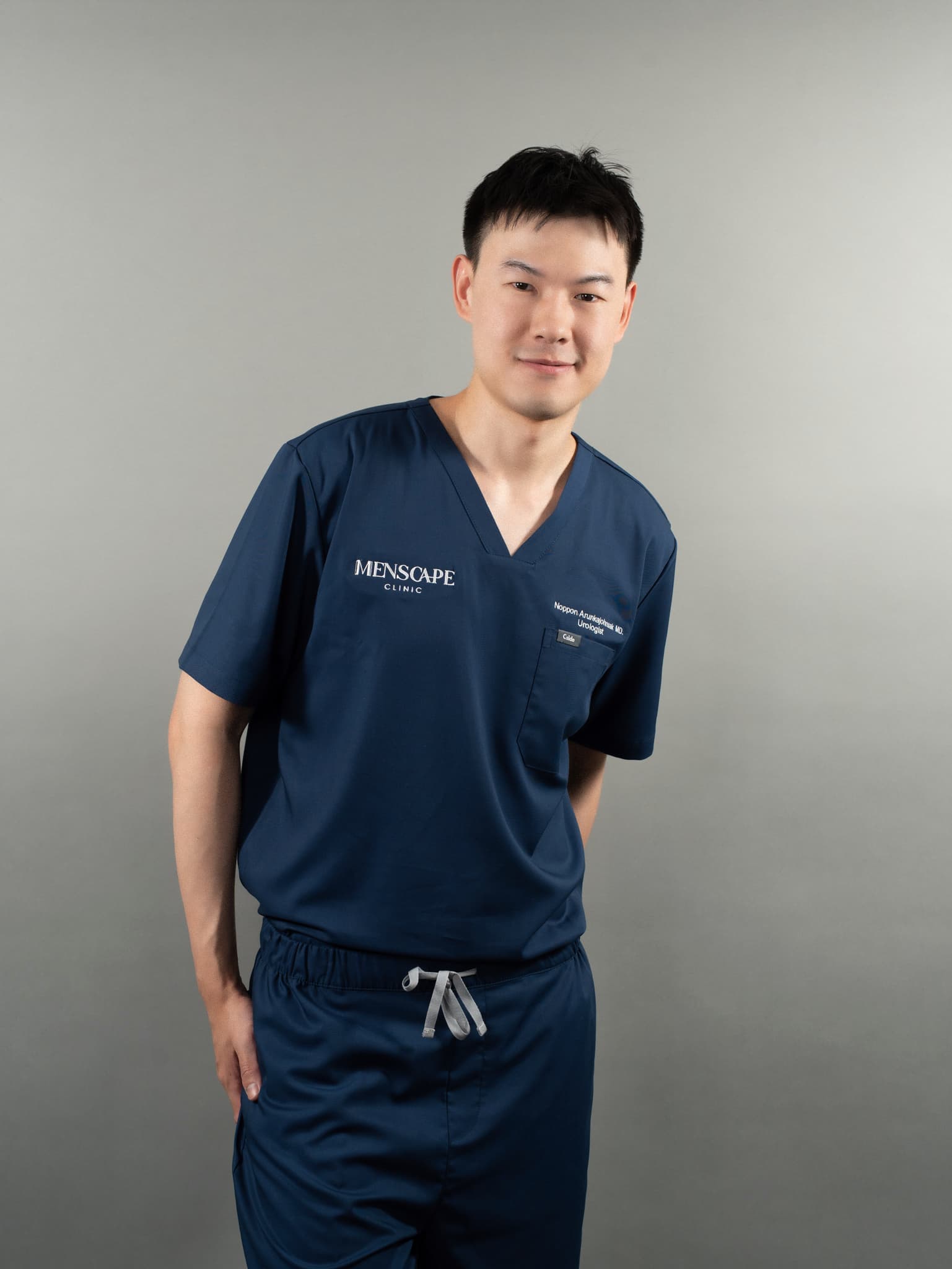
Because bladder Botox needs a prescription and a proper assessment, the first step is always a consultation, not a booking for the injection itself. At Menscape Bangkok, our urology team will review your symptoms and history, check your urine, assess how well you empty your bladder, and confirm whether bladder Botox is the right move for you or whether another path fits better. If it is suitable, you will get an itemised quote and a clear plan, including follow-up.
If urgency, frequency, or night-time trips are wearing you down and tablets have not solved it, book a consultation to talk it through with a specialist. This article is general information and does not replace personalised medical advice; any treatment decision and prescription must come from a qualified clinician after assessing you.
Frequently Asked Questions
How much does bladder Botox cost in Bangkok?
As an indicative range, an all-in bladder Botox treatment using the standard 100-unit overactive bladder dose typically runs about 35,000-70,000 THB (roughly 1,000-2,000 USD) in Bangkok, covering the drug, cystoscopy, urologist, facility, and local anaesthetic. The 200-unit dose used for neurogenic bladder costs more because it uses double the drug. These are planning figures; your exact quote depends on the dose and clinic, so confirm at consultation.
Why is the drug the most expensive part?
OnabotulinumtoxinA is a specialised biologic medicine, and the overactive bladder dose of 100 units is a large quantity. Genuine, in-date, properly stored product is the single biggest line item, often more than the procedure itself, and hospital therapeutic pricing tends to run above cosmetic per-unit rates. A vial priced suspiciously low is a reason for caution, not celebration, especially for an injection into the bladder.
Is bladder Botox cheaper in Bangkok than in the US or UK?
Generally, yes. In the US the drug alone has a list price of about 1,292 USD for a 200-unit vial, and an uninsured overactive bladder treatment including the procedure commonly runs about 1,000-2,500 USD or more, while UK private bladder Botox with cystoscopy is typically quoted in the low thousands of pounds. Bangkok all-in pricing for the same 100-unit dose usually lands below those figures for a comparable day-case procedure, which is why many international patients combine it with a visit. Exact figures are provider-dependent.
How long does bladder Botox last?
The effect is temporary. Published data put the median duration at about 7.6 months for the 100-unit overactive bladder dose and about 9.0 months for the 200-unit neurogenic dose, and patient information often describes it as roughly six months, or 4 to 9 months, with re-treatment two to three times a year. Symptoms returning is the signal to discuss a repeat; injections are usually given at least 12 weeks apart.
Does it hurt, and will I be put to sleep?
Most men have bladder Botox awake, as a day case, using only local anaesthetic gel in the urethra. The injection part takes around 15 minutes, and men typically feel pressure or small pinches rather than sharp pain. Light sedation or, rarely, a general anaesthetic is an option if you are very anxious, but it adds cost.
What are the main risks?
The most common issue is a urinary tract infection, reported in about 18% of overactive bladder patients, along with a day or two of stinging and a little blood in the urine. The most important risk is temporary difficulty emptying the bladder, needing short-term self-catheterisation in roughly 5-8% of overactive bladder cases. Seek urgent care if you cannot pass urine, develop a fever with back pain, or notice swallowing difficulty or muscle weakness.
Who should not have bladder Botox?
It should not be given if you currently have a urinary tract infection, are in urinary retention and not already catheterising, or have a high leftover bladder volume (post-void residual above 200 mL) without self-catheterising. It is also avoided with a known allergy to the drug, and used cautiously in neuromuscular disorders. A urologist confirms suitability before treatment.
Is it suitable as a first treatment for overactive bladder?
Usually not. Guidelines position bladder Botox after lifestyle changes, bladder retraining, and medication have been tried and have not given enough relief, or could not be tolerated. In men it is also important to confirm the problem is a genuinely overactive bladder rather than prostate-related obstruction, which a consultation sorts out.
Do I need a prescription and a consultation first?
Yes. Bladder Botox is a prescription medical procedure, not a walk-in cosmetic treatment. It can only be carried out after a urologist has assessed your symptoms, checked your urine for infection, and measured how well you empty your bladder. The injection is then scheduled separately once you are confirmed as a suitable candidate.
)
/)
/)
/)
/)
/)