/)
Losing reliable bladder control after prostate surgery is one of the more isolating things a man can go through, and it rarely gets talked about openly. If pads, pelvic floor exercises and medication have not given you back the control you want, an artificial urinary sphincter (AUS) is often the next conversation. It is the most established surgical fix for moderate to severe male stress incontinence, and for many men it is the option that finally lets them stop planning their day around the nearest toilet.
This guide focuses on what the procedure costs in Bangkok, why the price looks the way it does, and what you actually get for the money. It also covers who the operation suits, who it does not, how recovery is staged, and the risks worth understanding before you commit. Pricing here is built from current Bangkok market ranges and is meant to give you a realistic planning figure, not a binding quote. An artificial urinary sphincter is a prescription surgical implant: it can only be recommended and fitted after a urologist has assessed you in person, so treat every number below as indicative and confirm it at consultation.
What an artificial urinary sphincter actually is
An artificial urinary sphincter is a small, fully implanted, fluid-filled device that does the job your natural sphincter muscle can no longer do: it keeps the urethra (the tube that carries urine out of the body) closed until you decide to empty your bladder. The version used in the overwhelming majority of cases worldwide is the AMS 800, which manufacturer Boston Scientific describes as the gold standard treatment for moderate to severe male stress urinary incontinence after prostate surgery (Boston Scientific).
The system has three connected parts, all hidden under the skin once healed:
A cuff that wraps gently around the urethra and, when filled with sterile fluid, squeezes it closed to hold urine in.
A pressure-regulating balloon placed in the lower abdomen, which stores the fluid and sets how firmly the cuff squeezes.
A control pump placed in the scrotum, which you press to move fluid out of the cuff when you want to urinate.
When you need to pass urine, you squeeze the pump a few times. That shifts fluid from the cuff into the balloon, the cuff opens, and you empty your bladder normally. Over the next minute or two the cuff automatically refills and reseals, restoring continence without you having to do anything else. Cleveland Clinic describes the same three-component design and pump-activated mechanism (Cleveland Clinic).
One point that surprises many men: the device is not turned on during surgery. It is left deactivated for several weeks so tissues can heal around the cuff, then switched on at a later visit. More on that in the recovery section.
Why this is mostly a men's procedure
Stress urinary incontinence in men is overwhelmingly a consequence of prostate treatment. After a radical prostatectomy (removal of the prostate for cancer), and sometimes after radiation or surgery for an enlarged prostate, the natural sphincter can be weakened or damaged. The result is leakage when you cough, stand, lift or exercise. For most men this improves over the first 6 to 12 months with pelvic floor rehabilitation, but a proportion are left with persistent, bothersome leakage that conservative measures do not fix.
That is the group the AUS is designed for. Cleveland Clinic notes the device is used primarily in men with stress incontinence who have not responded to other treatments, most commonly after prostate cancer surgery (Cleveland Clinic). A 2014 review in the International Journal of Urology calls the AMS 800 the most commonly implanted artificial urinary sphincter and the gold standard for treating post-prostatectomy urinary incontinence (James & McCammon, 2014).
Artificial urinary sphincter cost in Bangkok (THB and USD)
For a cost-driven decision, here is the part that matters most. The figures below reflect current Bangkok pricing for AUS implantation as an all-in surgical package and are indicative; your final quote depends on the hospital, the surgeon and your individual case. Confirm everything at consultation.
Item | Bangkok (THB) | Bangkok (USD approx.) | Notes |
AUS implant package, all-in (typical range) | 340,000 - 510,000 | 10,000 - 15,000 | Device + surgeon + hospital + anaesthesia + short stay + follow-up |
Typical mid-point quote | ~425,000 | ~12,500 | Standard primary (first-time) implant, uncomplicated case |
The AMS 800 device alone | ~200,000 - 320,000 | ~6,000 - 9,500 | Usually the single largest line item |
Specialist consultation + workup | 3,000 - 15,000 | ~90 - 450 | Urine flow tests, scope, urine culture; often credited toward surgery |
Activation visit (6-8 weeks post-op) | Often included | Often included | Device switched on and pump training given |
Revision / replacement surgery (future, if needed) | 300,000 - 500,000+ | ~9,000 - 15,000+ | Plan for the possibility after roughly 10 years |
USD values are approximate and move with the exchange rate (calculated near 34 THB to 1 USD). Treat the package figure as your planning number and ask each hospital exactly what is and is not inside it.
How Bangkok compares to the US, UK and Australia
This is where medical travel earns its keep. The same operation, with the same device, costs far more in most high-income countries.
Country | Typical AUS cost (USD) | Approx. THB | Indicative saving vs Bangkok |
Thailand (Bangkok) | 10,000 - 15,000 | 340,000 - 510,000 | Reference |
United States | 30,000+ (often higher with hospital fees) | 1,020,000+ | Around 55-65% |
United Kingdom (private) | 18,000 - 28,000 | ~610,000 - 950,000 | Around 40-55% |
Australia (private) | 20,000 - 30,000 | ~680,000 - 1,020,000 | Around 45-55% |
International medical-travel pricing puts the average Bangkok figure near 12,500 USD (about 425,000 THB), within a typical range of 10,000 to 15,000 USD (Bookimed). By comparison, the same procedure is commonly quoted at around 30,000 USD or more as a self-pay all-in cost in the United States. US, UK and Australian figures vary widely with insurance status, hospital and surgeon, so the savings column is a realistic range rather than a fixed discount. Even at the conservative end, the gap is large enough that some men fly in specifically for this procedure.
What drives the cost
AUS pricing behaves differently from most surgery because a single component, the implant, dominates the bill. Understanding the moving parts helps you read a quote properly.
The device. The AMS 800 is a premium, sterile, single-use implant with antibiotic-treated components, and it accounts for the largest share of the total. This is why AUS quotes cluster in a narrower band than many operations: you cannot discount the hardware much.
Surgeon and team fees. You are paying for a urologist who does implant surgery regularly. Higher case volume tends to mean fewer complications, which is worth more than a small fee difference.
Hospital and anaesthesia. Operating-room time, the anaesthetist, and usually one night as an inpatient. International private hospitals in Bangkok cost more than local hospitals but bundle in English-speaking coordination.
Pre-operative workup. Urine flow testing, a look inside the urethra and bladder with a small camera (cystoscopy), and a urine culture to rule out infection before any implant goes in.
Cuff sizing and pressure selection. The cuff comes in a range of sizes and the balloon in several pressure bands; the right combination is chosen during surgery and does not usually change the price, but it does affect your result.
Future revision. Mechanical devices can eventually wear out. Budgeting for a possible replacement down the line is part of an honest long-term cost picture.
Who is a candidate, and who is not
An AUS is a considered step, not a first move. You are likely to be a reasonable candidate if:
You have moderate to severe stress urinary incontinence, typically using two or more pads a day, that has not improved enough with time and pelvic floor rehabilitation.
Your leakage is at least 6 to 12 months out from prostate surgery, so natural recovery has had a fair chance.
You have the manual dexterity and cognitive ability to operate the scrotal pump reliably, which matters every single time you urinate.
Any prostate cancer is treated and stable, and your urinary tract is free of active infection or untreated narrowing.
When an AUS is usually not the right choice (contraindications and cautions)
Active urinary tract infection, which must be cleared before any implant is placed because infection around the device is a serious problem.
An untreated urethral stricture (narrowing) or bladder neck contracture, which generally needs fixing first.
Poor hand function or significant cognitive impairment that would make safe, consistent pump use unrealistic, since a device you cannot operate offers no benefit.
Significant prior pelvic radiation, which is not an absolute barrier but does raise the risk of cuff erosion and reduces continence outcomes; radiotherapy has been linked to less reliable results and higher complication rates and calls for careful counselling.
Predominant urgency incontinence (a sudden bladder spasm rather than leakage on exertion), which an AUS does not treat and which needs a different approach.
A proper assessment exists precisely to sort this out. The point of the consultation is not to sell you a device; it is to confirm the device is the right tool for your specific bladder problem.
How the surgery and recovery work, step by step
The operation is usually done under general or spinal anaesthesia and takes in the region of one to two hours for a straightforward first implant.
Anaesthesia and positioning. You are anaesthetised and positioned to give the surgeon access to the area between the scrotum and the rectum, where the urethra is reached.
Placing the cuff. A small incision is made and the cuff is positioned around the urethra at the point that gives the best seal.
Placing the balloon and pump. The pressure-regulating balloon goes into the lower abdomen and the control pump sits in the scrotum, all connected by fine tubing and hidden under the skin.
Deactivation. The device is deliberately left switched off so the cuff does not compress healing tissue. You go home still leaking, which is expected and temporary.
Hospital stay. Most men stay one night. A catheter, if used, is typically removed before discharge or shortly after.
Staged recovery timeline
Days 1 to 7. Expect soreness, bruising and swelling in the scrotum and groin. Light walking is encouraged; you avoid lifting, cycling and straining. Pain is normally controlled with simple medication.
Weeks 1 to 2. Skin incisions usually heal within about two weeks, per Cleveland Clinic. You are still leaking because the device is off. Keep the area clean and watch for signs of infection.
Weeks 6 to 8. This is the key milestone. The device is activated at a clinic visit and you are taught to use the pump. Cleveland Clinic notes activation usually happens six to eight weeks after the procedure, once tissues have healed (Cleveland Clinic). Continence improves from this point, not from the day of surgery.
Months 2 to 3. Most men settle into a routine, build confidence with the pump and return to normal activity, including exercise and intimacy, as comfort allows.
If you are travelling to Bangkok for this, plan your trip around that activation visit. You should be in the city for the surgery and the early healing review, and either stay through activation at around 6 to 8 weeks or arrange to return for it. Discuss the logistics with the clinic before you book flights.
What results to expect (the real numbers)
The honest version: an AUS is very good at reducing leakage, but "dry" usually means "down to a pad a day," not necessarily zero.
Success, defined as zero to one pad per day, is high. Cleveland Clinic notes some studies show a success rate over 90% (Cleveland Clinic), and a long-term review in *Advances in Urology* reported pad use of 0 to 1 per day in around 90% of primary implant patients in some series (Montague, 2012).
Total dryness (no pads at all) is less common than social continence. The 2014 International Journal of Urology review puts it plainly: most patients achieve social continence of about one pad a day, while rates of total continence are meaningfully lower (James & McCammon, 2014).
Satisfaction is generally strong. The same review reports patient satisfaction exceeding 80% in most series, and the long-term data show figures around 90% satisfied with around 96% willing to recommend the procedure to a friend in some cohorts (Montague, 2012).
Durability is good but not permanent. The device can last up to about 10 years (Cleveland Clinic), with long-term series showing freedom from mechanical failure around 79% at 5 years and roughly 64 to 72% at 10 years (Montague, 2012). In plain terms, a good number of men will need a revision eventually.
Set expectations around "far drier and back in control," not "perfectly dry forever," and you will not be disappointed.
Risks and side effects
Every implant carries risk, and an AUS is no exception. Most men do well, but you should go in with eyes open.
More common, usually manageable issues:
Scrotal and groin swelling, bruising and discomfort in the first couple of weeks.
Temporary difficulty getting used to the pump, which the activation visit and follow-up are there to coach you through.
Persistent or recurrent leakage in a minority, sometimes from gradual thinning of the urethral tissue under the cuff (urethral atrophy), which is a leading reason for revision.
Less common but more serious problems:
Infection of the device, with the frequency reported in the range of roughly 0.5 to 7% in the literature, which often means removing the implant (Ha & Yoo, 2019).
Cuff erosion, where the cuff wears into the urethra, reported at rates of about 3.8 to 10% (Ha & Yoo, 2019).
Mechanical failure of a component over time, requiring replacement.
Urethral atrophy, reported at rates of roughly 9.6 to 11.4%, a leading reason for revision surgery (Ha & Yoo, 2019).
Have a question about your treatment?
Message our Bangkok clinic on WhatsApp and a doctor replies within minutes during clinic hours.
Seek urgent medical care if you notice
Fever, spreading redness, increasing pain or pus around any incision or in the scrotum, which can signal device infection.
Sudden inability to urinate, or new blood in the urine.
Severe or worsening scrotal swelling and pain.
Any blood at the urethra, or new severe pain when passing urine, which may point to erosion.
These warrant same-day assessment, not a wait-and-see. If you have travelled home after surgery, contact the operating clinic and also seek local emergency care.
Choosing a safe clinic, and the red flags
For an implant that lives inside your body for years, who does the surgery matters as much as what it costs. Look for:
A urologist who performs implant and reconstructive surgery regularly, not occasionally. Ask directly about their AUS case volume and their infection and revision rates.
A hospital with proper sterile operating facilities and a clear protocol for screening out infection before surgery, since contamination is the enemy of any implant.
The genuine AMS 800 device from the manufacturer, with the components and serial details documented for your records.
A transparent, itemised quote that spells out the device, surgeon, hospital, anaesthesia, stay and the activation visit, so you are comparing like with like.
A clear follow-up and revision plan, including who looks after you if a component fails years later.
Red flags worth walking away from: a price that looks far below the device cost alone (the hardware is expensive for a reason); reluctance to name the surgeon or share their experience; no pre-operative infection screening; pressure to book on the day; or vague answers about what happens if something goes wrong later. A reputable clinic will welcome these questions, not dodge them.
How the AUS compares with other options
An AUS is not the only treatment for male stress incontinence, and it is not always the first choice. This table sets it against the main alternatives.
Option | Best suited to | How it works | Durability | Indicative Bangkok cost (THB) |
Pelvic floor rehab + lifestyle | Mild leakage, early after prostate surgery | Strengthens supporting muscles | Ongoing effort | Low (3,000 - 20,000 per programme) |
Male sling | Mild to moderate, stable leakage | A supportive sling lifts and compresses the urethra | Good; no moving parts | ~250,000 - 450,000 |
Artificial urinary sphincter (AMS 800) | Moderate to severe leakage | Patient-controlled cuff opens and closes the urethra | Up to ~10 years; revision possible | 340,000 - 510,000 |
Bulking agents | Mild leakage or those wanting a minimal procedure | Injections bulk up the urethral wall | Often temporary, may need repeating | ~80,000 - 200,000 |
Figures are indicative Bangkok ranges and overlap considerably; the right option depends on how severe your leakage is, your dexterity, your radiation history and your goals. The AUS stands out as the most reliable choice for moderate to severe leakage, which is exactly why it is the one most men in that group end up choosing. Your surgeon will help you weigh it against a sling or bulking agents based on your assessment.
Booking a consultation
Because an artificial urinary sphincter is a prescription surgical implant, the only way to get an accurate, personal quote, and to know whether it is even the right operation for you, is a proper consultation with a urologist. That visit reviews your history, examines you, runs the necessary bladder tests, and produces an itemised plan and price rather than a generic estimate.
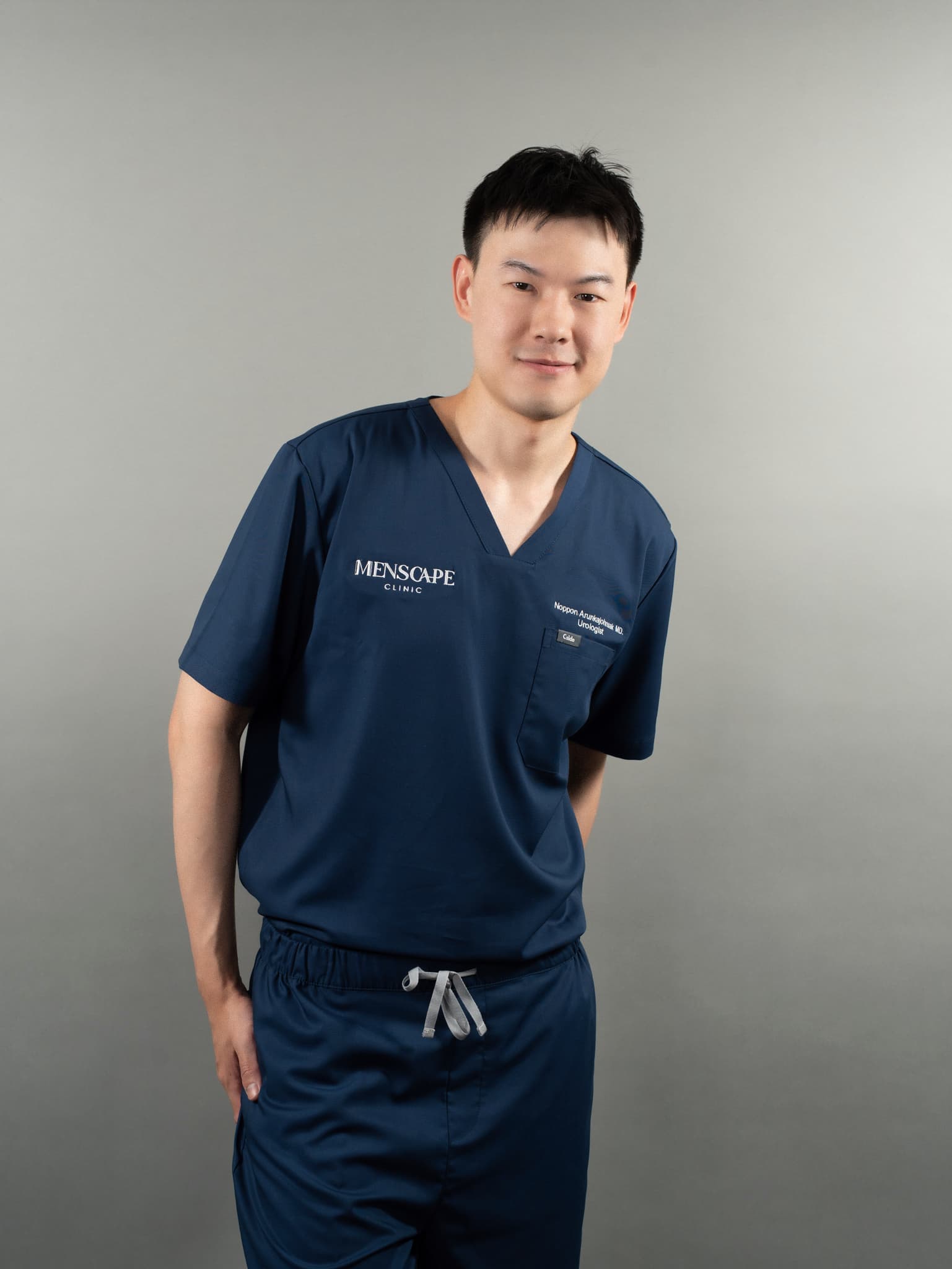
At Menscape Bangkok our urology team manages male urinary incontinence as part of routine practice, with a men's-health focus and English-speaking care throughout. If leakage after prostate surgery is limiting your life, book a consultation to discuss whether an AUS, a sling or another approach fits your situation, and to get a transparent quote for your case. All prices in this guide are indicative and confirmed only after assessment.
Frequently Asked Questions
How much does an artificial urinary sphincter cost in Bangkok?
As an all-in surgical package, AUS implantation in Bangkok typically runs about 340,000 to 510,000 THB, roughly 10,000 to 15,000 USD, with a mid-point near 425,000 THB (about 12,500 USD). The AMS 800 device itself is usually the largest single cost. These are indicative figures; your final quote depends on the hospital, surgeon and your individual case, so confirm at consultation.
How much can I save compared with the US or UK?
The same operation commonly costs 30,000 USD or more in the United States and roughly 18,000 to 30,000 USD privately in the UK or Australia. That puts Bangkok savings in the region of 40 to 65%, depending heavily on your insurance status and the hospital you compare against. Even at the conservative end, the gap is substantial.
Why is the device such a large part of the price?
The AMS 800 is a premium, single-use, sterile implant with antibiotic-treated components, and it accounts for the biggest share of the total bill. This is why AUS quotes cluster in a fairly narrow band: unlike many operations, the hardware cost cannot be discounted much, so prices below the device cost alone should raise suspicion.
When is the device turned on after surgery?
It is deliberately left switched off during and after surgery so the cuff does not compress healing tissue. You go home still leaking, which is normal. The device is activated at a clinic visit usually 6 to 8 weeks later, once tissues have healed, and that is when your continence improves. If you are travelling for surgery, plan your trip around this activation visit.
How well does an artificial urinary sphincter work?
Success, defined as zero to one pad per day, is high, with some studies showing over 90%. However, complete dryness with no pads at all is less common than getting down to about one pad a day. Patient satisfaction generally exceeds 80% in published series. The realistic goal is being far drier and back in control rather than perfectly dry forever.
How long does it last, and will I need another operation?
The device can last up to around 10 years. Long-term data show freedom from mechanical failure of roughly 79% at 5 years and about 64 to 72% at 10 years, so a meaningful number of men eventually need a revision or replacement. It is sensible to factor a possible future revision, broadly similar in cost to the first implant, into your long-term planning.
What are the main risks?
Most men do well, but risks include device infection (about 0.5 to 7%), cuff erosion into the urethra (about 3.8 to 10%), gradual urethral thinning that can reduce the result (about 9.6 to 11.4%), and mechanical failure over time. Seek urgent care for fever, spreading redness or pus around an incision, sudden inability to urinate, blood in the urine, or severe scrotal pain and swelling.
Who is not a good candidate for an AUS?
An AUS is usually not appropriate if you have an active urinary tract infection, an untreated urethral narrowing, hand function or memory problems that would make operating the pump unreliable, or predominantly urgency-type leakage, which the device does not treat. Significant prior pelvic radiation does not rule it out but raises the risk of erosion and calls for careful counselling. A consultation exists to sort this out.
Is an artificial urinary sphincter only for men?
In practice it is overwhelmingly a men's procedure, because male stress incontinence is usually a consequence of prostate surgery or radiation that weakens the natural sphincter. The device is rarely used in women. Menscape focuses on men's urological health, including post-prostatectomy incontinence.
Do I need a prescription or referral?
Yes. An artificial urinary sphincter is a prescription surgical implant fitted only after a urologist assesses you, reviews your history and runs bladder tests. It is not something you can buy or book without that evaluation, which is also the only way to confirm it is the right operation for your specific type of leakage.
)
/)
/)
/)
/)
/)