/)
/)
/)
/)
/)
Artificial Urinary Sphincter · The Definitive Solution for Male Stress Incontinence in Bangkok
An artificial urinary sphincter (AUS) is an implanted device that restores continence in men with stress urinary incontinence · most commonly after prostate cancer surgery. The AUS uses a urethral cuff, a fluid reservoir, and a scrotal control pump to keep the urethra closed except when you actively choose to urinate. Over 85% of carefully selected men achieve complete or near-complete continence after AUS implantation.
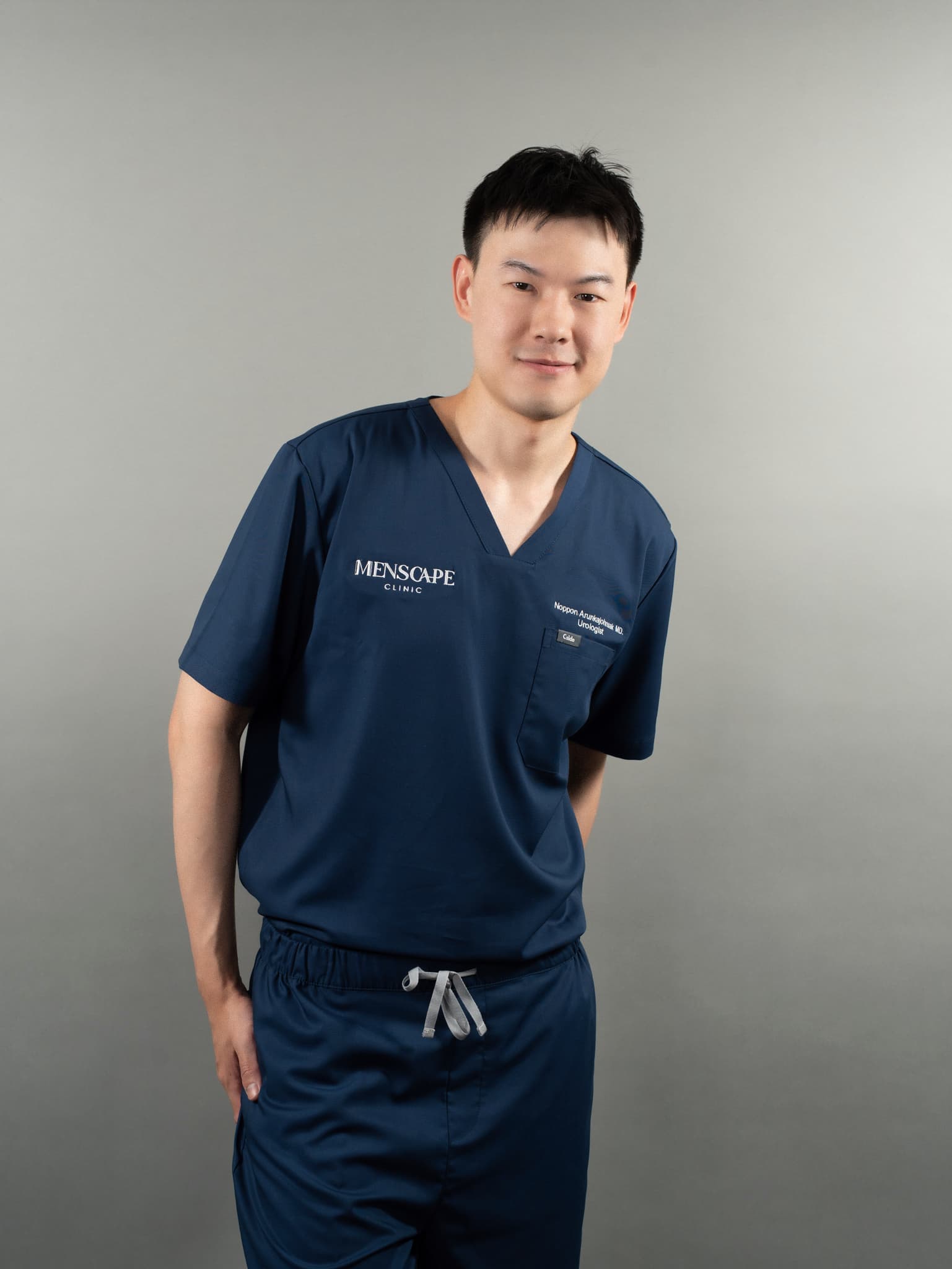
Medically reviewed by Dr. Noppon Arunkajohnsak (Win), Board-certified Urologist
9 years of experience
Our solutions
Why patients choose Artificial Urinary Sphincter
What Our Patients Say
Male Surgery
The difference was night and day. I hadn’t left the house without worrying about leaks in years.
Wachirawit, 67
Male Surgery
I was nervous about surgery, but once the device was switched on, life came back to normal faster than I expected. Sleeping through the night feels incredible again.
Khom, 64
Book your consultation today.
/)
How to Prepare for Artificial Urinary Sphincter
Continence assessment
Pad-weight test, voiding diary, and cystoscopy to confirm stress incontinence and rule out other causes.Urethral evaluation
Cystoscopy and urodynamics confirm urethral integrity and bladder function · prior radiation or urethral stricture changes the surgical plan.Antibiotic prophylaxis
Targeted IV antibiotics before incision · infection of an implant is the most serious complication.Stop blood thinners
5-7 days before surgery only if cleared by your prescribing doctor.Pre-anesthesia assessment
Bloods, ECG, chest X-ray as indicated by age and comorbidities.Fast pre-surgery
No food or water for 6-8 hours before the procedure.
/)
What Happens During Artificial Urinary Sphincter
Anesthesia
General or spinal anesthesia.Perineal incision
Small incision in the perineum to access the bulbar urethra.Cuff placement
A precisely sized inflatable cuff is placed around the urethra · cuff size is measured intraoperatively.Reservoir placement
A pressure-regulating balloon reservoir is placed in the lower abdomen through a small lower-abdominal incision.Pump placement
The control pump is placed in the scrotum, on the side of your dominant hand.Activation
The device is left deactivated for 4-6 weeks to allow tissue healing. At a clinic visit, the device is activated and you’re trained on pump use.
/)
Explore Our Topics
About Artificial Urinary Sphincter
/)
Specialist Functional Urology
AUS implantation is a specialist procedure · outcomes depend on surgeon experience with the AMS 800 device, cuff sizing, and revision technique. Our team performs AUS regularly.
Pre-Op Continence Workup
We confirm the cause of incontinence before recommending AUS · for some men, male sling or PRO-ACT balloons are more appropriate than AUS.
Post-Implant Activation and Training
Patient training on pump operation is critical for long-term outcomes · we use structured activation visits and follow-up to ensure correct device use.
Private, Discreet Recovery
Confidential care, WhatsApp recovery support, English-language follow-up for international patients.
Frequently asked questions
When should I consider AUS?
You should consider an Artificial Urinary Sphincter (AUS) if you experience moderate-to-severe stress urinary incontinence, typically defined as needing more than 1-2 pads per day. This is particularly relevant if your incontinence persists at least 12 months after a prostatectomy or other lower-urinary-tract surgery and hasn't improved with conservative treatments like behavioral training or pelvic floor therapy. For milder incontinence, less invasive options such as a male sling or PRO-ACT balloons might be more suitable for your condition.
How long until I’m continent after the surgery?
After your AUS implantation surgery, the device is kept inactive for approximately 4-6 weeks. This crucial period allows for proper tissue healing and integration around the implanted components. Once this healing is complete, you will return to the clinic for device activation. At this appointment, our team will train you thoroughly on how to operate the pump. Continence is typically immediate and effective once the device is activated and you are proficient in its use.
What are the risks of an implant?
While AUS implantation is generally safe, it's important to be aware of potential risks. The most serious risk is infection of the implant, occurring in 1-3% of cases. This usually necessitates device removal and re-implantation once the infection clears. Mechanical failure, affecting 5-10% of devices over 5 years, may require revision surgery to restore function. Urethral erosion, where the cuff wears through the urethra, is a rare but serious complication that our team carefully monitors for.
How long does the device last?
Modern Artificial Urinary Sphincter devices, specifically the AMS 800, are designed for long-term durability. You can generally expect your device to function effectively for 10-15 years before a revision might be necessary. Should mechanical failure occur, which is typically due to component wear, a revision surgery usually involves replacing the affected part. This procedure is highly successful in restoring the device's original function and your continence.
How much does AUS cost in Bangkok?
The total cost for an Artificial Urinary Sphincter procedure in Bangkok encompasses several components. This includes the significant cost of the implant device itself, the surgical fees, hospital admission for your stay, and the necessary follow-up visits for device activation and training. To receive a precise and personalized quote that details all these elements and aligns with your specific needs, we recommend booking a consultation with our specialists.
What are the success rates and long-term outcomes for Artificial Urinary Sphincter?
Artificial Urinary Sphincter (AUS) boasts high success rates for restoring continence. Studies show that 80-90% of men achieve significant improvement or complete dryness, often reducing pad use to zero or one per day. Patient satisfaction rates are also very high, typically exceeding 90%. Long-term, the device effectively manages stress urinary incontinence for many years, significantly improving your quality of life and confidence.
What anesthesia options are available for Artificial Urinary Sphincter surgery?
For your Artificial Urinary Sphincter surgery, you will typically receive general anesthesia, meaning you will be completely asleep throughout the procedure. This ensures your comfort and minimizes any discomfort during the operation. In some cases, regional anesthesia, such as a spinal block, combined with sedation might be an option. Our anesthesiologist will discuss the best and safest anesthesia plan tailored to your health and the specifics of your surgery during your pre-operative assessment.
What should I expect at the consultation for AUS?
During your consultation, you'll meet with our experienced urologist specializing in male incontinence. We will review your medical history, perform a physical examination, and likely conduct tests such as a urinalysis and urodynamic studies to assess your bladder function and the severity of your incontinence. We'll discuss the AUS procedure in detail, including risks and benefits, and together decide if it's the right treatment for your specific condition and goals.
What are the medical-tourism logistics for international patients?
For international patients, we recommend planning to stay in Bangkok for approximately 7-10 days for the initial surgery and immediate post-operative care. Your follow-up device activation, typically 4-6 weeks later, can often be coordinated remotely via secure video calls or WhatsApp with our team, or you can plan a return visit. You are generally safe to fly home 3-5 days after your surgery, provided you feel well and have no complications.
THE DEFINITIVE SOLUTION FOR MALE STRESS INCONTINENCE
THE DEFINITIVE SOLUTION FOR
MALE STRESS INCONTINENCE
/)
)
Dr. Noppon Arunkajohnsak (Win)
Board-certified Urologist
- Experience
- 9 years
Dr. Noppon is a board-certified urologist trained at Siriraj Hospital, Mahidol University. With over 9 years of experience, he focuses on urological consultation and men's health, providing discreet, evidence-based, patient-centred care.