/)
Deciding you are done having children, or that you never wanted them, is a big call. Once you have made it, the next question is usually practical: what is the simplest, most reliable way to make that decision permanent without disrupting your life or your sex life? For many men, the answer is a vasectomy, and specifically the no-scalpel version, which has largely replaced the older incision method in modern clinics.
This guide is written for men weighing up a no-scalpel vasectomy in Bangkok, whether you live here, work here, or are considering combining the procedure with a trip. It covers what the operation actually involves, transparent pricing in Thai baht and US dollars, who is a good candidate and who is not, a realistic day-by-day recovery timeline, the risks worth knowing about, and how Bangkok compares with having it done at home. The clinical claims here are drawn from urology guidelines and peer-reviewed sources, which are listed at the end.
What a no-scalpel vasectomy actually is
A vasectomy is a minor surgical procedure that makes a man permanently unable to father children. It works by interrupting the two vas deferens, the tubes that carry sperm from each testicle up toward the urethra. Once those tubes are sealed, sperm can no longer reach the semen you ejaculate. The testicles keep producing sperm, but the body simply reabsorbs it, the same way it does normally between ejaculations.
The phrase "no-scalpel" refers to how the surgeon reaches the vas, not to a different end result. In a conventional vasectomy, the surgeon makes one or two small cuts in the scrotum with a scalpel. In the no-scalpel technique, the surgeon uses a sharp-pointed clamp to make a single tiny puncture in the skin, then gently stretches that opening to lift each vas through it. The technique was developed by Dr. Li Shunqiang in China in 1974 and has since become the preferred approach worldwide.
The reason it took over is not marketing. It is measurably gentler. A Cochrane systematic review comparing the two approaches concluded that the no-scalpel method produced less bleeding, less hematoma, less infection, and less pain, along with a shorter operation, while delivering the same contraceptive effectiveness. The American Urological Association guideline goes further and specifically recommends a minimally invasive approach such as no-scalpel vasectomy, citing a sharply lower rate of scrotal hematoma (around 1.8 percent versus 12.2 percent for the incision method). Plainly put: same outcome, fewer complications, faster healing.
The single puncture is so small it usually does not need a stitch and closes on its own within a few days, often leaving no visible scar. The whole thing is done awake under local anaesthetic, as a walk-in, walk-out procedure.
Bangkok pricing: THB, USD, and how much you save
Cost is one of the main reasons men ask about having this done in Bangkok rather than at home, so here it is up front. The figures below are indicative ranges gathered from Thai clinics and hospitals and from international price guides, and the USD conversions are approximate and move with the exchange rate. Always confirm the exact figure and what it includes at your own consultation, because packages vary.
Where / option | Typical price (THB) | Approx. USD | Notes |
Non-profit family-planning clinic (e.g. PDA) | ~6,000 | ~185 | Lowest-cost route; basic service, limited extras |
Private men's-health clinic, Bangkok | ~18,000-25,000 | ~550-770 | Often includes consult, local anaesthetic, follow-up |
Private / international hospital, Bangkok | ~20,000-30,000 | ~610-920 | Higher facility fees; English-speaking, premium setting |
Pre-operative tests (if needed) | ~500-1,500 | ~15-46 | Sometimes billed separately |
Post-vasectomy semen analysis | ~500-1,500 | ~15-46 | May be bundled or charged at follow-up |
Now the comparison that matters if you are travelling for it:
Country | Typical private price | Approx. USD | Notes |
Thailand (Bangkok, private clinic) | ~18,000-30,000 THB | ~550-920 | Self-pay, short wait |
United States | ~1,000-3,000 USD typical | 1,000-3,000+ | Highly variable; hospital or surgery-center cases can run toward 4,000+; insurance may cover part |
United Kingdom (private) | ~500-1,500 GBP | ~650-1,950 | Free on the NHS but with long waits |
The headline is straightforward. A self-pay no-scalpel vasectomy in a private Bangkok clinic commonly lands 50 to 70 percent below a typical private US price, and comfortably below private UK rates. The UK has a free NHS route, so the saving there is about time and convenience rather than money. For uninsured Americans, or expats without local cover, the gap can be several thousand dollars.
A note on the very cheapest option: non-profit clinics such as the Population and Community Development Association can perform the procedure for around 6,000 THB, which is excellent value. The trade-off tends to be in scheduling, language support, and the surrounding experience rather than the surgery itself. A dedicated men's-health clinic typically bundles the consultation, the procedure, local anaesthetic, and the follow-up visit into one transparent price, which many international patients prefer.
What actually drives the cost
Facility type. A flagship international hospital carries higher overheads than a focused outpatient clinic, and you pay for that setting.
What is included. A quoted price may or may not cover the initial consultation, pre-op blood tests, the local anaesthetic, the follow-up visit, and the all-important semen test. Ask for the bundled total, not just the procedure fee.
Surgeon experience. A urologist who performs vasectomies routinely may price differently from a general surgeon, and experience genuinely matters for complication rates.
Language and aftercare. English-speaking staff, written aftercare instructions, and easy follow-up access add value that does not show up in a bare price tag.
Menscape's no-scalpel vasectomy is priced well below typical Western hospital costs and is quoted as a single package covering the consultation, the procedure, local anaesthetic, and a follow-up appointment, with the exact figure confirmed at consultation. See the no-scalpel vasectomy service page for current pricing.
Who is a good candidate, and who is not
A no-scalpel vasectomy suits a man who is confident he does not want children in the future, or does not want any more. The defining feature of this procedure is permanence, so candidacy is really about certainty more than physical fitness.
You are likely a good candidate if you:
Are sure your family is complete, or that you do not want biological children.
Want a one-time, long-term form of contraception rather than something to manage daily or per encounter.
Prefer a low-risk outpatient option over a more involved operation.
Have discussed it with your partner, where relevant, and you both feel settled on the decision.
A vasectomy is generally not the right choice if:
You are uncertain, are going through a period of upheaval, or feel any meaningful chance you may want children later. Reversal exists, but it is expensive and success is not guaranteed, so the honest planning assumption is that this is permanent.
You are looking for protection against sexually transmitted infections. A vasectomy does nothing for STIs, and condoms remain necessary if that is a concern.
You expect it to change libido, erections, testosterone, or the sensation of orgasm. It does not, which is reassuring, but it also means it is not a treatment for any of those things.
Contraindications and reasons to delay
Certain conditions can make the procedure harder or call for extra care. These do not always rule it out, but they should be raised at your consultation:
An active infection of the scrotum, groin, or skin in the area, which should be treated first.
A large varicocele, hydrocele, prior scrotal or hernia surgery, or scarring that distorts the anatomy, which can make the vas harder to isolate.
Undescended testes or an unusually difficult-to-feel vas.
Bleeding disorders or use of blood-thinning medication, which may need to be managed or paused under medical guidance before surgery.
Any reasonable doubt about the decision itself. A responsible clinician will sometimes recommend waiting rather than proceeding.
Thai practice, like guidance elsewhere, treats vasectomy as an elective, irreversible decision that calls for informed consent and an unhurried conversation. If a clinic seems willing to skip that conversation, treat it as a warning sign.
Step by step: what happens on the day
The procedure itself is quick, usually 15 to 20 minutes, and you go home the same day. Here is the typical sequence.
Consultation and consent. The doctor reviews your medical history, confirms you understand the procedure is intended to be permanent, examines the scrotum to locate each vas, and answers your questions. This may happen on a separate day or immediately before.
Preparation. You lie down and the area is cleaned. Shaving is minimal and often done for you.
Local anaesthetic. A small injection numbs the skin and the area around each vas. This is the part most men describe as a brief pinch or sting. After it takes effect, you should feel pressure and movement but not sharp pain.
Accessing the vas. Using the no-scalpel instrument, the surgeon makes one small puncture, lifts the first vas through it, and then the second through the same opening.
Sealing the tubes. A short segment of each vas is divided, and the ends are sealed, commonly by cautery, often with a thin layer of tissue placed between the cut ends to lower the chance of the tube rejoining. Clips may also be used.
Closing up. The tiny opening is usually left to close on its own, sometimes with a single small stitch. A dressing and supportive underwear keep things comfortable.
Brief recovery and discharge. You rest for a short while, get written aftercare instructions, and head home, ideally with someone to drive you.
You stay awake throughout. Many men find the anticipation worse than the reality.
Recovery, stage by stage
Recovery from a no-scalpel vasectomy is genuinely fast for most men, but it is not instant, and rushing the first week is the main way to run into trouble. The timeline below is typical; your own clinic's advice always takes priority.
Day 0 to 2. Expect mild soreness, some swelling, and possibly light bruising. Rest with your feet up, apply an ice pack on and off, wear snug supportive underwear, and take simple pain relief if needed. Most men who do desk work can return within one to two days. MedlinePlus notes that many men return to non-physical work the next day and to normal activities within three to seven days.
Days 3 to 7. Soreness settles steadily. You can usually resume light daily activity and gentle walking. Avoid heavy lifting, strenuous exercise, and cycling until the area feels normal. Keep the puncture site clean and dry as instructed.
Week 1 to 2. Most men are back to exercise and to sex around the one-week mark, guided by comfort. There is no rush, and a little extra rest does no harm.
Weeks 8 to 12 and the semen test. This is the step men most often skip, and skipping it is risky. You are not yet sterile after the procedure. Sperm already past the cut point can linger for weeks. Guidelines suggest a semen sample can be checked as early as eight weeks, and many clinics test at around three months or after roughly 15 to 20 ejaculations. You are only cleared to stop other contraception once a semen analysis confirms there are no moving sperm (technically, azoospermia or only rare non-motile sperm). Until that confirmation, keep using another method.
If you want a deeper walk-through of healing and warning signs, our frenulectomy recovery guide covers similar outpatient-recovery principles for male genital procedures.
How effective is it, in numbers
A vasectomy is among the most reliable forms of contraception available, but the numbers are worth understanding precisely.
Once a follow-up semen test confirms clearance, the long-term risk of pregnancy is roughly 1 in 2,000, a figure cited by the AUA guideline and reflected in NHS patient information.
The chance the procedure fails and the tubes rejoin enough to need a repeat is small. StatPearls puts the failure rate requiring a repeat procedure at about 0.24 percent.
Effectiveness is essentially the same whether the surgeon uses the no-scalpel or the conventional incision approach. The Cochrane review found no difference in effectiveness between the two; the advantages of no-scalpel are in healing and complications, not contraceptive reliability.
Crucially, you are not protected in the first weeks or months. Effectiveness depends entirely on confirming clearance with the semen test before relying on it.
For comparison, that 1-in-2,000 long-term risk is lower than typical real-world failure rates for condoms or birth control pills, which is a large part of why couples who are done having children choose it.
Risks and side effects
A no-scalpel vasectomy is a low-risk procedure, and serious complications are uncommon. Still, no surgery is risk-free, and you deserve the honest list.
Common and usually short-lived:
Soreness, swelling, and bruising of the scrotum for a few days.
A small amount of oozing or a spot of blood from the puncture site early on.
A firm lump called a sperm granuloma at the cut end of the vas, caused by a little sperm leakage. It is usually harmless and often resolves on its own.
Less common:
Hematoma, a collection of blood in the scrotum. The no-scalpel approach lowers this risk substantially compared with the incision method, but it can still happen.
Infection at the site. Across studies, hematoma and infection together occur in roughly 1 to 2 percent of cases.
Chronic scrotal pain. A minority of men, on the order of 1 to 2 percent, develop longer-lasting discomfort that affects quality of life and may need further management. This is the complication most worth discussing in advance, because it is the one that can persist.
Have a question about your treatment?
Message our Bangkok clinic on WhatsApp and a doctor replies within minutes during clinic hours.
When to seek urgent care
Contact your clinic or seek medical attention promptly if you notice:
A fever, spreading redness, or increasing warmth around the scrotum, which can signal infection.
Rapidly worsening swelling or a scrotum that becomes large, tense, and very painful, which can indicate a significant hematoma.
Pus or foul-smelling discharge from the wound.
Severe or escalating pain that pain relief does not touch.
These are uncommon, but they are the situations where being seen quickly matters. One reassuring point: a vasectomy does not affect testosterone production, erections, ejaculation volume in any noticeable way for most men, or the sensation of orgasm. It changes fertility and nothing else about your sexual function.
How a no-scalpel vasectomy compares with other contraception
It helps to see the procedure next to the alternatives a couple might be weighing, because the right choice depends on whether you want something permanent or reversible, and on who carries the burden.
Method | Typical effectiveness | Duration | What it involves | Best suited to |
No-scalpel vasectomy | Very high; ~1 in 2,000 long-term pregnancy risk after clearance | Permanent | One small puncture, ~15-20 min, local anaesthetic | Men certain their family is complete |
Conventional (incision) vasectomy | Very high; same as no-scalpel | Permanent | Scalpel incision, slightly higher hematoma risk | Same candidates; now less commonly chosen |
Condoms | Lower in real-world use | Single use | Worn each time; also prevent STIs | Anyone needing STI protection or temporary cover |
Birth control pill (partner) | High with perfect use, lower typical use | Daily | Daily hormonal medication | Couples sharing responsibility, wanting reversibility |
IUD (partner) | Very high | 3-10 years | Inserted by a clinician; reversible | Women wanting long-acting reversible contraception |
Female sterilisation | Very high | Permanent | More invasive abdominal procedure | Couples where it suits the woman's circumstances |
Two things stand out. First, a vasectomy is simpler, cheaper, and lower-risk than female sterilisation, which is why it is often the more sensible permanent option for a couple. Second, it is the only method here, apart from the incision vasectomy, that asks nothing of either partner once it is confirmed working. The trade-off is permanence.
Choosing a clinic safely in Bangkok
Bangkok offers genuinely high-quality men's-health care at prices well below the West, but standards vary, and this is a procedure where the surgeon's experience shows up directly in your complication risk. A few markers separate a safe choice from a gamble.
Look for:
A urologist or surgeon who performs vasectomies regularly. Volume and familiarity with the no-scalpel technique correlate with fewer complications. It is fair to ask how often they do the procedure.
A proper consultation and consent process. You should have an unhurried conversation about permanence, alternatives, and risks before anyone schedules surgery.
Transparent, itemised pricing. A trustworthy clinic tells you whether the quote includes the consult, anaesthetic, follow-up, and semen test, with no vague extras.
A clear follow-up pathway, including the semen analysis. The test that confirms you are sterile is part of the service, not an afterthought. Make sure it is included or clearly priced.
Clean, licensed facilities and English-language support if you are an international patient, so nothing about aftercare gets lost in translation.
Red flags worth walking away from:
Pressure to book immediately, or reluctance to discuss reversal, permanence, or risks.
A price that seems too good to be true and turns out to exclude the consultation, anaesthetic, or follow-up.
No clear plan for the post-vasectomy semen test.
Vague answers about who is performing the procedure or their experience.
If you are researching male surgical care in Bangkok more broadly, our guide to circumcision versus frenulectomy applies the same safe-clinic principles to related procedures.
Booking a consultation
A no-scalpel vasectomy is an elective surgical procedure, and in Thailand it requires an in-person medical consultation and assessment before it can be performed. No reputable clinic will operate without one. That visit is also your chance to ask everything: about technique, about what the price covers, about recovery for your specific job and lifestyle, and about the follow-up test.
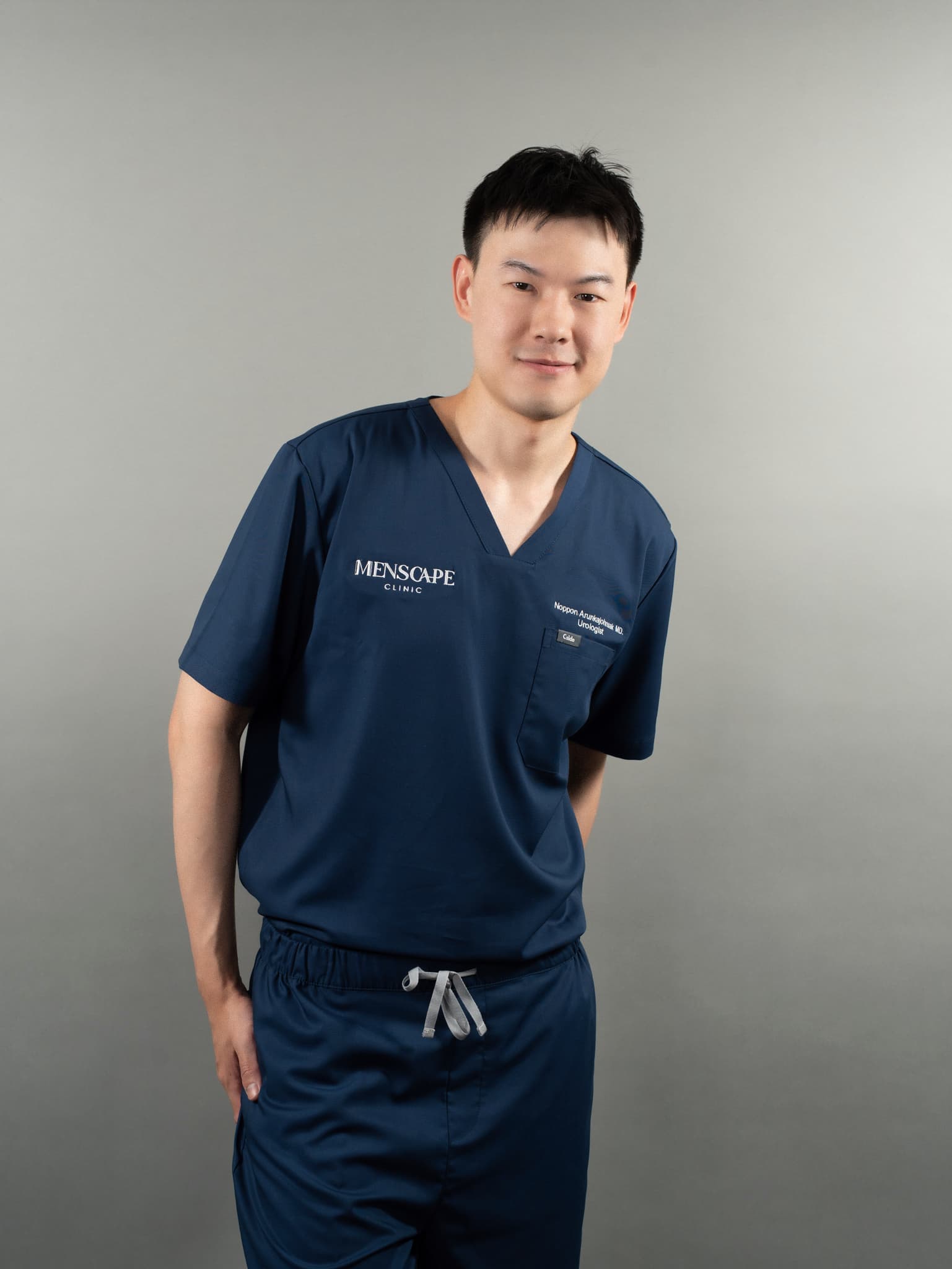
If you are considering the procedure in Bangkok, you can book a private, confidential consultation with Menscape Clinic to talk it through with a doctor and get a clear, itemised quote before deciding anything.
Frequently Asked Questions
Does a vasectomy affect testosterone, erections, or sex drive?
No. A vasectomy only interrupts the tubes that carry sperm. The testicles keep producing testosterone and releasing it into the bloodstream as normal, so libido, erections, ejaculation, and the sensation of orgasm are unchanged for the large majority of men. The only thing that changes is fertility. Semen volume also stays almost the same, because sperm makes up only a tiny fraction of the fluid.
How long until I am actually sterile after the procedure?
Not immediately. Sperm that is already past the point where the tubes were sealed can linger for weeks or months. Guidelines suggest a semen sample can be checked as early as eight weeks, and many clinics test at around three months or after roughly 15 to 20 ejaculations. You are only cleared to stop using other contraception once a semen analysis confirms there are no moving sperm. Until then, keep using another method.
Is a no-scalpel vasectomy painful?
Most men report only brief discomfort. The area is numbed with a local anaesthetic, and the part people notice most is the small injection itself, usually described as a quick sting. During the procedure you may feel pressure and movement but not sharp pain. Afterward, mild soreness and swelling for a few days are normal and respond well to ice, supportive underwear, and simple pain relief.
How much does a no-scalpel vasectomy cost in Bangkok?
It varies by setting. Non-profit family-planning clinics can perform it for around 6,000 THB. Private men's-health clinics typically charge roughly 18,000 to 25,000 THB, and private or international hospitals around 20,000 to 30,000 THB (about 550 to 920 USD). Pre-operative tests and the follow-up semen analysis may be extra. These are indicative figures, and the USD equivalent moves with the exchange rate, so confirm the bundled total and what it includes at your consultation.
How does the cost compare with the US or UK?
A self-pay no-scalpel vasectomy in a private Bangkok clinic commonly costs 50 to 70 percent less than a typical private US procedure, which usually runs from about 1,000 to 3,000 USD and can reach 4,000 USD or more at premium hospital or surgery-center settings. UK private prices sit around 500 to 1,500 GBP, and the procedure is available free on the NHS, though waiting lists can be long. For uninsured patients, Bangkok can represent a significant saving.
Can a vasectomy be reversed if I change my mind?
Reversal is technically possible, but it is more complex and expensive than the original procedure, and success is not guaranteed. The chance of restoring fertility falls the more time has passed since the vasectomy. Because of this, you should treat a vasectomy as a permanent decision. If you have any real doubt about wanting children in future, it is better to wait or choose a reversible method.
Will there be a visible scar?
Usually not. The no-scalpel technique uses a single small puncture rather than a cut, and it often does not need a stitch. The opening closes on its own within a few days and typically heals without a noticeable scar, which is one of the main advantages over the older incision method.
Does a vasectomy protect against sexually transmitted infections?
No. A vasectomy only prevents pregnancy. It offers no protection against STIs such as HIV, chlamydia, or gonorrhoea. If STI protection is a concern with a partner, you should continue to use condoms even after a vasectomy is confirmed effective.
Is a no-scalpel vasectomy safer than the conventional method?
The evidence points that way for complications. A Cochrane systematic review found the no-scalpel approach caused less bleeding, less hematoma, less infection, and less pain, with a shorter operation, while being just as effective. The American Urological Association guideline specifically recommends a minimally invasive approach such as no-scalpel vasectomy and reports a much lower scrotal hematoma rate compared with the incision technique.
)
/)
/)
/)
/)
/)