/)
An enlarged prostate is one of the most common reasons men over 50 end up in a urologist's office. The medical name is benign prostatic hyperplasia, or BPH, and while it is not cancer, it can make life genuinely miserable: a weak stream, getting up several times a night, the feeling that the bladder never fully empties, and in some cases sudden inability to pass urine at all. Medication helps many men. For others, the symptoms keep getting worse, or the prostate is simply too large for tablets to make a meaningful difference. That is where surgery comes in, and ThuLEP is one of the most effective and durable options available today.
This guide explains what ThuLEP is, how it works, who it suits and who it does not, what it costs in Bangkok compared with the UK and US, and what recovery actually looks like week by week. It is written for men weighing up their options, including those considering travelling to Thailand for treatment. None of it replaces a proper consultation. ThuLEP is a prescription surgical procedure, and whether it is right for you can only be decided after a urologist reviews your symptoms, flow studies, prostate size, and general health.
What ThuLEP is
ThuLEP stands for thulium laser enucleation of the prostate. It is a modern, size-independent operation for BPH that removes the entire obstructing portion of the prostate, not just a channel through it. The whole thing is done through the urethra with a thin telescope (an endoscope), so there are no external incisions and no skin cuts.
The key word is enucleation. The prostate has a natural plane, the surgical capsule, that separates the inner gland (the part that grows with age and squeezes the urethra) from the healthy outer shell. In ThuLEP the surgeon develops that plane largely by blunt dissection with the tip of the scope, much as a surgeon would shell a segment out by hand in old-fashioned open surgery, but through a telescope. The continuous-wave thulium laser is used to incise the mucosa at the start and to seal small blood vessels as each obstructing lobe is freed from the capsule, which keeps bleeding to a minimum. The freed tissue is pushed into the bladder, then a second instrument called a morcellator cuts it into small fragments and suctions them out. Everything removed is sent to the lab to check for any unexpected cancer.
Because enucleation removes the whole adenoma rather than trimming it, the result tends to last. Regrowth significant enough to need a repeat operation is uncommon. This is the same principle behind HoLEP (holmium laser enucleation), the technique ThuLEP is most often compared with. The two are close cousins; the main difference is the laser and how much of the dissection it does.
Thulium versus holmium
Both lasers do the same job, just with slightly different physics. The holmium laser used in HoLEP fires in pulses. The thulium laser used in ThuLEP delivers a continuous beam, which some surgeons find gives smoother, more precise incision and very effective sealing of small blood vessels as it works, so bleeding during the operation is usually minimal. In a prospective randomised non-inferiority trial of 150 men, enucleation with the thulium fibre laser, a closely related member of the thulium-laser family, produced functional results (symptom scores, flow rates, quality of life) that were not inferior to HoLEP, with comparable major complication rates of around 5 percent in both groups (Kosiba et al., World Journal of Urology, 2024). In practice, the choice between ThuLEP and HoLEP usually comes down to which system a particular surgeon trained on and uses most. Both are considered reference techniques for enucleation.
ThuLEP cost in Bangkok, and how it compares
Cost is one of the main reasons international patients look at Thailand for prostate surgery. Bangkok has experienced urologists, JCI-accredited hospitals, and thulium and holmium laser systems, at prices well below what the same operation costs privately in the UK, US, or Australia.
The figures below are indicative ranges drawn from Bangkok hospital and medical-travel sources. Actual quotes depend on the hospital, the surgeon, your prostate size (bigger glands take longer), how many nights you stay, and what your pre-operative work-up turns up. Treat these as a starting point and confirm the exact, itemised price at consultation.
Item | Bangkok (THB) | Bangkok (USD approx.) | Typical UK / US self-pay |
ThuLEP or HoLEP, all-in package | 150,000-330,000 | 4,500-9,500 | UK from GBP 6,500-9,000+; US often USD 12,000-20,000+ |
Surgeon fee (if itemised separately) | 50,000-110,000 | 1,500-3,200 | Frequently billed on top |
Hospital stay, per night | 8,000-20,000 | 240-600 | High |
Pre-op work-up (PSA, flow study, ultrasound, bloods) | 8,000-20,000 | 240-600 | Often extra |
Follow-up consultation | 1,000-3,000 | 30-90 | Often extra |
The savings column is the headline. Private HoLEP in the UK starts from roughly GBP 6,500 to GBP 8,500 and up before separate consultant and anaesthetist fees, and in the US a laser enucleation episode commonly lands well above USD 12,000 once facility, anaesthesia, and stay are added. A Bangkok package covering the same surgery, laser, hospital stay, and follow-up frequently comes in at less than half that, even before factoring in shorter waiting times. For men paying out of pocket, the difference can run to several thousand dollars.
A word of caution on quoted prices anywhere: a low headline number sometimes excludes anaesthesia, pre-operative tests, the pathology fee, or nights in hospital. Ask for a written quote that states exactly what is and is not included before you commit.
What drives the cost up or down
Prostate size. A 40 gram gland and a 150 gram gland are very different operations. Larger prostates take longer in theatre and may mean an extra night, which raises the price.
Hospital tier. A premium JCI-accredited international hospital in central Bangkok generally charges more than a smaller specialist centre for the same procedure.
Length of stay. Most men need one or two nights. Any extra nights for observation add to the bill.
Anaesthesia type. Spinal versus general anaesthesia, and the anaesthetist's fee, may be billed separately.
Work-up and pathology. Pre-operative tests and the lab examination of removed tissue are sometimes quoted on top of the surgical package.
Complexity. A man with a urinary catheter already in place, a very large gland, or significant other medical conditions may need more monitoring.
Who ThuLEP is for
ThuLEP tends to suit men with moderate to severe BPH symptoms that medication has not controlled, or who would rather not stay on tablets indefinitely. It is one of the few minimally invasive options that handles prostates of any size, including very large glands where TURP becomes difficult and where tissue-sparing procedures like UroLift or Rezum are not designed to deliver lasting results. Evidence supports its use specifically in large glands: in a study of 125 men with prostates over 80 mL (average around 107 mL), high-power ThuLEP cut symptom scores from about 27 to about 7 and roughly doubled urinary flow, with a transfusion rate of only 3.2 percent (Chang et al., BMC Urology, 2019).
You may be a reasonable candidate if you have:
Bothersome lower urinary tract symptoms (weak stream, hesitancy, frequency, nocturia, incomplete emptying) that disrupt sleep or daily life
Symptoms that persist despite alpha-blockers and/or 5-alpha-reductase inhibitors, or side effects from those drugs you would rather avoid
A large prostate where your urologist thinks TURP would be slow or higher-risk
Repeated urinary retention, recurrent infections, bladder stones, or blood in the urine caused by the enlarged prostate
A previous less invasive procedure that did not give lasting relief
Who it is not for, and contraindications
ThuLEP is not a first move. It is generally offered after a trial of medication and lifestyle measures, not instead of them, and not for mild symptoms that are not bothering you much. Some men are better served by another treatment, and some conditions need sorting out or clearing first. Discuss the procedure carefully, and mention anything below, if you have:
Suspected or confirmed prostate cancer that has not been assessed. An abnormal PSA or examination needs to be worked up first; the surgical plan may change.
Active urinary tract infection. This should be treated before any prostate surgery.
A bleeding disorder, or blood thinners that cannot be safely paused. Anticoagulant and antiplatelet medication has to be managed around the operation, and some men cannot stop them.
A urethral stricture or other anatomy that prevents passing the scope; this may need addressing first.
A neurogenic or poorly contracting bladder. If weak bladder muscle, rather than the prostate, is the main cause of the symptoms, removing prostate tissue may not fix them. Flow studies help sort this out.
Fitness for anaesthesia. Significant heart, lung, or other conditions need to be weighed by the anaesthetic team.
A strong wish to preserve ejaculation. Standard enucleation usually causes retrograde (dry) ejaculation. If keeping ejaculation matters to you, raise it early, because an ejaculation-sparing approach or a different procedure may be more appropriate.
The procedure, step by step
ThuLEP is done under spinal or general anaesthesia and usually takes somewhere between 60 and 150 minutes, depending mainly on prostate size. A rough outline of the day:
Anaesthesia and positioning. You are anaesthetised and positioned, and the area is prepared. No incision is made; access is entirely through the urethra.
Inspection. The surgeon passes the endoscope along the urethra and inspects the prostate and bladder.
Enucleation. The surgeon develops the plane along the surgical capsule, working mainly by blunt dissection with the tip of the scope and using the thulium laser to incise the mucosa and seal small vessels as each enlarged lobe is separated from the capsule. The freed tissue is moved into the bladder.
Morcellation. A morcellator breaks the enucleated tissue into small fragments and suctions them out so nothing is left behind.
Catheter. A urinary catheter is placed, sometimes with gentle bladder irrigation overnight to keep the urine clear.
Pathology. All removed tissue is sent to the laboratory to rule out cancer.
You then move to a ward for observation, typically for one night.
Recovery, stage by stage
Recovery from ThuLEP is generally quick, but it is not instant, and there is an adjustment period while the raw surface inside heals. A typical timeline, which your team will tailor to you:
Day 0 (day of surgery). You wake with a catheter and usually stay one night for observation. Mild burning and some blood-tinged urine are normal.
Day 1-2. The catheter usually comes out within 24 to 48 hours once the urine is clear, and most men go home the same day it is removed. You may notice urgency, frequency, and some stinging when passing urine at first.
First 1-2 weeks. Take it easy. Most men return to desk work and light activity around two weeks. Drink plenty of water, avoid heavy lifting and straining, and expect the stream to be much stronger than before, though urgency and the odd fleck of blood can come and go.
Weeks 2-6. Burning and urgency settle over these weeks. Avoid strenuous exercise, cycling, and straddle activities until cleared, commonly around the four to six week mark. A little blood in the urine around two to three weeks, as healing scabs separate, is common and usually passes; pushing fluids helps.
Beyond 6 weeks. Most men are back to full activity, including exercise and sex. The full benefit to flow and emptying is usually clear by this point.
If you are travelling to Bangkok for ThuLEP, plan to stay in the country for at least a week or two after surgery so the catheter can be removed, you can be reviewed, and any early issue can be handled before a long flight. Discuss timing and flight clearance with your surgeon rather than booking a tight return.
Results you can expect
Enucleation techniques are among the most effective BPH operations, and the gains tend to hold up over time:
Symptom relief. Symptom scores typically fall dramatically. In the large-gland study above, average IPSS dropped from roughly 27 (severe) to around 7 (mild) (Chang et al., 2019).
Stronger stream. Maximum urinary flow rate often roughly doubles, with men in studies improving from around 8-10 mL/s before surgery to the high teens or low twenties afterward.
Durability. Because the whole adenoma is removed, repeat surgery is uncommon. For holmium enucleation, fewer than 2 percent of men later need a second procedure for obstruction, according to Cleveland Clinic (Cleveland Clinic, HoLEP), and thulium enucleation shows similarly low retreatment rates.
Low bleeding. The laser seals as it cuts, so transfusion is rare, reported at about 3 percent even in very large glands.
Fast catheter removal. The catheter usually comes out within a day or so, much sooner than after open surgery.
Individual results vary with prostate size, bladder function, and overall health. Your urologist can give you a realistic picture based on your own measurements.
Risks and side effects
ThuLEP is considered safe, and serious complications are uncommon, but no surgery is risk-free. Your surgeon should walk you through these in detail and in the context of your own health.
Common and usually temporary:
Burning, urgency, and frequency when passing urine for the first few weeks
Blood in the urine on and off for up to a few weeks, often with a small flare around week two to three as healing scabs lift
Temporary urinary leakage or urgency incontinence while the bladder and sphincter readjust; most enucleation series report transient leakage in roughly 5 to 20 percent of men in the first weeks to months, with higher figures in some series reflecting combined urgency-plus-stress symptoms rather than typical lasting incontinence, and the great majority resolve
Specific to prostate surgery:
Retrograde ejaculation (dry orgasm). Because tissue around the bladder neck is removed, semen tends to flow backward into the bladder at orgasm instead of out. This happens in most men after standard enucleation, around 75 percent of cases for laser enucleation per Cleveland Clinic. It does not affect the sensation of orgasm but does affect natural fertility, which matters if you still want children. Importantly, ejaculation-sparing variants exist: in a prospective study of ejaculation-sparing ThuLEP, around 94 percent of men had preserved ejaculation at 12 months while still getting good symptom relief (Trama et al., Journal of Clinical Medicine, 2022). A separate series found erectile function essentially unchanged after ThuLEP, with retrograde ejaculation avoided in about half of men overall and most sexually active men (Carmignani et al., Asian Journal of Andrology, 2015). If preserving ejaculation matters to you, ask specifically whether an ejaculation-sparing technique is suitable.
Erectile function. Most studies show no meaningful change in erections after ThuLEP. Some men report changes, so it is worth discussing.
Less common:
Urethral stricture or bladder neck scarring (narrowing) that can cause a slower stream months later and may need a minor follow-up procedure
Urinary tract infection
Persistent (rather than temporary) incontinence, which is uncommon after enucleation in experienced hands
The general risks of anaesthesia
Seek urgent medical care if, after surgery, you have:
Inability to pass urine at all, with a painfully full bladder (possible clot blocking the catheter or urethra)
Heavy bleeding, large clots, or urine that looks like thick red wine rather than rose
Fever, chills, or severe burning suggesting infection
Severe lower abdominal pain
Calf swelling or pain, chest pain, or breathlessness (possible clot)
If you have travelled home, know in advance who to contact and where the nearest emergency department is.
Have a question about your treatment?
Message our Bangkok clinic on WhatsApp and a doctor replies within minutes during clinic hours.
How ThuLEP compares with other BPH procedures
There is no single best operation for every man; the right choice depends on prostate size, your priorities (especially around ejaculation), and your surgeon's expertise. The table below is a general comparison, not a substitute for personalised advice.
Procedure | How it works | Prostate size | Durability | Ejaculation effect | Notes |
ThuLEP | Thulium laser enucleates and removes the whole adenoma | Any size, including very large | High, low retreatment | Usually retrograde; sparing techniques possible | Minimal bleeding, short catheter time |
HoLEP | Holmium laser enucleates the whole adenoma | Any size, including very large | High, low retreatment | Usually retrograde | Very similar outcomes to ThuLEP |
TURP | Electric loop trims tissue from inside | Best for small to moderate | Good, slightly higher long-term retreatment than enucleation | Usually retrograde | Long-established; more bleeding than laser in larger glands |
UroLift | Implants hold the lobes open, no tissue removed | Smaller glands without a middle lobe | Lower, some need further treatment | Usually preserved | Day case; aimed at preserving ejaculation |
Rezum | Steam destroys tissue, body reabsorbs it | Smaller to moderate | Moderate, some need repeat | Often preserved | Minimally invasive; results build over weeks |
Simple prostatectomy | Open or robotic removal of the adenoma | Very large | High | Usually retrograde | More invasive, longer recovery; enucleation has largely replaced it |
For very large prostates, the realistic contest is usually between ThuLEP, HoLEP, and open or robotic simple prostatectomy, and enucleation generally wins on bleeding, catheter time, and recovery. For smaller glands in a man whose top priority is keeping ejaculation, a tissue-sparing option like UroLift or Rezum may be discussed instead, with the trade-off of less durable relief.
Choosing a clinic safely in Bangkok
Bangkok has excellent urology services, but quality varies, and prostate surgery is not something to bargain-shop on price alone. Things worth checking:
Surgeon credentials and volume. Look for a urologist with specific, regular experience in laser enucleation (ThuLEP or HoLEP), not just occasional cases. Enucleation has a real learning curve, and experience shows in outcomes and complication rates. Ask roughly how many of these procedures they do.
The right equipment. Confirm the hospital actually has a thulium (or holmium) enucleation laser and a morcellator, and that your named surgeon uses it routinely.
Accreditation. JCI accreditation and a recognised hospital reputation are reasonable baseline signals for safety and standards.
A written, itemised quote. It should spell out the surgery, laser, anaesthesia, hospital nights, pre-operative tests, pathology, and follow-up, so you are not surprised by add-ons.
A proper consultation and work-up. Any reputable provider will assess your symptoms, PSA, flow study, and prostate size before recommending surgery, and will discuss alternatives honestly.
Clear aftercare and contact. You want a plan for catheter removal, a review before you fly home, and a way to reach the team if something goes wrong.
Red flags: a quote far below everyone else with no itemisation; pressure to book surgery before any assessment; reluctance to name your surgeon or state their experience; no clear plan for follow-up or for handling complications; or being steered straight to surgery without any discussion of medication or less invasive options. Trust your instincts and get a second opinion if anything feels rushed.
Why men choose Menscape Bangkok
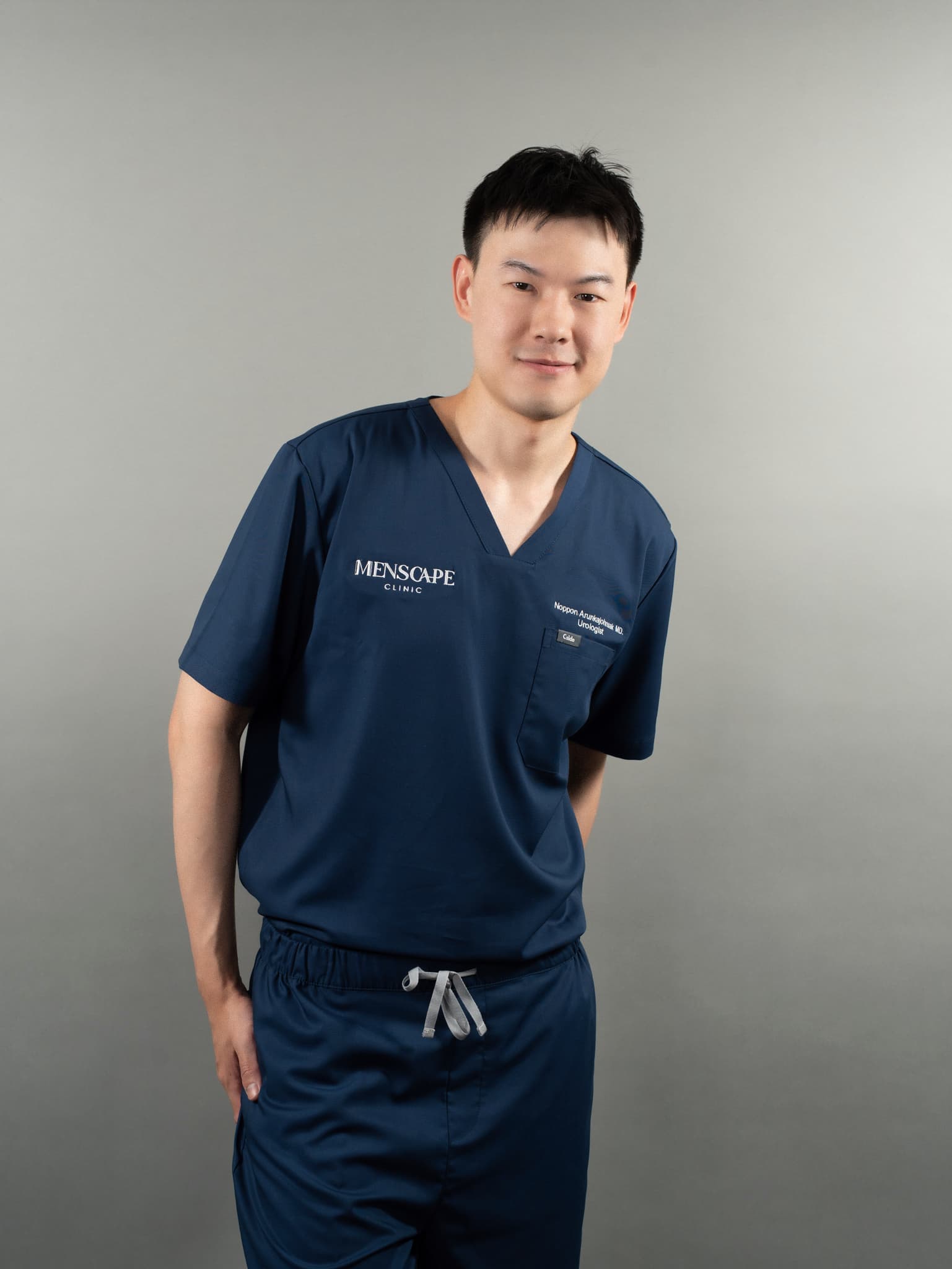
Menscape is a men's health clinic in Bangkok with a urology team experienced in advanced laser prostate surgery, including enucleation techniques, supported by modern laser systems. The focus is on assessing each man properly, laying out the full range of BPH options (medication, minimally invasive, and surgical), and recommending what genuinely fits your anatomy, symptoms, and goals, including an honest conversation about ejaculation if that matters to you. The aim is durable results and a recovery you understand in advance, with English-speaking care throughout.
Booking a ThuLEP consultation
If a weak stream, broken sleep from getting up to urinate, or repeated retention is wearing you down, and tablets have not fixed it, or you have been told your prostate is too large for some procedures, ThuLEP is worth discussing. It is a prescription surgical procedure: the only way to know whether it suits you is a consultation that reviews your symptoms, flow study, PSA, and prostate size, and weighs it against the alternatives.
Book a urology consultation with Menscape Bangkok to have your situation assessed and to get a clear, itemised quote for your care. You can also reach the team via WhatsApp or LINE to ask questions before you travel.
*This article is for general education and does not constitute medical advice. ThuLEP requires a medical consultation and is recommended only after individual assessment by a qualified urologist.*
Frequently Asked Questions
Is ThuLEP better than HoLEP?
Neither is clearly better; they are close cousins that remove the whole obstructing prostate the same way, just with different lasers. The thulium laser delivers a continuous beam, while the holmium laser used in HoLEP fires in pulses. A randomised trial using a thulium fibre laser (a closely related enucleation system) found it non-inferior to HoLEP on symptom scores, flow, quality of life, and complication rates. In practice the choice usually comes down to which laser system your surgeon is most experienced with. Both are reference techniques for enucleation, including for large prostates.
How much does ThuLEP cost in Bangkok?
As an indicative range, ThuLEP or the closely related HoLEP in Bangkok typically runs about THB 150,000-330,000, roughly USD 4,500-9,500, for an all-in package, depending on the hospital, surgeon, prostate size, and number of nights in hospital. That is often less than half the equivalent UK or US self-pay price. Always get a written, itemised quote at consultation, because some low headline prices exclude anaesthesia, pre-op tests, pathology, or hospital stay.
Will ThuLEP affect my sex life?
Erections are usually unaffected; most studies show no meaningful change in erectile function after ThuLEP. The common change is retrograde ejaculation, where semen flows backward into the bladder at orgasm so little or no fluid comes out. This happens in roughly three quarters of men after standard enucleation. It does not change the sensation of orgasm but does reduce natural fertility. If keeping ejaculation matters to you, ask about ejaculation-sparing ThuLEP, which in one study preserved ejaculation in about 94 percent of men at one year while still relieving symptoms.
How long is recovery after ThuLEP?
Most men stay one night, have the catheter removed within 24 to 48 hours, and go home the same day it comes out. Expect some burning, urgency, and on-and-off blood in the urine for the first few weeks. Most return to desk work and light activity around two weeks, and to full activity including exercise and sex by about six weeks. A small flare of blood around week two to three, as healing scabs lift, is common and usually settles with extra fluids.
Is ThuLEP suitable for a very large prostate?
Yes. ThuLEP is size-independent and is one of the better options for very large glands where TURP becomes slow and tissue-sparing procedures like UroLift or Rezum are not designed for lasting results. In a study of men with prostates over 80 mL (average around 107 mL), high-power ThuLEP cut symptom scores from about 27 to about 7 and roughly doubled urinary flow, with a low transfusion rate. For very large prostates the realistic alternatives are HoLEP or open/robotic prostatectomy, and enucleation generally wins on bleeding and recovery.
Does ThuLEP treat prostate cancer?
No. ThuLEP treats benign prostatic hyperplasia (non-cancerous enlargement). It is not a cancer operation. However, all tissue removed during ThuLEP is sent to the lab and examined, which occasionally turns up incidental cancer. If prostate cancer is suspected before surgery (for example from a raised PSA or an abnormal exam), that needs to be worked up first, and the plan may change.
Do I have to try medication before ThuLEP?
Usually, yes. ThuLEP is not a first-line step. It is generally offered after a trial of medication and lifestyle measures, or when drugs have not controlled the symptoms, caused side effects, or when the prostate is too large for tablets to help much. Some situations, such as repeated urinary retention, bladder stones, or kidney problems from the blockage, can move surgery up the list. Your urologist will advise based on your assessment.
How soon after ThuLEP can I fly home?
Plan to stay in Bangkok for at least one to two weeks after surgery so the catheter can be removed, you can be reviewed, and any early bleeding or irritation settles before a long flight. Long-haul flights too soon after pelvic surgery can raise the risk of clots and make any complication harder to manage far from your surgeon. Always get specific flight clearance from your surgeon rather than booking a tight return.
What are the warning signs I should not ignore after ThuLEP?
Seek urgent care if you cannot pass urine at all with a painfully full bladder, if you have heavy bleeding or large clots or urine the colour of thick red wine, if you develop fever or chills or severe burning, if you have severe lower abdominal pain, or if you get calf swelling, chest pain, or breathlessness. If you have travelled home, find out in advance who to contact and where your nearest emergency department is.
)
/)
/)
/)
/)
/)