/)
Losing a testicle is rarely just a physical event. Men who go through orchiectomy for cancer, who lose a testicle to a delayed torsion, or who were born without one often describe the same quiet things afterward: glancing down and feeling that something is missing, hesitating in the locker room, or feeling self-conscious the first time with a new partner. A testicular prosthesis is a small, well-established way to address that. It is a soft implant placed inside the scrotum to restore a balanced, natural look and feel.
Before anything else, an honest correction, because it shapes this entire article. Many men search for a "Boston Scientific testicular prosthesis." That product does not exist. Boston Scientific is a major manufacturer of penile implants for erectile dysfunction (the AMS 700 inflatable and the Tactra malleable), but it does not make a testicular implant. The brand names get crossed because both are men's-health urology devices. The device that actually holds FDA approval as a testicular prosthesis is the Torosa saline-filled implant from Coloplast, and some surgeons also use solid silicone models. We will use the correct devices throughout, while still answering what people searching the Boston Scientific term genuinely want to know.
This guide covers what the implant is and is not, who it suits and who it does not, transparent Bangkok pricing in THB and USD, the surgery step by step, a staged recovery timeline, the real risks, and how to choose a safe clinic. A testicular prosthesis requires a medical consultation and is recommended only after a urologist examines you in person.
What a Testicular Prosthesis Actually Is
A testicular prosthesis is an artificial testicle implanted in the scrotum to recreate the size, shape, and weight of a natural one. Two main types are used:
Saline-filled (Torosa, Coloplast). This is the only device cleared by the FDA specifically as a testicular prosthesis. It has a silicone elastomer shell filled with sterile saline (salt water), which gives a softer, more lifelike give. It comes in a range of preset sizes.
Solid silicone. A one-piece silicone elastomer implant. Widely used internationally, including across Asia and Europe. It tends to feel slightly firmer than saline but is durable and time-tested.
The single most important thing to understand is what the implant does not do. As the Cleveland Clinic and the Urology Care Foundation (the patient education arm of the American Urological Association) both make clear, a testicular prosthesis is purely cosmetic. It contains no living tissue. It produces no testosterone, makes no sperm, and plays no role in erections or orgasm. If you still have one healthy testicle, that testicle continues to handle hormones and fertility on its own, and the implant changes none of that. If both testicles are gone, you will need separate testosterone therapy regardless of whether you choose an implant, because the prosthesis cannot replace lost hormone function.
Put simply: this is about how the scrotum looks and feels, not about how the body works.
Why men choose it
Common reasons a urologist will offer or place a prosthesis include:
Orchiectomy for testicular cancer
A testicle lost to delayed testicular torsion (a twisted spermatic cord that cut off blood supply)
Trauma or injury requiring removal
Severe infection (for example, epididymo-orchitis or Fournier-type infection) that led to removal
Congenital absence (anorchism) or an undescended testicle that could not be saved
Significant atrophy leaving a noticeably uneven scrotum
A desire for symmetry and restored body image
Who Is a Good Candidate, and Who Is Not
Most men who have lost a testicle, or were born without one, can be considered for an implant. Good candidates generally:
Have lost one or both testicles, or have congenital absence or marked atrophy
Have enough healthy scrotal skin to comfortably hold an implant
Are in stable general health and can safely have day surgery
Understand the goal is cosmetic and symmetric, not functional
Have realistic expectations about feel and position
Who it is not for, and contraindications
A prosthesis is delayed or avoided in several situations. Be wary of any clinic that does not screen for these:
Active infection in the scrotum or groin. An implant placed into infected tissue is very likely to fail and have to be removed. Infection must be fully treated first.
Insufficient or scarred scrotal skin. If there is too little healthy skin, forcing in an implant raises the risk of the device pushing through the skin (extrusion). A staged approach or tissue expansion may be needed first.
Documented silicone sensitivity. Both saline and solid implants use a silicone shell, so a true silicone allergy is a reason to avoid them, per the device's own safety information.
Uncontrolled medical illness (for example, poorly controlled diabetes or a bleeding disorder) that makes surgery and healing risky until optimized.
Active cancer treatment timing. After orchiectomy for cancer, your oncology and urology team will advise on the safest window. Many men have the implant placed at the same time as removal; others wait.
There is no fixed age cap. The decision rests on tissue health, overall fitness, and your own preference after counseling.
Bangkok Pricing: THB and USD, With Savings vs the West
Pricing depends on the implant type (saline Torosa typically costs more than solid silicone), whether you need one implant or two, the hospital tier, and the anesthesia plan. The figures below are indicative Bangkok ranges drawn from current clinic and medical-tourism listings. Always confirm an itemized quote at your consultation, because the device, your anatomy, and any combined procedure change the number.
Item | Bangkok (THB) | Bangkok (USD approx.) | Typical US / UK price | Indicative saving in Bangkok |
Single implant, solid silicone, all-in | THB 60,000 - 110,000 | USD 1,700 - 3,100 | US avg ~USD 5,000; UK private ~GBP 4,000-6,000 | 40 - 65% |
Single implant, saline Torosa, all-in | THB 90,000 - 150,000 | USD 2,600 - 4,300 | US ~USD 5,000-7,000 | 35 - 55% |
Bilateral (two implants) | THB 120,000 - 230,000 | USD 3,400 - 6,600 | US ~USD 8,000-10,000 | up to ~50% |
Consultation + scrotal exam | THB 1,000 - 3,000 | USD 30 - 85 | Often USD 150-300 | substantial |
These figures are indicative; confirm at consult. A typical Bangkok package usually folds in the implant, surgeon and facility fees, anesthesia, and early follow-up. Independent medical-tourism data put Thailand savings near 56 percent against US rates for this procedure, which lines up with the ranges above.
What drives the cost
Implant type and brand. The FDA-cleared saline Torosa generally sits at the top of the range; solid silicone is more economical.
One implant or two. Bilateral surgery roughly doubles the device cost and adds operating time.
Custom or anatomical shaping. Anatomically contoured or custom-matched implants can add 20 to 30 percent.
Hospital tier and anesthesia. A JCI-accredited international hospital with a board-certified anesthetist costs more than a day clinic under local or spinal anesthesia.
Combined procedures. Some men time the implant alongside scrotal revision or other urology work, which changes the total.
For other men's urology procedures and how Bangkok pricing compares, see our guides on penile implant surgery in Bangkok and the urology consultation.
The Surgery, Step by Step
Testicular prosthesis placement is a short, well-standardized day procedure. It usually runs 30 to 60 minutes for one side.
Consultation and sizing. The urologist examines the scrotum and groin, reviews your history and any prior surgery, and discusses sizing. Many surgeons match the implant to your existing testicle (if you have one) or to a size that looks natural for your build. Expectations about feel and position are talked through here, because counseling is the part most linked to later satisfaction.
Anesthesia. Surgery is done under general anesthesia, spinal anesthesia, or sometimes local anesthesia with sedation, depending on the case and your preference.
The incision. A small incision is made, usually in the groin crease (inguinal) or high on the scrotum. The groin approach keeps the scar away from the scrotal skin and is often preferred to reduce extrusion risk.
Creating the space. The surgeon develops a pocket within the scrotal sac to seat the implant at a natural height.
Placing and fixing the implant. The prosthesis is inserted, positioned, and in many techniques anchored with a stitch so it does not ride up or flip.
Closing. The incision is closed in layers with dissolvable sutures, a dressing is applied, and supportive underwear helps hold everything in place.
Most men go home the same day with oral pain medication and clear aftercare instructions.
Recovery, Staged Week by Week
Recovery is generally straightforward, but rushing it raises the risk of swelling, fluid collection, and implant migration. A realistic staged timeline:
Days 1 to 3. Expect soreness, bruising, and swelling. Manage with prescribed pain relief, intermittent ice over the dressing, and a supportive jockstrap or snug briefs worn day and night. Gentle walking is fine and encouraged; lying flat all day is not.
Days 4 to 7. Discomfort eases. Many men return to desk-based work toward the end of week one. Keep the incision clean and dry, and keep wearing scrotal support.
Weeks 2 to 3. Swelling settles noticeably and the implant begins to feel more natural and settle into position. Avoid heavy lifting, cycling, and strenuous gym work.
Weeks 4 to 6. Most men resume sexual activity and exercise once cleared at follow-up. The implant should feel comfortable and move fairly naturally.
Around 3 months. Tissues fully soften and the final cosmetic result is apparent.
Follow your surgeon's specific timeline over any generic schedule, since incision type and whether you had one or two implants change the pace.
Quantified Results: What the Evidence Shows
The honest picture from published studies is that most men are happy they did it, with a consistent minority of texture and position complaints. These are real numbers from peer-reviewed urology research, not marketing claims.
In a study of satisfaction after radical orchiectomy (Urology, 2018), 82.5 percent of men rated the prosthesis as good or excellent, and 87.5 percent said they would have it implanted again. The same study found 44 percent felt the implant was too firm and 20 percent felt the position was inadequate.
In a series of testicular cancer patients, over 83 percent reported high or very high satisfaction and 86.1 percent would choose it again, while the leading complaints were firmness (52.4 percent felt it too firm), size (23.8 percent too small), and a position sitting too high (30.3 percent). The reoperation rate was about 4.7 percent, comparable to orchiectomy alone, with no ruptures or spontaneous extrusions in that cohort.
A 2024 literature review (Sexual Medicine Reviews) pooling 20 studies concluded that overall satisfaction with testicular prostheses is high, and that the American Urological Association recommends discussing the implant option before orchiectomy for both benign and cancer-related removals.
Two practical takeaways. First, satisfaction is strongly tied to good preoperative counseling and careful sizing and positioning, which is why an unhurried consultation matters. Second, a prosthesis is not promised to last forever. The device's own safety information states that testicular implants should not be considered lifetime implants and may need replacement surgery over time. Many last for years or decades, but that is not a guarantee.
Risks and Side Effects
Serious complications are uncommon, but no surgery is risk-free. Discuss all of these with your surgeon.
Common and usually minor:
Swelling, bruising, and soreness in the first week or two
A scar at the incision site
A sense that the implant feels firmer than a natural testicle
The implant sitting slightly higher than expected
Less common but important:
Infection, which sometimes requires removing the implant
Hematoma (a blood collection) or scrotal fluid buildup (hydrocele-like seroma)
Implant migration or rotation, where it rides up or flips
Capsular contracture, where scar tissue tightens around the implant and firms or distorts it
Extrusion, where the implant erodes through thin or compromised skin
Chronic discomfort, which occasionally leads to removal
Have a question about your treatment?
Message our Bangkok clinic on WhatsApp and a doctor replies within minutes during clinic hours.
When to seek urgent care
Contact your surgeon or seek prompt medical care if, after surgery, you notice:
Spreading redness, warmth, or pus, or fever and chills (possible infection)
Rapidly increasing swelling, severe pain, or a tense, growing collection (possible hematoma)
The implant pushing against or breaking through the skin
Pain that worsens rather than steadily improves after the first few days
Acting early on these signs is what protects the implant and your recovery.
Choosing a Safe Clinic in Bangkok, and Red Flags
Bangkok has genuine strengths for this procedure: experienced reconstructive urologists, internationally accredited hospitals, English-speaking men's-health clinics, and discreet, private care, often at a fraction of Western prices. But the quality gap between clinics is real, so vet carefully.
Green flags to look for:
A board-certified urologist performing the surgery, ideally with a track record in scrotal and reconstructive work
Clear information on which implant is used (saline Torosa versus solid silicone) and the brand
An itemized written quote covering implant, surgeon, facility, anesthesia, and follow-up
A proper in-person scrotal and groin exam before any price or date is fixed
Honest counseling about firmness, position, and the fact that the implant is cosmetic only
Accreditation (for example JCI) and a clean, sterile facility
Red flags to walk away from:
A clinic advertising a "Boston Scientific testicular implant," which signals they do not know the device landscape
Pressure to book or pay before an examination
No clear answer on implant brand, type, or what the price includes
Dismissing infection screening or skin-quality assessment
Prices that look too good to be true, often a sign of corners cut on the device or anesthesia
For how we approach safe, transparent care, see our guide to the best men's health clinic in Bangkok.
Comparison: Saline Torosa vs Solid Silicone
Feature | Saline-filled (Torosa, Coloplast) | Solid silicone |
FDA status | Only device FDA-approved as a testicular prosthesis | Long international use; not the FDA-cleared testicular device |
Feel | Softer, closer to natural give | Slightly firmer |
Sizes | Range of preset sizes | Range of preset sizes |
Typical Bangkok price (single) | THB 90,000 - 150,000 | THB 60,000 - 110,000 |
Function | Cosmetic only (no hormones or sperm) | Cosmetic only (no hormones or sperm) |
Lifespan | Durable but not lifetime; may need replacement | Durable but not lifetime; may need replacement |
Main reported complaints | Firmness, position too high | Firmness, position |
Both are reasonable choices. The right one depends on your priorities (feel versus budget), your anatomy, and what your surgeon recommends after examining you. If you want a deeper look at the specific device, see our guide to the Coloplast Torosa testicular prosthesis.
Booking a Consultation at Menscape
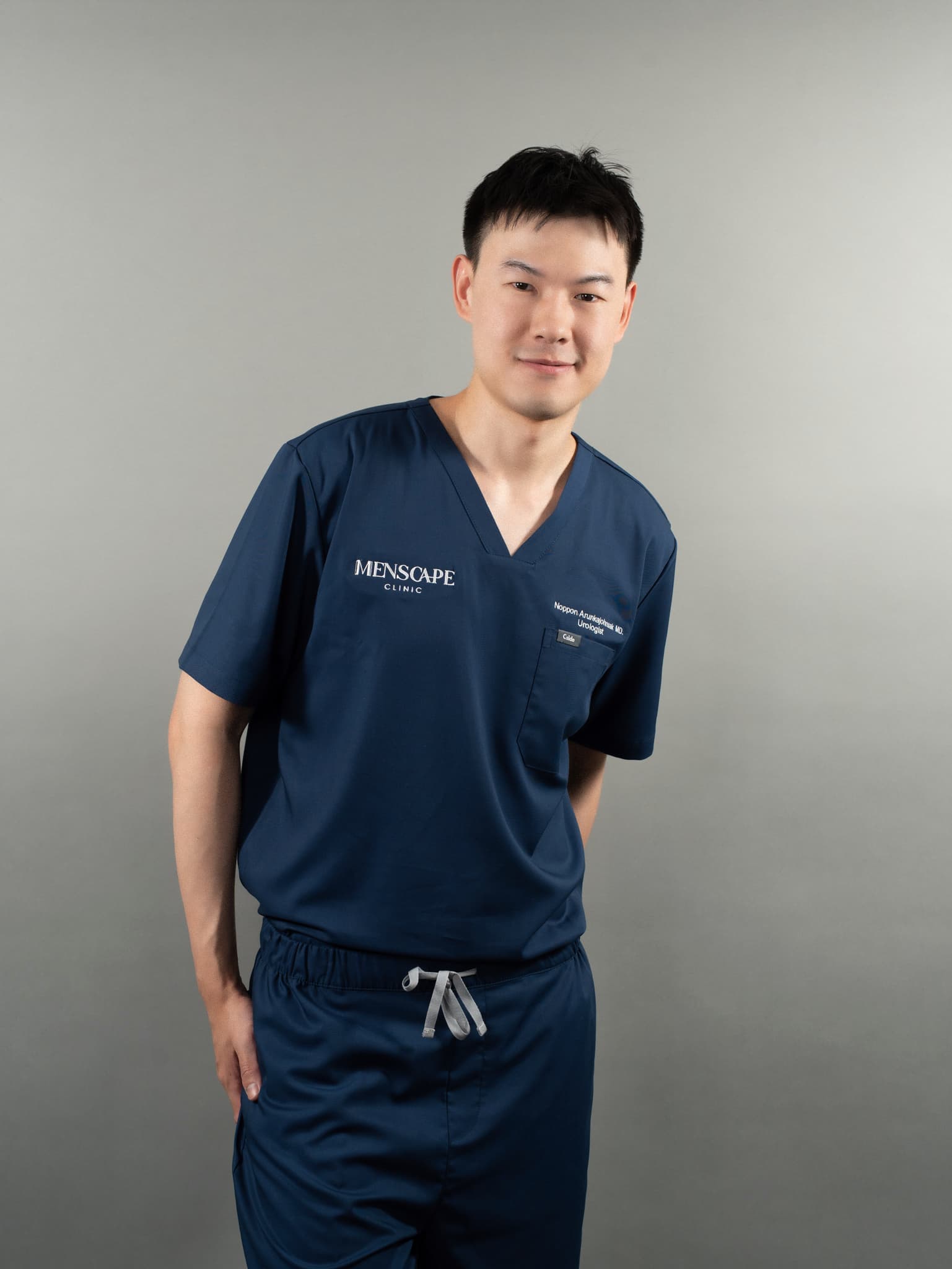
If you are weighing a testicular prosthesis, the most useful next step is a private consultation where a urologist can examine you, confirm whether you are a candidate, recommend the right implant type, and give you an itemized quote in THB. Menscape Bangkok offers discreet, men's-health-focused care with clear pricing and no pressure. A testicular prosthesis requires a medical consultation and is recommended only after individual assessment; it cannot be prescribed online or sight unseen.
To talk it through confidentially, book a consultation with Menscape Bangkok. We will explain your options honestly, including the realistic results and the limits of what an implant can and cannot do.
Frequently Asked Questions
Is there a Boston Scientific testicular prosthesis?
No. Boston Scientific makes penile implants for erectile dysfunction (the AMS 700 inflatable and the Tactra malleable), not testicular implants. The names get confused because both are men's-health urology devices. The only device FDA-approved as a testicular prosthesis is the Torosa saline-filled implant from Coloplast, and some surgeons also use solid silicone models.
Does a testicular implant produce testosterone or restore fertility?
No. A testicular prosthesis is purely cosmetic. It contains no living tissue and makes no testosterone and no sperm. If you have one healthy testicle, it continues to handle hormones and fertility on its own. If both testicles are gone, you will need separate testosterone therapy, because the implant cannot replace hormone function.
How much does a testicular implant cost in Bangkok?
As an indicative range, a single implant is typically quoted around THB 60,000 to 150,000 (roughly USD 1,700 to 4,300) all in, with solid silicone at the lower end and the saline Torosa higher. Two implants cost more. That usually undercuts the US average near USD 5,000. Confirm an itemized quote at your consultation, since the device, your anatomy, and any combined procedure change the price.
Will it look and feel natural?
For most men, yes, especially once swelling settles around three months. In published studies, more than 80 percent rate the result good or excellent. The most common complaints are that the implant can feel a little firmer than a natural testicle and may sit slightly higher, which is why careful sizing and positioning matter.
How long is recovery?
Most men return to desk work within about a week, resume exercise and sexual activity around four to six weeks once cleared, and see the final cosmetic result by roughly three months. Wearing supportive underwear and avoiding heavy lifting early on protects the result.
How long does the implant last?
Many last years or even decades, but the manufacturer states a testicular implant should not be considered a lifetime device and may need replacement surgery over time. There is no guaranteed lifespan.
Can I have the implant placed at the same time as testicle removal?
Often, yes. Many men have a prosthesis placed during the same operation as orchiectomy, and the American Urological Association recommends discussing the option before removal. Others choose to wait. Your urologist and, for cancer, your oncology team will advise on the safest timing.
What are the main risks?
Common minor effects are swelling, bruising, soreness, and a firmer-than-natural feel. Less common but important risks include infection (which can require removing the implant), hematoma or fluid buildup, implant migration or rotation, capsular contracture, and extrusion through thin skin. Seek urgent care for spreading redness, fever, severe or worsening pain, or the implant pushing against the skin.
Who should not get a testicular prosthesis?
Men with an active scrotal or groin infection, too little or scarred scrotal skin, a documented silicone allergy, or uncontrolled medical illness should delay or avoid the procedure until the issue is addressed. A urologist screens for these at an in-person exam.
)
/)
/)
/)
/)
/)