/)
Losing a testicle, whether to cancer surgery, a severe twist (torsion), trauma, or because one never developed, changes more than anatomy. Many men describe feeling unbalanced in their own body, self-conscious in the locker room, or hesitant during intimacy. A testicular prosthesis is a small, soft implant placed inside the scrotum to restore a natural-looking, natural-feeling shape and to bring the two sides back into symmetry. It does not produce sperm or testosterone, and it does not change sexual function. What it does, for the right man, is give back a sense of wholeness.
Bangkok has become a practical place to have this done. The city has a deep bench of urologists, several JCI-accredited hospitals, and pricing that sits well below US private rates without the long waits some public systems impose for what is classed as a cosmetic procedure. This guide lays out what the implant is, who it suits and who it does not, transparent Bangkok pricing in both baht and dollars, what recovery actually looks like week by week, the risks worth knowing, and how to tell a safe clinic from one to walk away from.
A quick note before the numbers: a testicular implant is a surgical device, and placing one requires a consultation and a urologist's assessment. The figures below are indicative and meant to help you plan. Your final quote, and whether surgery is appropriate at all, can only come from an in-person evaluation.
What a testicular prosthesis is
A testicular prosthesis is an implant shaped like a testicle that sits in the scrotum in the space where a natural testicle would be. Modern implants are made from medical-grade silicone, either as a soft solid elastomer or as a shell filled with silicone gel or saline (sterile salt water). According to the Cleveland Clinic, the standard prosthetic testicle today is a silicone rubber device, and implants can be placed in patients who were born without a testicle or who lost one to injury or a medical condition.
In the United States, the only implant cleared by the FDA for this use is the saline-filled Torosa prosthesis made by Coloplast, which comes in four anatomically shaped sizes (from extra-small to large) to match adult, adolescent, and pediatric patients. Outside the US, surgeons may also use CE-marked silicone implants from other manufacturers. The practical point for you as a patient is to confirm that whatever device your surgeon proposes is a recognized, medical-grade, regulator-cleared implant, not a generic filler.
One thing to be clear about from the start: a testicular prosthesis is purely cosmetic and structural. It restores the look and the weight, and it fills out the scrotum so the area feels balanced. It has no hormonal function. If you have lost both testicles, or your remaining testicle does not produce enough testosterone, the implant will not fix that, and you may need separate hormone replacement, which is a different conversation with your doctor.
Saline vs silicone, and shaped vs round
There are two broad design choices, and your surgeon will help you weigh them against your anatomy.
Saline-filled implants (such as Torosa) have a firm silicone shell holding sterile salt water. They have a long safety record and, if the shell were ever to leak, the saline is simply absorbed by the body.
Solid silicone or silicone-gel implants tend to feel slightly softer and closer to a natural testicle in consistency, which some men prefer.
Anatomically shaped implants are contoured like a real testicle rather than a simple sphere, which can give a more natural result, especially in slimmer men or where the scrotal skin is thin.
No single option is best for everyone. The right choice depends on your remaining anatomy, your skin, the size needed to match the other side, and what matters most to you in the result.
Testicular implant pricing in Bangkok (THB and USD)
Cost is usually the first question, so here it is up front. Bangkok pricing for a single (unilateral) implant, the most common scenario, spans a wide band depending on where you go. Budget specialist clinics advertise from around THB 60,000-90,000, while full-service private hospitals, with a named medical-grade device, a board-certified urologist, and structured aftercare, typically run THB 120,000-200,000. The figures below are indicative; confirm your exact quote at consultation.
Item | Bangkok (THB) | Bangkok (USD approx.) | US self-pay (USD) | UK private (GBP) |
Single implant, budget specialist clinic | 60,000 - 90,000 | 1,900 - 2,800 | 5,000 - 12,000 | 3,000 - 6,000 |
Single implant, full-service hospital package | 120,000 - 200,000 | 3,750 - 6,250 | 5,000 - 14,000 | 3,000 - 6,000 |
Bilateral (both sides), full-service | 200,000 - 320,000 | 6,250 - 10,000 | 9,000 - 22,000 | 5,500 - 11,000 |
Typical saving vs US self-pay | roughly 40-65% less | (smaller saving) |
USD conversions use an approximate rate of THB 32 per USD, which moves with the exchange rate, so treat the dollar figures as a guide rather than a fixed price. US and UK ranges are private/self-pay estimates drawn from published cost data and clinic listings. Note that in the US, insurers often cover an implant placed at the same time as cancer surgery (orchiectomy) but rarely cover it as a standalone cosmetic procedure. Versus private UK clinics the saving is smaller and sometimes marginal: a London andrology clinic, for example, lists testicle replacement from around GBP 2,700, which sits at or below a Bangkok full-service package, so the strongest cost case for travelling is against US pricing.
A Bangkok full-service price usually includes the surgeon's fee, the implant device, anesthesia, the operating theatre and day-case facility, routine post-operative medication, and standard follow-up visits. Items that may sit outside the headline figure include pre-operative blood tests and any ultrasound, a premium or imported device, treatment of both sides, and a hotel stay if you are travelling. A budget clinic quote may exclude several of these, which is part of why it is lower, so always ask for a written, itemized quotation and check what a low price does and does not cover.
For context on the gap: a US analysis published in PLOS One in 2024 found median perioperative costs in the US of around USD 7,823 when an implant was placed at the time of orchiectomy, and roughly USD 13,560 in total when the implant was staged as a separate later procedure. Bangkok's pricing for the implant step alone sits comfortably below both, which is what makes it attractive to international patients, and to expats already living in Thailand.
What drives the cost
The spread within these ranges comes down to a handful of factors:
Clinic type. A focused budget day-surgery clinic prices well below a full-service international hospital, though the two differ in facility, device, and aftercare, so compare like for like rather than on headline price alone.
Device type. A premium anatomically shaped or imported implant adds meaningfully to the bill compared with a standard model.
One side or both. A bilateral procedure roughly scales with the second device and a little extra theatre time.
First-time vs revision. Replacing or repositioning an existing implant, or operating on heavily scarred tissue, is more involved than a straightforward first implant.
Surgeon experience. A urologist who does reconstructive and prosthetic work regularly may price above a generalist, which is often money well spent for this kind of procedure.
Anesthesia choice. General anesthesia typically costs a little more than spinal or local-with-sedation.
Who is a good candidate, and who is not
The clearest candidates are men who are missing a testicle and are bothered by it. That includes men after an orchiectomy for testicular cancer, men who lost a testicle to trauma or to torsion that cut off the blood supply, and men born with an absent or severely underdeveloped testicle (congenital anorchia or an atrophic testis). Symmetry and a natural contour are the goals.
You are likely a reasonable candidate if you:
Are missing one or both testicles, or have a markedly underdeveloped one, and want to restore appearance and balance.
Are in good general health and fit for a short anesthetic.
Have realistic expectations: the implant looks and feels close to natural but is not identical to a biological testicle.
Have healthy, infection-free scrotal skin with enough room for the device.
A prosthesis is usually not the right move, or needs to wait, if you:
Have an active infection in the scrotum, groin, or skin nearby. Implanting near infection invites the device to become infected and need removal.
Are still in active cancer treatment where the timing needs to be coordinated with your oncologist. Implants can often be placed at the same time as orchiectomy, but that decision belongs to your surgical and cancer team.
Have very tight, scarred, or radiation-damaged scrotal skin with too little space, which raises the risk of the implant eroding through the skin (extrusion).
Smoke heavily and are unwilling to pause, since smoking impairs wound healing.
Have poorly controlled diabetes or another condition that significantly raises infection and healing risk, until it is better managed.
Are primarily seeking a change in sexual function or hormone levels. An implant does neither.
This is exactly why the procedure requires a consultation rather than an online booking. A urologist needs to examine the scrotal skin, check for infection, review your history, and confirm that an implant is appropriate and safe for you specifically.
The procedure, step by step
Testicular implant surgery is short and is usually done as a day case. Here is the typical sequence.
Consultation and sizing. Your surgeon examines you, discusses device type and size to match your other side (or your frame, if both sides are being done), and confirms you are fit for surgery. Pre-operative blood tests are arranged.
Anesthesia. Most implants are placed under general anesthesia or a spinal block, sometimes local anesthetic with sedation for a single implant. You will not feel the procedure.
Incision. As the Cleveland Clinic describes, the surgeon makes a small cut either in the lower groin or at the top of the scrotum. A groin (inguinal) incision is common because it keeps the suture line away from the most mobile part of the scrotum.
Creating the pocket and placing the implant. The surgeon gently develops a space within the scrotum, positions the correctly sized implant, and often anchors it with a stitch so it settles in a natural low position rather than riding up.
Closing up. The incision is closed with sutures, usually dissolvable, and a supportive dressing is applied. The whole operation generally takes under an hour.
Recovery and discharge. After a short spell in recovery, most men go home the same day with pain medication, antibiotics, and clear aftercare instructions, including wearing supportive underwear.
Recovery, week by week
Recovery is generally straightforward, but the timeline matters because rushing back to activity is one of the avoidable ways things go wrong.
First 24-48 hours. Expect soreness, swelling, and bruising. The Cleveland Clinic notes pain and tenderness are most noticeable in this window. Ice (over a cloth, not on bare skin), supportive underwear, and the prescribed pain relief help. Rest with the area supported.
Days 3-7. Pain settles into mild discomfort. Many men return to desk work or light duties around this point if they feel up to it. Keep the wound clean and dry and follow your clinic's bathing advice.
Weeks 1-2. Swelling continues to come down. Most clinics advise waiting at least a week or two before masturbation or sexual intercourse. Avoid soaking the wound in pools or baths until it has fully sealed.
Weeks 3-4. Activity expands. Strenuous exercise, heavy lifting, and contact sport are usually held off for about a month while the internal pocket heals and the implant settles into position.
Weeks 4-6. Most men are back to full activity, including sex and the gym, by this stage. The implant softens slightly into its final position over the following weeks.
Months 2-3. Final settling. Any minor firmness or high position often eases as tissues relax around the device.
These windows are typical, not guarantees. Heavier or bilateral procedures, or revision surgery, can take a little longer, and your surgeon's specific guidance always overrides a general timeline.
Results: what the evidence shows
Most men who choose a testicular prosthesis are glad they did, and the published data backs that up while being honest about the limits.
A questionnaire study of testicular cancer patients in BMC Urology found overall satisfaction was high in more than 80% of implant recipients, and 86% said they would choose to have the prosthesis again. That is a strong endorsement for what is, at its core, a quality-of-life procedure. The same study was candid about the common gripes: some men felt the implant was a little too firm (about half), sat slightly too high (around 30%), or was a touch too small (about a quarter). A broader review in the Asian Journal of Andrology reached the same conclusion, reporting high patient satisfaction and low complication rates, with the most common postoperative concerns being minor and centered on implant position, size, and weight.
The practical takeaways:
Most men are satisfied and would do it again, which is the headline most patients care about.
Appearance and balance improve, restoring symmetry and a natural contour, which is exactly the goal.
It will not be identical to a biological testicle. Implants tend to feel a little firmer and may sit slightly higher. Discussing size and position carefully before surgery, and choosing an experienced surgeon who anchors the implant well, reduces these complaints.
It does nothing for function. No change to erections, sensation, ejaculation, fertility, or testosterone.
One more useful finding for men facing cancer surgery: research suggests placing an implant at the same time as orchiectomy tends to have a lower removal rate than placing it later as a separate operation. The PLOS One cost analysis reported an explantation (removal) rate of about 4.7% for implants placed concurrently versus 14.3% for staged placement, and lower reoperation rates too (around 3% vs 8%). If you are about to have a testicle removed, it is worth asking your surgeon whether an implant at the same sitting makes sense for you.
Have a question about your treatment?
Message our Bangkok clinic on WhatsApp and a doctor replies within minutes during clinic hours.
Risks and side effects
Testicular implant surgery is generally safe, and serious complications are uncommon, but no surgery is risk-free. Knowing what is normal and what is not helps you recover with less worry and act fast if something is off.
Common and usually self-limiting:
Pain, tenderness, swelling, and bruising in the first days to weeks.
A sensation that the implant feels firmer than expected or sits higher than your natural side. This often eases as tissues settle, and can sometimes be improved with revision if it persists and bothers you.
A small, well-healed scar at the incision.
Less common but important:
Infection around the implant. Because the device is foreign material, an infection often means the implant has to be removed, treated, and replaced later. This is why surgeons are strict about not operating near active infection and why post-operative antibiotics and wound care matter.
Hematoma, a collection of blood in the scrotum, which can cause swelling and pain and occasionally needs draining.
Implant malposition or migration, where it shifts out of the intended position.
Extrusion or erosion, where the implant works its way toward or through thin or scarred skin.
Shell rupture or leak. Saline implants are absorbed harmlessly if the shell fails; any failed device may need replacing.
Chronic discomfort in a minority of men, occasionally significant enough to consider removal.
Seek urgent medical care if you notice any of these red-flag signs after surgery:
Spreading redness, increasing warmth, or worsening pain in the scrotum, especially with fever or chills, which can signal infection.
Rapidly increasing swelling or a tense, hard scrotum, which may indicate a hematoma.
Pus, foul-smelling discharge, or the wound opening up.
The implant becoming visible at the skin or starting to push through.
Pain that is getting worse rather than better, or that is not controlled by your prescribed medication.
If you have travelled to Bangkok for surgery, confirm before you fly home how the clinic handles complications remotely, and do not schedule your flight too tightly against the surgery date.
How to choose a safe clinic in Bangkok
The quality of your result and your safety hinge far more on the surgeon and facility than on the brochure. Use these checks.
Look for:
A board-certified urologist, ideally one who performs reconstructive or prosthetic genital surgery regularly. Ask directly how many testicular implants they place and ask to understand their approach to sizing and fixation.
An accredited facility with proper operating-theatre standards, sterile technique, and anesthesia cover. JCI accreditation is a reasonable marker, though excellent specialist clinics exist outside that scheme too.
A recognized, medical-grade implant named explicitly, such as a Coloplast Torosa or another CE-marked silicone device, not an unnamed generic.
A written, itemized quotation so there are no surprises, with a clear statement of what happens (and what it costs) if you need a revision or readmission.
A real aftercare plan: wound-care instructions, pain control, scheduled follow-up, and a way to reach the team if you have a problem, which matters even more for international patients.
An honest discussion of risks. A surgeon who walks you through infection, malposition, and the firmness-and-position trade-offs is taking your outcome seriously.
Walk away from clinics that:
Quote a price far below everyone else, which often signals a non-medical-grade device or cut corners on facility and anesthesia.
Cannot or will not name the implant brand and type.
Have no urology specialist actually performing the surgery.
Gloss over risks or promise a result indistinguishable from a natural testicle.
Offer no structured follow-up or no clear plan for managing complications.
Pressure you to book on the spot before a proper examination.
Bangkok vs the US and UK: how the options compare
Factor | Bangkok | US (self-pay) | UK (private) |
Typical price, single implant | THB 120,000-200,000 full-service (from THB 60,000 at budget clinics); about USD 3,750-6,250 | USD 5,000-14,000 | GBP 3,000-6,000 |
Wait for cosmetic (non-cancer) implant | Usually short, often weeks | Variable | Often long in public system; private is faster |
Insurance for standalone cosmetic case | Self-pay | Rarely covered | Rarely covered privately |
Device | Coloplast Torosa or CE-marked silicone | FDA-cleared Torosa | CE-marked devices |
Hospital accreditation available | Yes (several JCI hospitals) | Yes | Yes |
Combined with travel | Common, recovery before flying home | Local | Local |
For men already living in Thailand, the appeal is simply cost and access without travelling. For international patients, the clearest saving is against US self-pay pricing on a procedure insurance often will not touch; versus private UK clinics the gap is narrower, so weigh travel and recovery time against a more modest difference.
Talk to a Menscape urologist
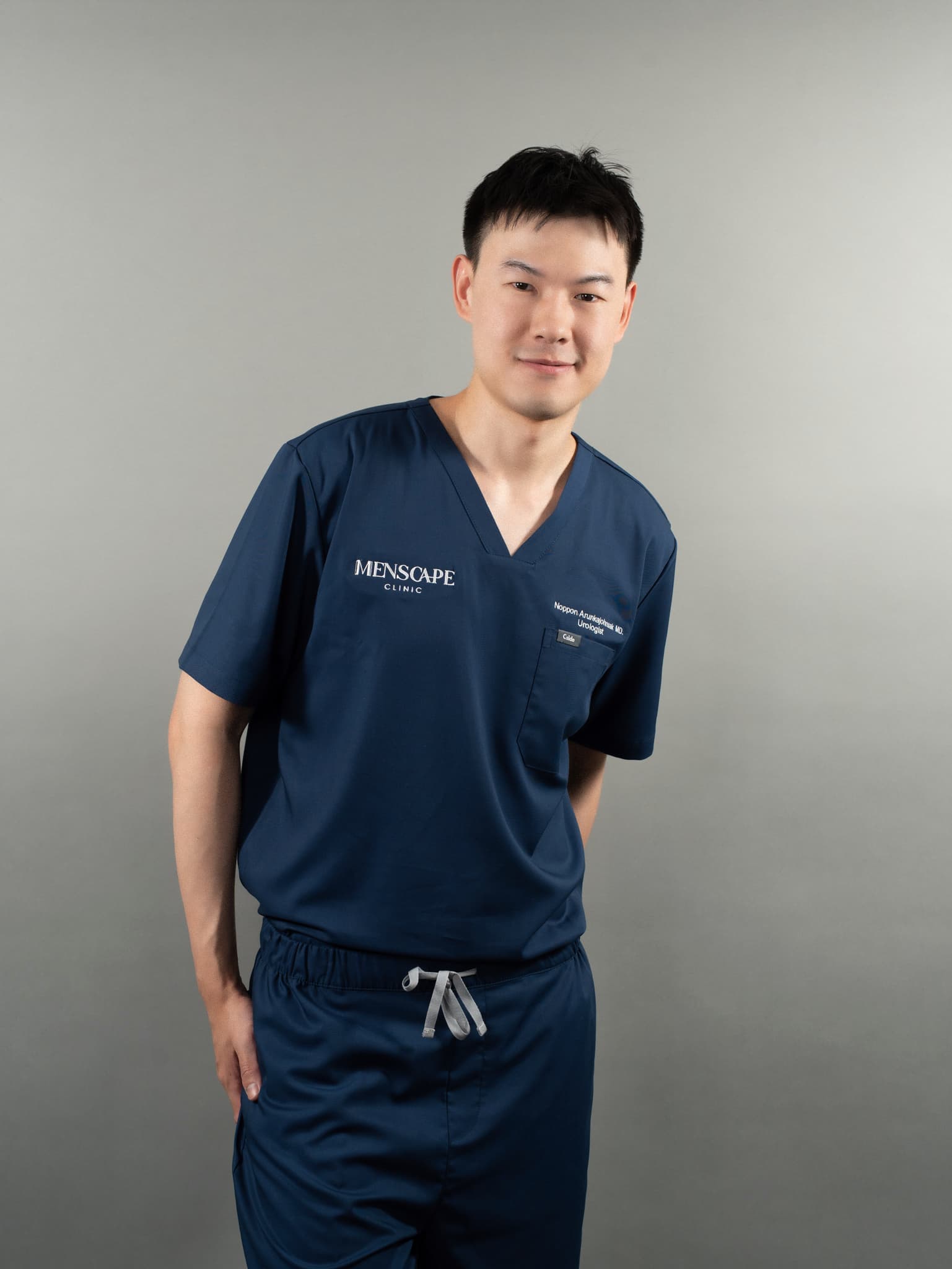
At Menscape in Bangkok, testicular prosthesis surgery is handled by urologists with experience in male genital and reconstructive procedures, in a discreet, men-focused setting. We use recognized, medical-grade implants, talk through device type and sizing so the result matches your anatomy, give you transparent written pricing, and provide structured follow-up and aftercare. Whether you are recovering from cancer surgery, an injury, torsion, or a testicle that never developed, the first step is a private consultation to confirm whether an implant is right for you and to plan it properly.
Surgery is only ever recommended after that in-person assessment. To explore your options, book a confidential consultation with our men's surgery team.
Frequently Asked Questions
Does a testicular implant affect testosterone, fertility, or erections?
No. A testicular prosthesis is cosmetic and structural only. It restores the look, weight, and symmetry of the scrotum but produces no hormones and no sperm, and it does not change erections, sensation, or ejaculation. If you have lost both testicles or your remaining testicle does not make enough testosterone, that is managed separately, usually with hormone replacement under your doctor's guidance.
How much does testicular prosthesis surgery cost in Bangkok?
For a single implant at a full-service private hospital, expect roughly THB 120,000-200,000 (about USD 3,750-6,250), with budget specialist clinics starting nearer THB 60,000-90,000. Bilateral surgery costs more. That is commonly 40-65% below US self-pay prices, with a smaller saving versus private UK clinics. These figures are indicative and the USD values move with the exchange rate; get a written, itemized quote at consultation, since pre-operative tests, a premium device, or treating both sides can sit outside the headline price.
Will the implant look and feel natural? Can anyone tell?
For most men it looks natural and restores symmetry, and it is not noticeable to others under normal circumstances. In published studies, over 80% of recipients were satisfied and 86% would choose it again. Being honest, an implant usually feels slightly firmer than a biological testicle and can sit a little higher, which is why careful sizing and an experienced surgeon who anchors it in a low, natural position make a real difference.
When can I have sex and go back to the gym?
Most clinics advise waiting at least one to two weeks before any sexual activity and about four weeks before strenuous exercise, heavy lifting, or contact sport. The majority of men are back to full activity, including sex and the gym, by around four to six weeks. Heavier, bilateral, or revision procedures can take a little longer. Follow your surgeon's specific instructions over any general timeline.
Can I get a testicular implant at the same time as cancer surgery?
Often, yes. An implant can frequently be placed at the same operation as the orchiectomy, and research suggests this concurrent approach has a lower removal rate (about 4.7% versus 14.3% for staged placement) and lower reoperation rates than adding the implant later. The timing depends on your surgical and oncology team, so raise it before your cancer surgery if you are interested.
What can go wrong, and when should I worry?
Common issues are short-term pain, swelling, and bruising, plus occasional firmness or a slightly high position. Less common problems include infection, hematoma, the implant shifting or eroding through thin skin, and shell rupture. Seek urgent care for spreading redness or warmth, fever or chills, rapidly increasing or tense swelling, pus or a foul discharge, the wound opening, or the implant becoming visible at the skin. Infection around an implant often means it has to be removed.
How long does a testicular prosthesis last?
Modern medical-grade implants are designed to last many years, often decades, and most men never need a replacement. A device may need to be replaced if it becomes infected, ruptures, shifts out of position, or causes ongoing discomfort. There is no fixed expiry date; routine follow-up and reporting any new pain or change in position are the best ways to catch a problem early.
Can I choose the size of the implant?
Within limits, yes. Implants come in several sizes, and your surgeon will recommend one that matches your other testicle for symmetry, or suits your frame if both sides are being done. Skin laxity and the space available also influence the choice. Discuss your preference at consultation, since a size that looks balanced and sits comfortably matters more than simply picking the largest option.
Do I need a consultation, or can I just book the surgery?
A consultation is required. A urologist needs to examine your scrotal skin, rule out infection, review your medical history, and confirm an implant is safe and appropriate for you, then discuss device type and sizing. Testicular prosthesis surgery is a medical procedure with a device, not a product you can buy from a price list, and any reputable Bangkok clinic will insist on an in-person assessment first.
)
/)
/)
/)
/)
/)