/)
Prominent or protruding ears are one of the few facial features men rarely talk about but often think about, especially with the short back-and-sides and skin fades that dominate men's hairstyles. There is nowhere for the ears to hide. Otoplasty, the surgery that reshapes and repositions the ears, is a small, well-established operation that brings the ears closer to the head and softens an overly sharp or asymmetric look. It is permanent, the incisions sit hidden behind the ear, and recovery is measured in days rather than weeks.
Bangkok has become a practical place to have it done. Costs sit well below US, UK and Australian pricing, the surgical infrastructure is mature, and a clinic that works specifically with men can plan a result that looks natural on a male face rather than over-corrected or "pinned flat." This guide lays out realistic Bangkok pricing in both Thai baht and US dollars, what actually drives the cost, who is and is not a good candidate, how the surgery and recovery go week by week, the risks worth knowing, and how to separate a safe clinic from a cheap one.
A quick but important note before the numbers: otoplasty is elective surgery. Nothing here is a substitute for an in-person assessment. The right technique, the realistic result and the final quote can only be set after a surgeon examines your ears and cartilage in person.
What otoplasty does (and the male angle)
Otoplasty is an umbrella term for several procedures on the outer ear (the auricle). The most common version men ask about is correction of prominent ears, where the ear sticks out further from the side of the head than average. This usually comes down to one or both of two things: an underdeveloped antihelical fold (the inner cartilage ridge that normally folds the ear back) and an over-deep conchal bowl (the cup of cartilage nearest the skull). A good operation addresses whichever is responsible.
Related procedures sit under the same heading: reducing overly large ears (macrotia), repairing split or stretched earlobes (common after years of heavy earrings or a gauge), reshaping ears after injury or sport, and revising an earlier otoplasty that was over- or under-done. According to the American Society of Plastic Surgeons, otoplasty also covers ears that are misshapen from trauma and dissatisfaction with previous ear surgery.
The male-specific point matters more than it sounds. Men generally do not want a perfectly flat, symmetrical, "tucked" ear. On a male face that reads as overdone and slightly feminine. The aesthetic goal for most men is a natural setback that still leaves a visible, masculine ear contour, with the helical rim sitting just inside the line of the cheekbone when viewed from the front, and the two ears reasonably balanced rather than identical. A surgeon used to operating on men plans for that, and for the fact that male skin is thicker and male cartilage often stiffer, which changes how much correction a given technique delivers.
Otoplasty cost in Bangkok: THB and USD, plus savings
The single most useful thing this page can give you is honest pricing. The figures below are indicative ranges drawn from Bangkok and Thailand clinic and hospital pricing in 2025-2026. Treat them as a planning guide, not a quote. Your actual price depends on your anatomy, the technique chosen, whether one or both ears are treated, the facility, and the anaesthetic used. Always confirm at consultation.
Procedure | Typical Bangkok price (THB) | Approx. USD | Notes |
Bilateral otoplasty (both ears), local anaesthetic | 35,000 - 70,000 | ~1,050 - 2,150 | The standard case; most male prominent-ear corrections sit here |
Bilateral otoplasty, premium hospital / sedation package | 60,000 - 90,000 | ~1,850 - 2,750 | JCI-level facility, all-inclusive package, light IV sedation |
Single-ear (unilateral) correction | 25,000 - 50,000 | ~760 - 1,530 | For asymmetry where only one ear protrudes |
Earlobe repair (split or stretched lobe) | 8,000 - 25,000 | ~245 - 760 | Per side; often done under pure local anaesthetic |
Revision otoplasty | +10,000 - 35,000 | +~305 - 1,070 | Added to the base; harder and more variable than a primary case |
USD figures use an approximate rate near THB 32.7 to 1 USD (mid-market rate, June 2026) and will move with the exchange rate. Use them for rough comparison only.
How that compares to the US and UK
This is where Bangkok earns its reputation. In the United States, the surgeon fee alone for ear surgery averaged about USD 4,625 in recent figures published by the American Society of Plastic Surgeons, and that figure explicitly excludes anaesthesia, the operating facility and other costs. Once those are added, a typical all-in US otoplasty commonly lands somewhere in the USD 5,000-10,000 range, though that wider total is an industry estimate rather than an ASPS-published figure. UK private pricing is broadly comparable, often quoted around GBP 3,000-5,000.
Where | Typical all-in cost (both ears) | Relative to Bangkok |
Bangkok | ~USD 1,050 - 2,750 | Baseline |
United States | ~USD 5,000 - 10,000+ | Roughly 3-5x higher |
United Kingdom | ~USD 4,000 - 6,500 | Roughly 2-4x higher |
In practical terms, having otoplasty in Bangkok commonly costs 50-70% less than the equivalent in the US, even before you factor in that the Bangkok numbers above are frequently package prices that already bundle the consultation, theatre, anaesthetic and follow-up. The gap reflects lower facility and labour costs in Thailand, not a lower standard of surgery at a reputable clinic.
What drives the price
Two otoplasty quotes in the same city can differ by a wide margin for legitimate reasons. The main drivers:
One ear or two. Bilateral correction is the common case and the base price. A single-ear correction for asymmetry is cheaper, though sometimes the better-positioned ear is also adjusted slightly so the pair matches, which can change the quote.
Technique and complexity. A straightforward suture-based setback on soft cartilage is quicker than a case needing cartilage scoring, conchal reduction, or work on stiff, previously operated tissue. More surgical steps mean more theatre time and a higher fee.
Surgeon experience. A surgeon who does a high volume of facial and ear work, and who specifically plans masculine results, generally charges more. For an aesthetic operation where millimetres and symmetry decide the outcome, this is usually money well spent.
Facility level. A JCI-accredited hospital with a full operating theatre and overnight capability carries higher overheads than a day-surgery clinic. Either can be appropriate for otoplasty; the facility should match the anaesthetic plan.
Anaesthetic. Most otoplasty is done awake under local anaesthetic, sometimes with light IV sedation to keep you relaxed. Full general anaesthesia, used in some cases or by preference, adds anaesthetist and recovery costs.
Revision versus primary. Re-doing an earlier otoplasty is technically harder because of scar tissue and altered anatomy, and it is priced accordingly.
What the package includes. A low headline number that excludes anaesthesia, medications, the post-op headband and follow-up is not actually low. Compare like with like.
Who is a good candidate (and who is not)
Otoplasty is one of the more forgiving cosmetic operations in terms of candidacy, but it is not for everyone. You are likely a good candidate if:
Your ears are fully grown. Ear cartilage reaches near-adult size early; the ASPS notes children are generally considered from around age 5, once the cartilage is stable. Every adult male qualifies on this point.
You are bothered by ears that protrude, are asymmetric, are unusually large, or have a torn or stretched lobe.
You are in good general health, and ideally a non-smoker or willing to stop around the surgery, since smoking impairs skin and cartilage healing.
You understand the goal is improvement and balance, not a flawless mirror-image pair of ears.
It is not the right move, or needs caution, if:
You expect perfect symmetry. No two ears are identical before surgery and they will not be afterwards. A natural, balanced result is the realistic target.
You have an active skin infection or inflammation over the ears, which should be treated first.
You have a personal or family history of keloid scarring. The incision is hidden, but keloid-prone skin raises the risk of a thickened scar and warrants a frank discussion first.
You have a bleeding disorder or take blood thinners that cannot be safely paused, which raises the haematoma risk.
Your expectations are being driven by someone else, or by a single unflattering photo, rather than a settled wish of your own.
Contraindications to flag at consultation
Tell the surgeon about any bleeding or clotting disorder, blood-thinning or anti-platelet medication (including daily aspirin and some supplements such as fish oil and high-dose vitamin E), diabetes or other conditions that slow healing, prior keloids, any skin condition affecting the ears, and your smoking and alcohol habits. Poorly controlled diabetes, an untreated bleeding tendency and active infection are the main reasons to delay.
Step by step: how male otoplasty is done
The exact technique is chosen for your anatomy, but a typical prominent-ear correction runs like this.
Consultation and planning. The surgeon examines both ears, measures how far each sits from the head, identifies whether the problem is a weak antihelical fold, a deep conchal bowl, or both, and agrees the target look with you. Photographs are taken. This is the moment to say clearly that you want a natural, masculine result.
Anaesthetic. Most men have it awake under local anaesthetic injected around the ear, often with light sedation so you feel relaxed and drowsy but breathing on your own. General anaesthesia is an option in selected cases.
Incision. A small incision is made in the natural crease behind the ear, where any scar is hidden against the skull. In some techniques a tiny anterior approach is added to score the cartilage.
Reshaping the cartilage. Depending on the plan, the surgeon weakens and folds the cartilage to recreate the missing antihelical fold (often with permanent sutures, the Mustardé approach), and/or stitches the conchal bowl back toward the skull (the Furnas approach), and/or scores the front of the cartilage so it curves more readily. Cartilage-sparing suture techniques and cartilage-scoring techniques are both well supported in the literature.
Setting the position and symmetry. The surgeon sits you up or checks both ears against each other repeatedly to balance projection and contour, fine-tuning before closing.
Closure and dressing. The hidden incision is closed, and a supportive head dressing or bandage is applied to protect the new shape while early healing begins.
Start to finish, a bilateral case usually takes about 1-2 hours. It is almost always a day procedure, and most men walk out the same day with a head wrap in place.
Recovery, week by week
Otoplasty downtime is short, but the cartilage needs protecting while it settles. A representative timeline:
Days 1-3.A bulky head dressing stays on to support the ears and limit swelling. Expect some throbbing, tightness and bruising; simple pain relief usually handles it. Sleep on your back, head improved. Keep the dressing dry.
Around day 3-7. The bulky dressing is typically removed and swapped for a soft elastic headband. The ears will look swollen and sit a little tighter than the final result. Many men return to desk or remote work within this window, certainly by the end of the first week, once comfortable and presentable.
Weeks 1-2. Sutures behind the ear are removed or, if dissolvable, begin to disappear. Swelling and bruising fade noticeably. The headband is usually worn full-time, including overnight.
Weeks 2-4. The headband is often stepped down to nights only, on the surgeon's advice. You can resume light activity, but no contact, no pulling clothes over the head carelessly, and nothing that risks a knock to the ears.
Weeks 4-6. Most men return to the gym and more strenuous exercise around this point. Contact sports, swimming and anything that could bend or strike the ear wait until cleared, often closer to 6-8 weeks.
Months 2-6. Residual swelling resolves, sensation around the ear normalises, and the result settles into its final shape. The hidden scar continues to mature and fade.
Wearing the headband as instructed genuinely matters. Series with strong outcomes consistently tie their low recurrence rates to disciplined post-op headband use and trauma avoidance, so this is the part of recovery most in your control.
Results: what the evidence shows
Otoplasty has a well-documented track record, which is reassuring for an elective operation. A few representative findings:
In a 10-year review of 2,333 ear outcomes published in *Plastic and Reconstructive Surgery*, the so-called Belfast experience, the procedure showed high efficacy for correcting prominent ears with high patient and surgeon satisfaction, and anterior-scoring technique carried a significantly lower all-cause reoperation rate than suture-only methods.
A series of Mustardé otoplasties in PRS Global Open reported patient and surgeon satisfaction in about 97% of cases, with major complications requiring reoperation in only 1.7%.
A retrospective analysis at a tertiary facial plastic surgery centre found overall patient satisfaction of around 86%, with complications that were generally mild and manageable.
The practical takeaways: results are permanent, since cartilage that has been reshaped and fixed in its new position stays there; satisfaction is high in well-selected patients; and the main way to need a second operation is recurrence, which good technique and headband compliance keep low. Because the incision sits in the crease behind the ear, the scar is hidden in everyday life and from the front is invisible.
Risks and side effects
Otoplasty is low-risk relative to larger cosmetic operations, but it is still surgery. Most men experience only the expected, temporary effects; serious complications are uncommon.
Common and expected (temporary):
Swelling, bruising and tenderness around the ears for one to two weeks
Tightness or a pulling sensation as the cartilage settles
Numbness or altered sensation of the ear that gradually recovers over weeks to a few months
A faint scar in the crease behind the ear
Less common complications. A systematic review and meta-analysis of cartilage-sparing otoplasty (Journal of Craniofacial Surgery, 2024) found the most frequent issue was recurrence or reoperation at about 4.3%, followed by suture erosion or extrusion at roughly 2.5% and haematoma or bleeding at about 1.3%, with wound infection less frequent still. Other recognised but uncommon problems include asymmetry between the ears, over-correction (the over-pinned look men specifically want to avoid), a visible or palpable suture, keloid or hypertrophic scarring in prone individuals, and a small chance of recurrence of the prominence over time.
Red flags: seek urgent medical care. Contact your surgeon or go to an emergency department promptly if you notice:
Severe, worsening or one-sided pain, especially with rapidly increasing swelling on one ear, which can signal a haematoma (a blood collection) that needs urgent drainage to protect the cartilage
Fever, spreading redness, heat or pus around the ear, suggesting infection
The ear becoming very dark, dusky or pale, or skin that looks like it is breaking down, which can indicate compromised blood supply
Bleeding that soaks through the dressing and will not settle with gentle pressure
Treated early, these problems are usually manageable. Treated late, a haematoma or infection involving cartilage can affect the final shape, which is exactly why a clinic with proper follow-up and reachable aftercare matters.
Have a question about your treatment?
Message our Bangkok clinic on WhatsApp and a doctor replies within minutes during clinic hours.
Choosing a safe clinic in Bangkok, and the red flags
The difference between an excellent and a poor otoplasty is almost entirely the surgeon and the setup, not the city. What to look for:
A surgeon qualified and experienced in ear and facial surgery, who does this regularly rather than occasionally. Ask roughly how many otoplasties they perform.
An accredited facility. Look for hospital or clinic accreditation (JCI at the hospital level, or recognised national standards) and a proper, sterile operating environment matched to your anaesthetic.
Before-and-after photos of male patients, ideally with ears like yours, so you can judge whether their results look natural and masculine rather than flattened.
A clear explanation of your specific plan, including which technique and why, and a realistic description of the result and its limits.
A written quote that itemises inclusions: consultation, surgery, anaesthetic, medications, the post-op headband and follow-up visits.
Real follow-up and reachable aftercare, which matters most if you are travelling and need someone to call in the first two weeks.
Treat these as warning signs:
Prices that look far too good to be true, which often means a cut corner somewhere (facility, sterility, surgeon experience or follow-up)
Surgery offered in a non-accredited or improvised setting
A "one technique fits everyone" pitch, or sutures-only with no proper cartilage assessment
No interest in your goals, no real consultation, and pressure to book immediately
A clinic that cannot show male before-and-after results or explain its complication and revision policy
Otoplasty compared with the alternatives
For most adult men with genuinely prominent ears, surgery is the only reliable option, but it helps to see where it sits.
Option | What it does | Best for | Permanence | Rough Bangkok cost |
Surgical otoplasty | Reshapes/repositions ear cartilage via a hidden incision | Adults with prominent, large or asymmetric ears | Permanent | THB 35,000-90,000 |
Incisionless (suture-only) otoplasty | Repositions the ear with sutures and no skin removal | Selected cases with soft, pliable cartilage | Permanent, slightly higher recurrence risk in some hands | Similar to surgical, varies |
Earlobe repair | Closes a split or stretched lobe | Torn or gauged earlobes | Permanent | THB 8,000-25,000 per side |
Non-surgical "ear stickers" / correctors | Temporarily hold the ear back externally | No correction once removed; not a real fix for adults | None | Low, but not a treatment |
Doing nothing | No change | Men not actually bothered by their ears | n/a | None |
Ear-moulding splints can genuinely reshape ears, but only in newborns within the first weeks of life while the cartilage is soft. For adult men, surgery is the option that works.
Booking a consultation
If protruding or uneven ears have been bothering you, the next step is a proper assessment rather than a search for the lowest price. A surgeon needs to examine your ears, identify what is actually causing the prominence, and tell you which technique fits, what result is realistic for a male face, and what it will cost in your case. That conversation is also where you confirm the figures in this guide against a real, itemised quote.
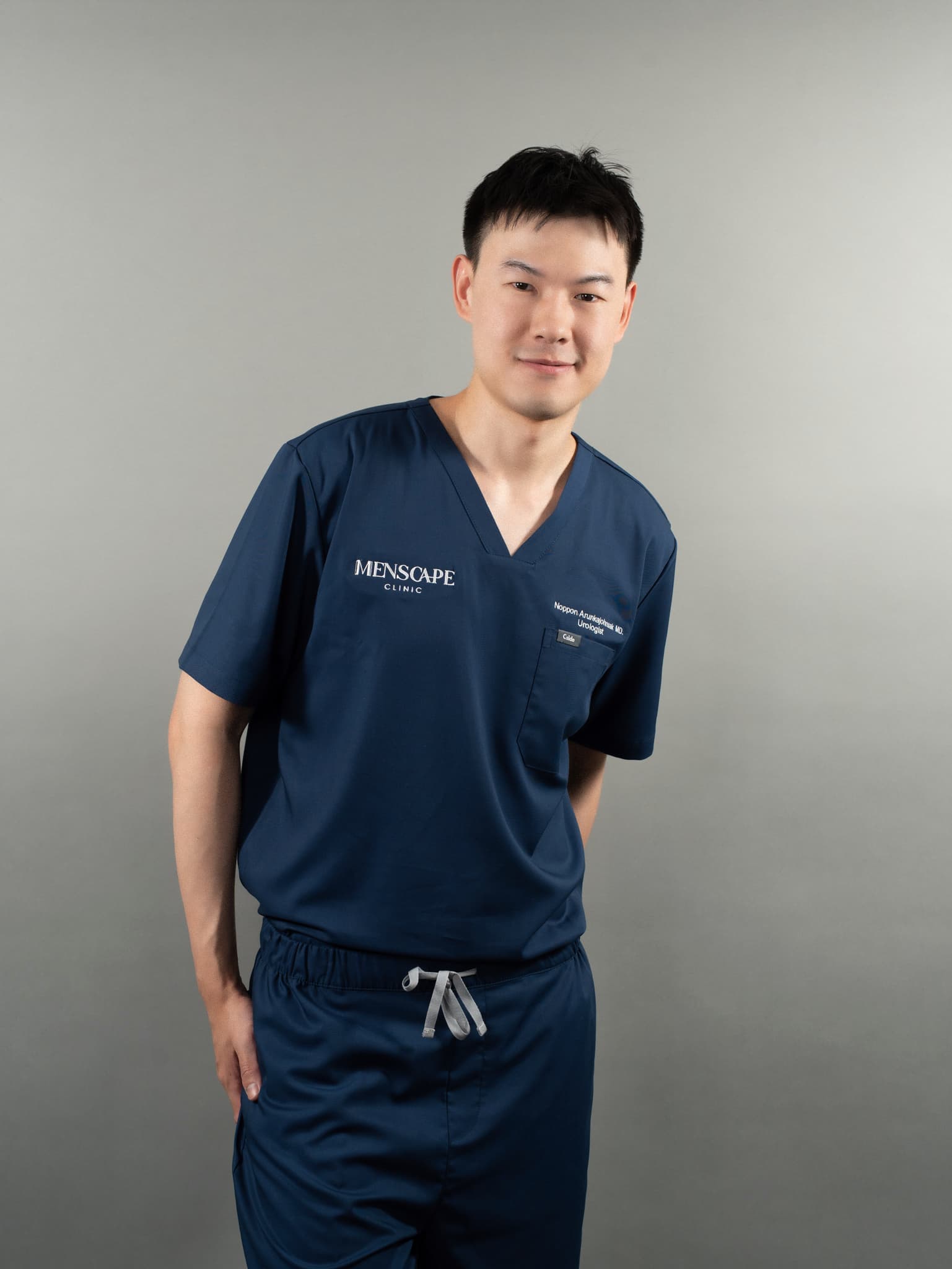
To plan a male otoplasty assessment or ask about pricing and recovery around your travel and work schedule, book a consultation with Menscape. Bring any old photos and a clear sense of the look you want; natural and balanced is the goal we plan for.
Otoplasty is elective surgery and requires an in-person medical consultation. Suitability, technique and final pricing can only be confirmed after a qualified surgeon examines you.
Frequently Asked Questions
How much does otoplasty for men cost in Bangkok?
As an indicative range, both-ear (bilateral) otoplasty in Bangkok typically costs about THB 35,000-90,000, roughly USD 1,050-2,750, with premium all-inclusive hospital packages at the upper end and single-ear corrections lower. Earlobe repair is cheaper, often THB 8,000-25,000 per side. These are planning figures only; confirm your exact price at consultation, since it depends on technique, one ear versus two, the facility and any revision work.
How much cheaper is otoplasty in Bangkok than the US or UK?
Substantially. In the US the surgeon fee alone for ear surgery averaged about USD 4,625 in recent ASPS figures, before anaesthesia and facility costs, so an all-in US otoplasty often reaches USD 5,000-10,000. Bangkok pricing of roughly USD 1,050-2,750, frequently as a package, commonly works out 50-70% lower. UK private pricing sits between the two.
Is otoplasty permanent?
Yes. Once the ear cartilage is reshaped and fixed in its new position, the correction is intended to last for life. The main exception is recurrence, where the ear gradually drifts back toward its old shape; published series put reoperation for recurrence at only a few percent, and disciplined use of the post-op headband helps keep it low.
Will the scar be visible?
In almost all cases, no. The main incision is placed in the natural crease behind the ear, against the skull, so it is hidden in everyday life and invisible from the front. The scar fades over several months. Men prone to keloid scarring should raise this at consultation, as it can affect how the scar heals.
How long is recovery, and when can I go back to work and the gym?
A supportive head dressing stays on for the first few days, then is usually swapped for a soft headband. Most men return to desk or remote work within about a week. Light activity resumes after a couple of weeks, the gym and strenuous exercise typically around 4-6 weeks, and contact sports or swimming once the surgeon clears you, often closer to 6-8 weeks.
Is otoplasty painful, and what anaesthetic is used?
Most men have it awake under local anaesthetic around the ear, often with light sedation to stay relaxed; general anaesthesia is an option in selected cases. There is throbbing and tightness for the first few days, usually well controlled with simple pain relief. Sharp or worsening one-sided pain with rising swelling is not normal and should be reported promptly.
Can just one ear be corrected if only one sticks out?
Yes. Single-ear (unilateral) otoplasty is common for asymmetry and costs less than treating both. Sometimes the surgeon also fine-tunes the better-positioned ear slightly so the pair balances, since matching two ears can require working on both. The plan is set after examining how each ear sits.
Will my ears look obviously 'pinned' or flat?
They should not, if the surgeon plans for a male result. The goal for men is a natural setback that keeps a visible, masculine ear contour and reasonable symmetry, not a flat, over-corrected look. Over-correction is a recognised complication, so it is worth choosing a surgeon who shows natural before-and-after results in men and stating clearly that this is what you want.
What are the main risks of otoplasty?
Most effects are temporary: swelling, bruising, tenderness and numbness that settle over weeks. Less common complications include recurrence (about 4% in a 2024 meta-analysis of cartilage-sparing techniques), suture erosion (around 2.5%), haematoma (around 1.3%), asymmetry, over-correction and, in prone individuals, keloid scarring. Seek urgent care for severe one-sided pain with swelling, fever or spreading redness, or skin that turns dark or pale.
Do I need a consultation before booking otoplasty?
Yes, always. Otoplasty is elective surgery, and the right technique, a realistic result and the final price can only be set after a surgeon examines your ears and cartilage in person. The figures in this guide are indicative; an in-person assessment turns them into a quote that fits your anatomy and goals.
)
/)
/)
/)
/)
/)