/)
Scar revision for men in Bangkok: what it actually costs
Most men who ask about scar revision are not chasing perfection. They want a chest keloid that has stopped catching on a shirt collar, the pitted cheeks from teenage acne to read less harshly in photos, or a surgical line from an old hernia or appendix operation to fade into something they stop noticing. Bangkok has become a practical place to do that work. The city has a dense concentration of dermatology and plastic-surgery clinics, fractional CO2 and erbium lasers, radiofrequency microneedling, and surgeons who handle scar excision routinely, often at a fraction of United States or United Kingdom prices.
This guide lays out realistic Bangkok pricing in Thai baht and US dollars, explains which technique suits which scar, and is honest about what these treatments can and cannot deliver. Scar revision reduces the appearance and sometimes the symptoms of a scar. It does not erase it. As the Cleveland Clinic puts it plainly, scar revision "won't completely eliminate your scar," and realistic expectations are part of a good outcome. Everything below is indicative and meant to inform a conversation with a clinician, not to replace one. Any treatment described here requires an in-person medical consultation and, for prescription medications or injectables, a prescription.
What "scar revision" covers
Scar revision is an umbrella term, not a single procedure. It spans non-surgical resurfacing, injectable treatments, and actual surgery, and the right tool depends entirely on what kind of scar you have.
Atrophic (depressed) scars. The pitted, indented marks left by acne or chickenpox. Subtypes matter: rolling, boxcar and icepick scars respond differently. These usually need a mix of subcision, laser resurfacing and sometimes fillers.
Hypertrophic scars. Raised, firm, red scars that stay within the boundary of the original wound. Common after surgery, burns or deep cuts.
Keloid scars. Raised scars that grow beyond the original injury and do not fade on their own. The Cleveland Clinic notes keloids are more common in people with darker skin and that they "don't fade over time." In men they cluster on the chest, shoulders, jawline (often from shaving or acne) and earlobes.
Surgical and trauma scars. Linear scars from operations or accidents, sometimes widened, raised, or pulling on surrounding skin.
Burn scars. Often a combination of textural change, tightness (contracture) and discolouration.
Identifying the scar type is the first job of any consultation, because it dictates both the technique and the price. A man with a single keloid on the chest and a man with widespread boxcar acne scarring are on completely different treatment paths.
Treatment options and how they work
Laser resurfacing (fractional CO2 and erbium)
Fractional lasers drill microscopic columns into the skin, triggering collagen remodelling as the tissue heals. For atrophic acne scars this is one of the better-studied approaches. A 2022 Bayesian network meta-analysis in *Annals of Translational Medicine* found fractional CO2 laser, alone or combined with platelet-rich plasma, ranked among the most effective interventions for facial acne scars (PMC9843402). Treatment is fractional rather than fully ablative in most modern protocols, which shortens downtime. Expect a course of three to six sessions spaced four to eight weeks apart, not a single visit.
A note on skin tone, which matters for many men in Thailand: ablative and aggressive laser settings carry a higher risk of post-inflammatory hyperpigmentation (temporary darkening) in deeper skin tones. A clinician who treats Asian and mixed skin daily will usually dial settings down or favour non-ablative or erbium devices.
Radiofrequency (RF) microneedling
RF microneedling delivers heat through fine needles into the dermis, stimulating collagen with less surface disruption than ablative laser. It tends to be gentler on pigmented skin, which makes it a frequent choice for men with medium-to-dark complexions. It is often used in combination with subcision or laser rather than as a standalone fix.
Subcision
Subcision uses a needle or blunt cannula passed under the skin to cut the fibrous bands that tether rolling scars down, releasing the depression. A 2023 review in *Clinical, Cosmetic and Investigational Dermatology* concluded subcision is "a particularly effective treatment for atrophic acne scars" and that combining it with other modalities improves results: one protocol reported clinical improvement in 94.1 percent of patients when hyaluronic acid was injected after subcision, versus 67.3 percent with subcision alone (PMC9868281). Subcision is frequently bundled with laser or filler in a single plan.
Dermal fillers
For deeper individual depressions, a hyaluronic-acid filler can lift the scar floor immediately. The effect is real but temporary, typically lasting several months to a year or two depending on product, after which it is repeated. Fillers are usually one part of a combination, not the whole answer.
Steroid injections for keloids and hypertrophic scars
Intralesional corticosteroid (commonly triamcinolone) flattens and softens raised scars over a series of injections spaced a few weeks apart. It is first-line for keloids, but it is not a one-and-done. A 2021 review in *Cureus* reported that triamcinolone monotherapy carries mean recurrence rates of roughly 33 percent at one year and 50 percent at five years, and that combination approaches do better: steroid plus cryotherapy showed about 12 percent recurrence, and surgery plus steroid about 15 percent (PMC7847784). This is why a credible clinic talks about a protocol over months, not a single shot.
Surgical scar revision
Surgery physically removes the scar and re-closes the wound more neatly, sometimes using geometric techniques like Z-plasty to reorient or release a scar that is pulling. It suits widened or poorly positioned surgical and trauma scars, and selected keloids when paired with post-operative steroid or pressure therapy to fight recurrence. It is the most invasive and most expensive option, and on its own a keloid excised without adjuvant treatment can recur, sometimes larger.
Silicone and topical support
Silicone gel or sheeting is a low-cost adjunct often recommended after surgery or alongside other treatments. Be aware the evidence is modest: a 2021 Cochrane review rated the certainty of evidence for silicone gel sheeting in treating hypertrophic scars as "low, or very low" (Cochrane CD013357). It is reasonable as support, not as a standalone cure.
Bangkok scar revision pricing (THB and USD)
The table below reflects indicative 2026 ranges from Bangkok dermatology and plastic-surgery clinics. Figures are per session unless stated, and conversions use roughly THB 34 to USD 1. Always confirm exact pricing, inclusions and the number of sessions at your consultation, because a quoted price often covers one session of a multi-session plan.
Treatment | Bangkok (THB) | Bangkok (USD) | Typical US/UK equivalent | Indicative saving |
Keloid/hypertrophic steroid injection | 800-3,000 / session | ~25-90 | USD 100-500 / session | 60-80% |
Laser + steroid combo (keloid) | 2,500-6,000 / session | ~75-175 | USD 300-800 / session | 50-75% |
Subcision (depressed scars) | 3,000-20,000 / session | ~90-590 | USD 500-1,500 / session | 50-70% |
Fractional CO2 / laser resurfacing | 3,000-12,000 / session | ~90-350 | USD 1,500-3,000 / session | 70-85% |
RF microneedling | 4,000-15,000 / session | ~120-440 | USD 600-1,200 / session | 50-70% |
Dermal filler for scars | 10,000-25,000 / session | ~295-735 | USD 600-1,500 / session | 40-60% |
Surgical scar revision | 15,000-60,000 | ~440-1,765 | USD 1,500-5,000+ | 55-75% |
Acne-scar combination package | 10,000-30,000 | ~295-880 | USD 2,000-6,000 | 60-80% |
US and UK comparison figures are drawn from published clinic ranges, where a single fractional CO2 session commonly runs USD 1,500-3,000 and subcision USD 500-1,500. Bangkok pricing for the same modalities is frequently 50-80 percent lower, which is the core reason men combine treatment with a trip. The trade-off is that a full multi-session acne-scar course may need a longer stay or a return visit, so factor sessions and spacing into your planning, not just per-session price.
What drives the cost
Two men with "acne scars" can get quotes that differ five-fold. The variables that move the price:
Scar type and severity. A handful of rolling scars on the cheeks is a different job from full-face boxcar and icepick scarring.
Number of sessions. This is the single biggest swing. Most meaningful improvement in atrophic scars takes three to six sessions; budget for the course, not the first visit.
Single versus combination therapy. Subcision plus laser plus occasional filler costs more than one modality but, per the evidence above, usually outperforms any single treatment.
Technology used. Newer fractional CO2 platforms and gold-standard RF microneedling devices command higher per-session fees than older equipment.
Treated area. A single earlobe keloid is cheap; a chest or back covering a large surface is not.
Practitioner. A board-certified dermatologist or plastic surgeon with scar-specific experience prices above a general aesthetic technician, and for keloids or surgery that experience is worth paying for.
Anaesthesia and facility. Surgical revision under sedation in a hospital-grade facility costs more than an in-clinic injection under topical numbing.
Who is a candidate, and who is not
Good candidates are men in general good health with a mature, stable scar (most scars keep changing for up to a year, and treating too early can disappoint), realistic expectations, and the patience for a multi-session plan. Men troubled by acne scarring, an old surgical line, or a localised keloid are typically well served.
Scar revision is a poor fit, or needs to wait, if:
Your acne is still active. Treat the acne first. Resurfacing inflamed skin risks new scarring.
You expect complete removal. No technique erases a scar. If a clinic guarantees that, treat it as a red flag.
You are keloid-prone and want aggressive laser or surgery without adjuvant therapy. In keloid-forming skin, surgery or laser alone can trigger a larger keloid; these cases need a combination protocol from the outset.
Contraindications and cautions
Certain situations call for delay or specialist input:
Recent isotretinoin (oral acne medication). Many clinicians wait a period after stopping before ablative resurfacing because of healing concerns; raise this directly at consult.
Active skin infection or cold sores in the treatment area.
Bleeding disorders or blood thinners, which matter for subcision and surgery.
Poorly controlled diabetes or conditions that impair wound healing.
A strong personal history of keloids, which changes the whole approach and the consent conversation.
Pregnancy, for which most elective scar procedures are deferred.
Deeper skin tones are not a contraindication, but they do change technique and settings to limit the risk of pigment change. This is a reason to choose a clinician experienced with Asian and mixed skin.
What treatment and recovery look like, step by step
The exact journey depends on the technique, but a typical combination plan for atrophic acne scars looks roughly like this.
Consultation and scar mapping. The clinician examines the scars in good light, classifies them, photographs a baseline, reviews your history and medications, and proposes a sequenced plan with a session count and cost.
Numbing and the procedure. Topical anaesthetic for most laser and microneedling work; local injection for subcision; sedation or local for surgery. A laser or microneedling session on the face commonly takes 30-60 minutes.
Immediate aftermath. Redness, mild swelling and a sunburn-like sensation are normal after laser or RF. Subcision can bruise. Surgical sites have sutures.
A staged recovery for laser or RF microneedling typically runs:
Days 1-3. Redness, possible swelling, sometimes pinpoint scabbing. Most men return to desk work within a day or two, though visible facial redness may linger.
Days 4-7. Surface healing, often some flaking or peeling as new skin emerges. Strict sun protection is essential to avoid pigment problems.
Weeks 2-4. Skin settles; early texture improvement may show but the collagen remodelling is still underway.
Months 1-3 and beyond. The real gains in fractional treatments build over weeks to months as collagen reorganises, which is why sessions are spaced out.
For surgical revision, expect sutures for one to two weeks, several weeks of activity restriction depending on location, and many months before the new scar matures and fades to its final appearance. For keloid steroid courses, injections recur every few weeks over months.
Have a question about your treatment?
Message our Bangkok clinic on WhatsApp and a doctor replies within minutes during clinic hours.
What results to realistically expect
The honest framing is meaningful improvement, not erasure. The evidence gives some concrete anchors:
For atrophic acne scars, combination subcision plus laser approaches have reported substantial improvement: one protocol combining subcision with chemical peel and fractional CO2 in 114 patients achieved a mean scar improvement of 2.9 on a 4-point scale, and adding suction to subcision lifted mean improvement to about 72 percent versus roughly 44 percent without (PMC9868281).
For keloids, combination therapy meaningfully cuts recurrence versus steroid alone, but recurrence is never zero; steroid plus cryotherapy sat near 12 percent and surgery plus steroid near 15 percent in pooled data (PMC7847784).
Translation: most men should expect scars to become flatter, softer, less pitted or less noticeable over a course of treatments, with improvement measured in degrees rather than disappearance. Keloids specifically can recur and may need maintenance.
Risks and side effects
Common, usually temporary effects after resurfacing, subcision or RF include redness, swelling, bruising, mild crusting, and a sunburn-like feeling for a few days. Steroid injections can cause skin thinning, surface vessel prominence or a lightened patch at the site. Surgery carries the standard wound risks.
The more important risks to understand:
Post-inflammatory hyperpigmentation or hypopigmentation, especially in deeper skin tones, which is usually temporary but can persist.
New or worsened scarring if healing goes wrong or the wrong settings are used.
Keloid recurrence or growth after surgery or laser in keloid-prone skin without adjuvant therapy.
Infection at any treated or surgical site.
Seek prompt medical care if you notice spreading redness and warmth, increasing pain after the first few days, pus or foul-smelling discharge, fever, significant unexpected bleeding, or wound edges separating. These are not normal recovery and warrant urgent review, ideally at the clinic that treated you.
How to choose a safe clinic in Bangkok
The right clinic is the one that diagnoses before it treats and is candid about limits. Look for:
A board-certified dermatologist or plastic surgeon doing the assessment, not a salesperson or unsupervised technician.
A proper diagnostic consultation that classifies your scar type and photographs a baseline before quoting.
A combination, sequenced plan with a stated number of sessions and transparent THB pricing, including what each price does and does not cover.
Experience with your skin tone, and a clear explanation of how settings are adjusted to limit pigment risk.
Realistic expectations, framed as improvement over a course of treatment.
Red flags worth walking away from:
Prices that look too good to be true, often a sign of older equipment or no physician oversight.
No doctor consultation, or no scar-type assessment before treatment.
Any guarantee of "complete scar removal," which is not achievable.
Pressure to commit to a large package on the spot without a written plan.
Comparison: which approach fits which scar
Scar type | First-line approach in Bangkok | Typical sessions | Indicative THB | Realistic outcome |
Rolling acne scars | Subcision + fractional laser, sometimes filler | 3-6 | 3,000-20,000 / session | Marked softening, depressions lift |
Boxcar / icepick acne scars | Fractional CO2, focal techniques | 3-6 | 3,000-12,000 / session | Texture improves, not erased |
Keloid (chest, shoulder, ear, jaw) | Steroid injection, often + laser; surgery in selected cases with adjuvant | 3-6+ over months | 800-6,000 / session | Flatter, softer; recurrence possible |
Hypertrophic surgical scar | Steroid + silicone; laser; surgical revision if needed | Varies | 2,500-60,000 | Flatter, less red over months |
Widened or pulling surgical/trauma scar | Surgical revision (± Z-plasty) | Usually 1, then maturation | 15,000-60,000 | Neater, repositioned line |
Burn scar (textured/contracture) | Combination, specialist-led | Multiple | Assessed individually | Improved texture/tightness |
Booking a consultation at Menscape
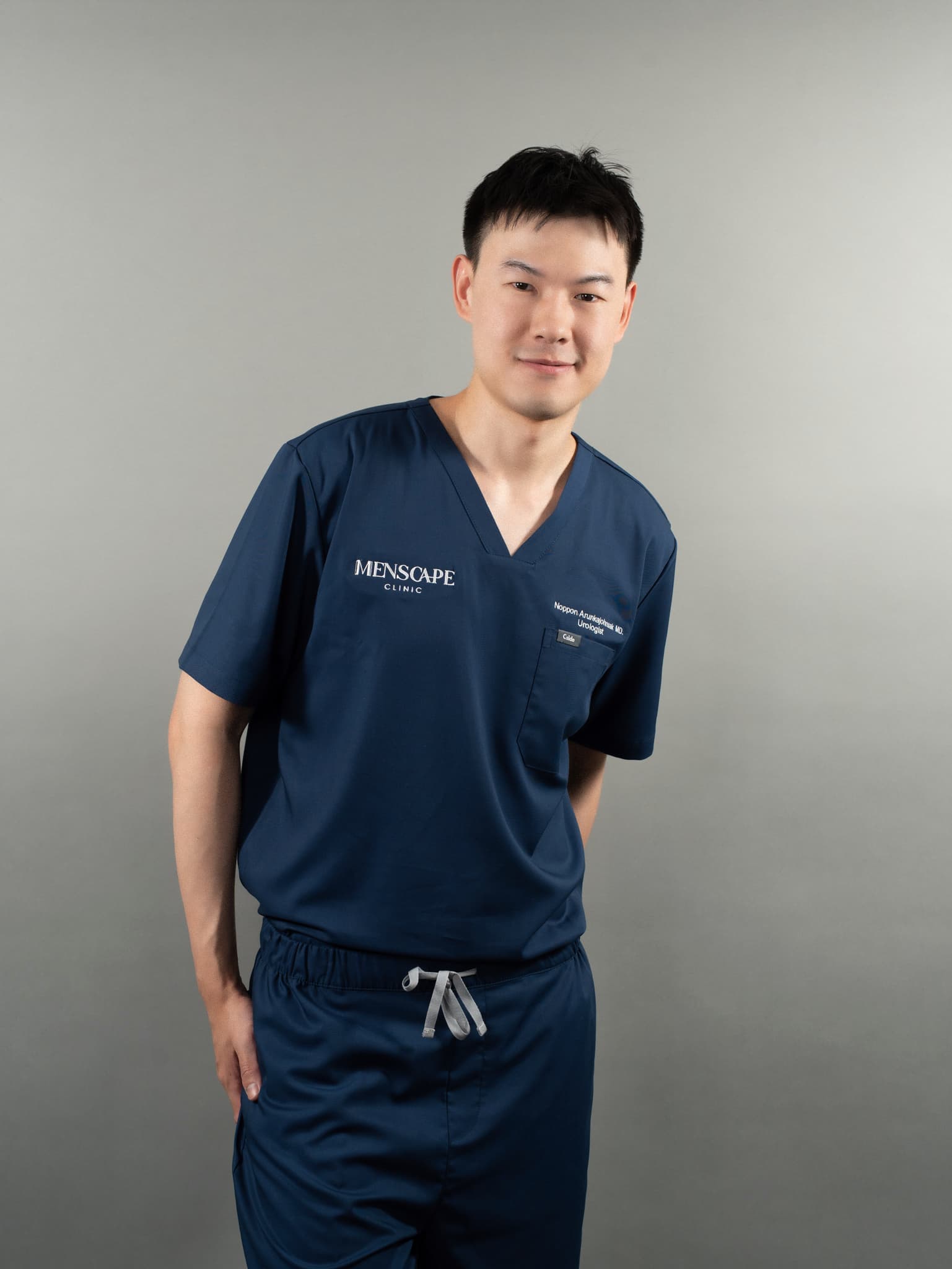
Menscape is a men's health clinic in Bangkok, and scar revision is exactly the kind of treatment where a male-focused, discreet assessment helps men actually start the conversation. Because the right plan and the final cost depend entirely on your scar type, skin tone and goals, the first step is an in-person consultation where a clinician examines the scars, explains the realistic range of improvement, and gives you a written, sequenced plan with transparent THB pricing. You can book a consultation to get an individualised quote. Scar revision is a medical treatment that requires that consultation, and any prescription medication or injectable involved requires a prescription.
If you are also weighing other procedures while in Bangkok, our guides on kidney stone treatment costs and the difference between circumcision and frenulectomy follow the same transparent-pricing approach.
Frequently Asked Questions
How much does scar revision cost for men in Bangkok?
Indicative 2026 ranges run from about THB 800-3,000 per session for a keloid steroid injection, THB 3,000-20,000 per session for laser, RF microneedling or subcision, and THB 15,000-60,000 for surgical revision. Combination acne-scar packages commonly fall in the THB 10,000-30,000 range. These are per-session or per-procedure figures, so the total depends on how many sessions your scar needs. Confirm exact pricing and inclusions at a consultation.
How does Bangkok pricing compare with the US or UK?
For the same modalities, Bangkok is frequently 50-80 percent cheaper. A single fractional CO2 session that often costs USD 1,500-3,000 in the US or UK is commonly THB 3,000-12,000 (roughly USD 90-350) in Bangkok, and subcision that runs USD 500-1,500 abroad is often THB 3,000-20,000 locally. The trade-off is that a full multi-session course may need a longer stay or a return trip.
Can scars be completely removed?
No. Scar revision reduces the appearance and sometimes the symptoms of a scar but cannot erase it, as the Cleveland Clinic states directly. A realistic goal is a flatter, softer, less noticeable scar over a course of treatment. Any clinic guaranteeing complete removal is making a claim that is not achievable, and that should be treated as a warning sign.
How many sessions will I need?
It depends on the scar. Atrophic acne scars usually need three to six sessions of laser, subcision or combination treatment spaced four to eight weeks apart. Keloid steroid courses run over several months with injections every few weeks. A widened surgical scar may be addressed in one operation, but the new scar then takes many months to mature. The session count is the biggest driver of total cost.
Do keloids come back after treatment?
They can. Steroid (triamcinolone) injection alone carries mean recurrence rates of roughly 33 percent at one year and 50 percent at five years in pooled data, while combination approaches lower that, with steroid plus cryotherapy near 12 percent and surgery plus steroid near 15 percent. Recurrence is never zero, so keloid-prone men should expect a combination protocol and possible maintenance rather than a single fix.
Is laser scar treatment safe for darker or Asian skin tones?
Yes, with appropriate technique. Deeper skin tones carry a higher risk of post-inflammatory hyperpigmentation (temporary darkening) with aggressive ablative laser, so clinicians often adjust settings, choose non-ablative or erbium devices, or favour RF microneedling. Choosing a practitioner experienced with Asian and mixed skin matters more than the specific brand of device.
How long is the downtime?
For fractional laser or RF microneedling, expect redness and possible swelling for one to three days, with surface flaking or peeling through day seven and strict sun protection throughout. Many men return to desk work within a day or two. Subcision can bruise for several days. Surgical revision involves sutures for one to two weeks and several weeks of activity restriction depending on location.
Which scar treatments need a prescription or medical consultation?
All of them require an in-person consultation, and injectables and prescription medications (such as corticosteroid injections, certain numbing agents, or oral medications) require a prescription from a licensed clinician. Scar revision is a medical procedure, not a retail purchase, so a proper diagnostic assessment of your scar type and skin should always come before any treatment or quote.
What does a scar revision consultation involve?
The clinician examines the scars in good light, classifies the type (atrophic, hypertrophic, keloid, surgical, burn), photographs a baseline, reviews your medical history and medications, and proposes a sequenced plan with a stated number of sessions and transparent pricing. You should leave with a realistic sense of the improvement possible and a written quote, not pressure to commit on the spot.
)
/)
/)
/)
/)
/)