/)
If you have trained hard, eaten reasonably well, and still cannot shift the fat over your lower abdomen, your flanks, or your chest, you are the patient liposuction was designed for. Bangkok has become one of the more popular places to have it done, partly because the technology on offer (VASER ultrasound, high-definition sculpting, radiofrequency skin tightening) matches what you would find in London or Los Angeles, and partly because the price is often a fraction of what the same operation costs in the West.
This guide lays out what male liposuction actually costs in Bangkok in 2026, in both Thai baht and US dollars, with a transparent comparison against US pricing. It also covers what drives the final number, who is and is not a good candidate, how recovery really unfolds, the risks worth taking seriously, and how to tell a safe clinic from a cheap one. The pricing here is built from current Bangkok clinic and hospital rates, but every figure is indicative. Liposuction is surgery, and your real quote can only come from an in-person consultation with a licensed surgeon who has examined you.
What male liposuction is (and what it is not)
Liposuction removes localised pockets of subcutaneous fat through small cannulas (thin hollow tubes) inserted through incisions a few millimetres long. In men, the goal is usually different from the female version: rather than smoothing curves, the surgeon is trying to reveal and sharpen the underlying muscle, define the waist, flatten the chest, or carve the linea alba and oblique grooves that read as an athletic midsection.
Two points matter before you look at any price. First, this is not a weight-loss procedure. The Cleveland Clinic is explicit that liposuction "doesn't treat excess weight or obesity" and will not stop you regaining weight if your diet and training slip. The fat cells removed are gone for good, but the ones left behind can still expand. Second, it is a regulated surgical procedure. In Thailand, as elsewhere, it requires a medical consultation, anaesthesia planning, and a prescription or surgical order from a licensed doctor. No reputable clinic will quote you a fixed price and book a date without examining you first.
Male liposuction cost in Bangkok: 2026 price table (THB and USD)
The table below reflects typical Bangkok clinic and hospital pricing in 2026, expressed per treatment area unless stated. USD figures use an approximate rate of 32 THB to 1 USD and are rounded. The right-hand column shows roughly what the comparable procedure costs in the United States, where the American Society of Plastic Surgeons reports an average surgeon's fee of USD 4,711 for liposuction, and that figure excludes anaesthesia, the operating facility, garments and follow-up.
Procedure / area | Bangkok price (THB) | Bangkok price (USD approx) | Typical US total | Indicative saving |
Standard (suction-assisted) lipo, single area | 35,000-80,000 | 1,090-2,500 | 4,000-7,000 | ~55-70% |
VASER (ultrasound-assisted) lipo, single area | 45,000-130,000 | 1,400-4,060 | 5,000-9,000 | ~50-65% |
Abdomen + flanks (midsection package) | 110,000-220,000 | 3,440-6,880 | 8,000-14,000 | ~50-60% |
High-definition / abdominal etching (full torso) | 150,000-320,000 | 4,690-10,000 | 9,000-18,000 | ~45-55% |
Male chest / gynaecomastia (lipo +/- gland excision) | 60,000-160,000 | 1,880-5,000 | 5,500-10,000 | ~50-60% |
Chin and neck (jawline definition) | 25,000-70,000 | 780-2,190 | 3,000-6,000 | ~55-70% |
Skin tightening add-on (BodyTite / Renuvion type) | 40,000-90,000 per zone | 1,250-2,810 | included or +3,000-6,000 | varies |
A few real-world anchors to calibrate against: a well-known Bangkok body-contouring centre lists standard single-area liposuction from around 59,000 THB, a "sexy line" six-pack sculpting procedure from about 69,000 THB, and accessory-breast (chest) removal from roughly 59,000 to 79,000 THB depending on whether skin is excised. Those are credible mid-market numbers. Clinics advertising a single area for 25,000-35,000 THB exist, but at that level you should ask hard questions about the anaesthesia setup and the facility (more on that below).
These ranges are indicative and move with your anatomy, the clinic tier and the exchange rate. Treat them as a planning bracket, not a quote, and confirm the all-in figure (surgeon, anaesthesia, facility, garment, follow-up) in writing at your consultation.
What is included, and the costs people forget
A liposuction "price" can mean very different things between clinics. When you compare quotes, make sure each one spells out:
Surgeon's fee and anaesthetist's fee.
Operating theatre or hospital facility fee.
Type of anaesthesia (local with sedation versus general) and overnight stay if any.
Pre-operative blood work, ECG and medical clearance.
The compression garment (you may need two, and a second size as you deswell).
Post-operative medication, dressings and follow-up visits.
Lymphatic drainage massage sessions, if the clinic recommends them.
For international patients, budget separately for flights, 10-14 nights of accommodation (you should not fly home immediately), airport transfers, and a companion if you want one. Some Bangkok hospitals bundle a hotel night, transfers and meals into a package; itemise these so you are comparing like with like.
Techniques compared: standard, VASER, high-definition and skin tightening
Men are most often sold "VASER" or "Hi-Def" lipo, so it helps to understand what you are actually paying more for.
Technique | How it works | Best for | Relative cost |
Standard / suction-assisted (SAL) | Manual cannula breaks up and suctions fat | Debulking larger fat volumes; simple flank or abdominal reduction | Lowest |
Power-assisted (PAL) | Vibrating cannula removes fat faster with less surgeon fatigue | Fibrous male fat; efficient larger-area work | Low-mid |
VASER (ultrasound-assisted) | Ultrasound energy emulsifies fat before removal, sparing nearby tissue | Precise sculpting; fibrous chest tissue; smoother results | Mid-high |
High-definition / abdominal etching | Selective superficial fat removal along muscle borders to reveal a six-pack and obliques | Lean, athletic men wanting visible definition | Highest |
Radiofrequency / helium skin tightening (BodyTite, Renuvion) | Heats the underside of the skin to stimulate contraction | Mild skin laxity after fat removal | Add-on |
High-definition work is where the surgeon's skill, not the machine, decides the result. A 2024 classification study in *Aesthetic Plastic Surgery* graded candidates by a simple skin "pinch test": men with a pinch of roughly 1-2 cm and good skin quality are the ideal candidates for visible etching (this athletic subgroup reported mean satisfaction of about 7.6 out of 10), while those with a thicker pinch or loose skin need a more conservative plan or added skin tightening. Ask which class you fall into rather than assuming a six-pack is guaranteed.
What drives your cost up or down
Five factors explain almost all of the variation between quotes:
Technique. High-definition and VASER cost more than standard suction because they take longer and need specialised equipment. Etching a full torso is a different operation from debulking one flank.
Number of areas. Each additional zone adds operating time and often a higher anaesthesia tier. Abdomen, flanks, chest and chin treated together cost far more than a single area, though packages usually price below the sum of the parts.
Starting body fat and volume. More fat to remove means longer surgery and, past a threshold, a higher-risk anaesthetic. Surgeons cap how much can be safely aspirated in one sitting.
Hospital tier. A JCI-accredited hospital with a full theatre and overnight care charges more for the facility than a day-surgery clinic. You are partly paying for the safety infrastructure.
Surgeon experience. A surgeon who does male torsos every week may charge a premium and is usually worth it. Male sculpting is unforgiving: over-resection looks worse on a man's flat planes than on a woman's curves.
Who is a good candidate, and who is not
Liposuction works best when it does the one job it is good at: removing stubborn, diet-resistant fat from someone who is already close to their target weight. According to the Cleveland Clinic, suitable candidates are typically at an average or slightly above-average weight, have firm, elastic skin and good muscle tone, do not smoke, and have realistic expectations; it lists a BMI over 25 as a reason you may not be a good fit.
You are likely not a good candidate, or should expect a more cautious plan, if any of the following apply:
You are significantly overweight or have a BMI over 25 and are looking to lose weight. Liposuction is not the tool; weight loss should come first.
Your skin is loose or has poor elasticity (after major weight loss, for example). You may need skin excision such as a male tummy tuck or a body lift rather than, or in addition to, lipo.
You smoke and are unwilling to stop for several weeks around surgery, which meaningfully raises wound and healing risk.
You have uncontrolled diabetes, a bleeding disorder, significant heart or lung disease, or another condition your surgeon judges makes anaesthesia unsafe.
A note on male chest fat and gynaecomastia
If your concern is the chest, the cause matters. True gynaecomastia is enlargement of the actual breast gland, driven by a shift in the oestrogen-to-androgen ratio, and it is common: an NCBI Endotext review notes a reported prevalence of roughly 36-57% in men over 60, with many cases in adolescence too. Pseudogynaecomastia is simple fatty enlargement. Liposuction alone handles fatty chest fullness well, but firm glandular tissue usually needs direct excision through a small incision under the areola. A surgeon should examine you to tell the two apart, and persistent or one-sided gland enlargement should be checked to exclude other causes. This is exactly why a fixed online price is not enough; you need an examination.
The procedure, step by step
While details vary by technique and clinic, a typical male liposuction day looks like this:
Marking. Standing up, the surgeon marks the fat pads, muscle borders and the grooves to be defined. For etching, this map is the operation.
Anaesthesia. Smaller single areas can be done under local anaesthetic with sedation; larger or multi-area cases usually use general anaesthesia with an anaesthetist present.
Tumescent infiltration. A dilute fluid with local anaesthetic and adrenaline is injected to numb the area, shrink blood vessels and reduce bleeding and bruising.
Fat emulsification (VASER/HD only). Ultrasound energy loosens fat before removal, which helps in fibrous male tissue.
Aspiration and sculpting. The surgeon removes fat through millimetre incisions, refining the contour and, in HD work, deliberately leaving fat over muscle bellies to create shadow and definition.
Closure and garment. Tiny incisions are left to drain or closed with a stitch or two, and you are fitted into a compression garment before you leave.
Surgeons limit how much fat is removed in one session for safety. A single-centre study of large-volume liposuction in the *International Archives of Medicine* defined "large-volume" as removing roughly 4 litres of fat (or about 5 litres of total aspirate, fat plus wetting solution) and found it can be done safely in selected patients, with low and mostly minor complication rates. Even so, larger aspirations carry more physiological stress, which is why surgeons cap volume per session and sometimes stage aggressive multi-area requests across two operations.
Recovery timeline
Recovery is very doable but not nothing. A realistic schedule:
Days 0-3: Soreness like a hard gym session plus bruising and swelling. Fluid may leak from incision sites for a day or two (this is normal). You walk the same day to reduce clot risk.
Days 4-7: Bruising peaks then fades. Most men with desk jobs return to light work around day 5-7. Compression garment worn almost continuously.
Weeks 2-3: Swelling settles noticeably. Light cardio and walking are usually fine; avoid heavy lifting and core strain.
Weeks 4-6: Most patients return to full training, including weights, around the 4-6 week mark with surgeon clearance.
Months 3-6: Final contour emerges as the last of the swelling resolves and skin retracts. The Cleveland Clinic notes results keep refining over three to six months.
Most surgeons recommend wearing the compression garment for around six weeks and may suggest lymphatic drainage massage to speed deswelling. International patients should plan to stay in Bangkok for roughly 10-14 days so the surgeon can review you, remove any sutures and clear you to fly.
Results: what the numbers actually show
Done well, the contour change is permanent because the removed fat cells do not regrow, provided you keep your weight stable. The evidence on high-definition work is encouraging. A 10-year retrospective study of abdominal etching published in *Aesthetic Surgery Journal Open Forum* in 2025 followed 345 patients (124 of them men) and reported that 95.07% were satisfied with their result. Major complications were rare, with no cases of fat embolism, and the common minor issues were contour irregularity (9.85%) and seroma, a collection of fluid (8.11%). A separate 2024 classification study reported mean patient satisfaction of about 7.6 out of 10 for etching in its athletic, ideal-candidate group.
Two honest caveats. Results depend heavily on your skin retracting over the new contour, which is less reliable with age or loose skin. And definition is maintained by your lifestyle: the sculpted look fades behind a layer of new fat if you gain weight, even though the treated cells are gone.
Have a question about your treatment?
Message our Bangkok clinic on WhatsApp and a doctor replies within minutes during clinic hours.
Risks and side effects
Liposuction is generally safe in appropriate candidates and accredited settings, but it is surgery and carries real risks. Expected, temporary effects include swelling, bruising, soreness, numbness and fluid leakage from incisions for the first day or two.
More significant complications, most of them uncommon, include:
Contour irregularities (lumps, dents, asymmetry, over-resection). The most common aesthetic complication and the hardest to fix; it tracks with surgeon skill.
Seroma (fluid collection) and haematoma (blood collection), sometimes needing drainage.
Infection at incision sites.
Prolonged numbness or changes in skin sensation.
Skin discolouration or, rarely, areas of skin loss, especially in smokers.
Blood clots (deep vein thrombosis) and, very rarely, fat embolism, where fat enters the bloodstream.
Seek urgent medical care if you experience
Contact your surgeon or go to an emergency department right away if you have: a fever over 38°C, spreading redness, severe or worsening pain, pus or a foul smell from an incision, one calf that is hot, swollen and painful, or, most urgently, chest pain, shortness of breath or sudden confusion. These can signal infection, a clot or a fat embolism and are emergencies.
How to choose a safe clinic in Bangkok (and the red flags)
Bangkok has genuinely excellent surgeons and also a long tail of clinics competing on price alone. Protect yourself by checking:
Accreditation. Prefer a hospital or surgery centre with recognised accreditation (JCI, or AACI for ambulatory surgery). One leading Bangkok body-contouring centre, for example, holds AACI certification, which signals audited safety standards.
A named, qualified surgeon. You should be able to identify the specific surgeon, confirm their board certification in plastic surgery, and see that they do male contouring regularly. Male-specific before-and-after photos matter more than generic galleries.
A real anaesthesia plan. For anything beyond a small single area, a dedicated anaesthetist should be present. Liposuction done "without an anaesthesia specialist" in a back room is a serious safety compromise.
An in-person consultation and medical clearance. Blood tests, a medical history and an honest discussion of whether you are a candidate should precede any firm date.
Transparent, itemised pricing. A credible clinic breaks the quote into surgeon, anaesthesia, facility, garment and follow-up.
Walk away if a clinic: quotes a suspiciously low headline price, pressures you to book immediately or pay a large deposit before examining you, will not name your surgeon, performs surgery in a non-accredited facility, skips anaesthesia specialists, or cannot show male results. A bargain that skips the safety infrastructure is not a bargain.
Why men choose Bangkok for liposuction
The honest answer is value plus capability. You can access VASER and high-definition sculpting from experienced surgeons at 40-65% below typical US prices, in private, well-equipped hospitals, often with English-speaking coordinators and packages that fold in accommodation and transfers. Add the discretion of recovering away from home and the ability to combine a procedure with a stay in the city, and the appeal is clear, as long as you choose on safety and surgeon track record rather than the lowest number.
If your situation is more about skin than fat, read our companion guides on the male tummy tuck and male body lift. For background on the procedure itself, see our overview of liposuction for men.
Book a consultation
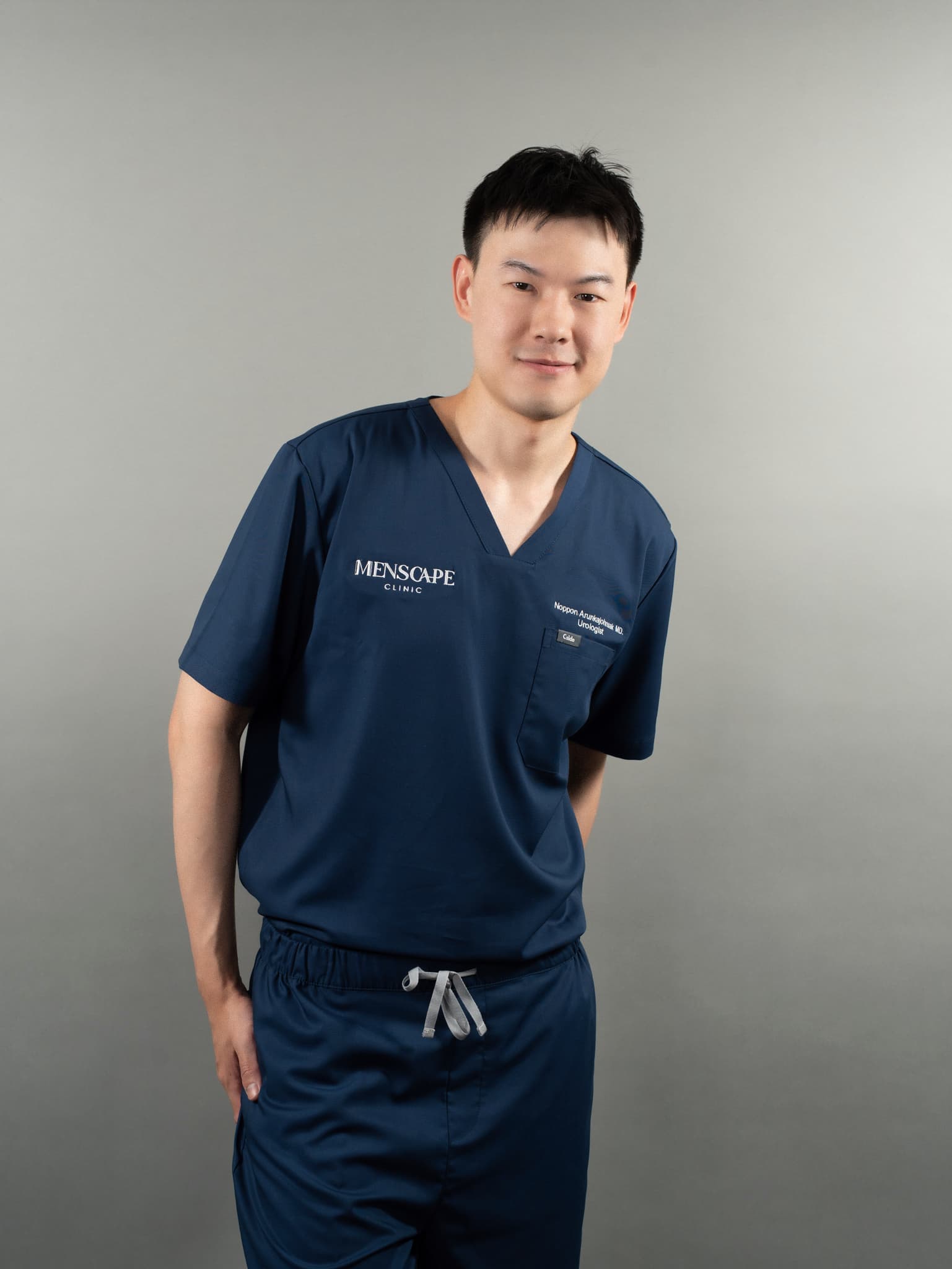
Every figure in this guide is indicative and meant for planning. Your actual cost, your candidacy and the safest technique for your body can only be settled in person. Liposuction is a surgical procedure that requires a medical consultation and a prescription from a licensed doctor. To get a personalised, itemised quote and an honest assessment of what is realistic for your physique, book a male liposuction consultation at Menscape Bangkok.
Frequently Asked Questions
How much does male liposuction cost in Bangkok in 2026?
As a planning bracket, a single area with VASER typically runs about 45,000-130,000 THB (roughly USD 1,400-4,060), a midsection package (abdomen plus flanks) about 110,000-220,000 THB, and full high-definition torso etching about 150,000-320,000 THB (around USD 4,700-10,000). Male chest or gynaecomastia surgery is commonly 60,000-160,000 THB. These are indicative ranges; your real quote depends on your anatomy and the clinic, and can only be confirmed at an in-person consultation.
How much cheaper is liposuction in Bangkok than in the US or UK?
For comparable procedures it is often 40-65% less. The American Society of Plastic Surgeons reports an average US surgeon's fee alone of USD 4,711 for liposuction, before anaesthesia, facility and garment costs, so US totals frequently land between USD 5,000 and 14,000 or more. The same work in Bangkok commonly costs a fraction of that, though you should factor in flights and 10-14 nights of accommodation.
Is liposuction a way to lose weight?
No. Liposuction is body sculpting, not weight loss. The Cleveland Clinic states plainly that it does not treat excess weight or obesity and will not stop you regaining weight. It removes localised, diet-resistant fat from someone already near a stable weight. If weight loss is the goal, that should come first through diet, exercise or medical support.
Will the fat come back after liposuction?
The fat cells that are removed do not grow back, so the contour change is permanent if your weight stays stable. However, the fat cells left behind can still enlarge, so significant weight gain can blunt or reverse the result and add fat to untreated areas. Maintaining your result depends on diet and training.
What is the difference between VASER, standard and high-definition liposuction?
Standard (suction-assisted) liposuction mechanically removes fat and is best for simple debulking. VASER uses ultrasound to emulsify fat before removal, which helps with precise sculpting and fibrous male tissue. High-definition (abdominal etching) selectively removes superficial fat along muscle borders to reveal a six-pack and obliques, and is the most technically demanding and most expensive. The best choice depends on your body fat, skin quality and goals.
How long is the recovery from male liposuction?
Most men with desk jobs return to light work around day 5-7. Light cardio is usually fine within two to three weeks, and full training including weights typically resumes at 4-6 weeks with surgeon clearance. A compression garment is generally worn for about six weeks, and the final contour emerges over three to six months as swelling resolves. International patients should plan to stay in Bangkok for roughly 10-14 days.
Can liposuction treat man boobs or gynaecomastia?
It depends on the cause. Fatty chest fullness (pseudogynaecomastia) responds well to liposuction alone. True gynaecomastia, which is enlargement of the actual breast gland driven by a hormonal imbalance, usually needs direct excision of the firm tissue through a small incision under the areola, often combined with liposuction. A surgeon should examine you to distinguish the two, and persistent or one-sided enlargement should be checked to rule out other causes.
Is liposuction safe, and what are the main risks?
In suitable candidates and accredited facilities it is generally safe, and large studies of techniques like abdominal etching report high satisfaction with mostly minor complications such as contour irregularity and seroma (fluid collection). Serious complications such as infection, blood clots and, very rarely, fat embolism are possible. Seek urgent care for fever, spreading redness, a hot swollen painful calf, or chest pain and shortness of breath. Choosing an accredited facility, a qualified surgeon and proper anaesthesia substantially lowers risk.
Do I need a consultation, or can I just book online?
You need a consultation. Liposuction is a regulated surgical procedure that requires a medical assessment, anaesthesia planning and a prescription or surgical order from a licensed doctor. A reputable clinic will examine you, run pre-operative tests and confirm you are a candidate before quoting a firm, itemised price or setting a date. Be cautious of any clinic offering a fixed price and a booking without seeing you first.
)
/)
/)
/)
/)
/)