/)
If you have been told a kidney stone needs breaking up, one of the first questions is usually a practical one: what will it cost, and is having it done in Bangkok actually cheaper than at home? Extracorporeal shockwave lithotripsy, almost always shortened to ESWL or SWL, is the least invasive way to treat many stones. It uses focused sound pressure waves, delivered through the skin, to crack a stone into fragments small enough to pass in your urine. No cuts, no scope passed up the urinary tract, usually no overnight stay.
This guide lays out realistic Bangkok pricing in Thai baht and US dollars, shows how that compares with the United States and the United Kingdom, and explains the things that move the number up or down. It also covers who ESWL suits, who it does not, what recovery looks like, the risks worth knowing, and how to choose a clinic you can trust. The aim is that you arrive at a consultation already understanding the trade-offs, rather than reacting to a quote on the day.
One thing to be clear about from the start: ESWL is a medical procedure that requires a urologist's assessment and a recent CT scan before anyone can responsibly price it. Stones differ enormously in size, density and position, and those differences change both the plan and the bill. Every figure below is indicative and meant for planning. Your own quote should come after a consultation.
What ESWL is and when it is used
Your kidneys filter waste from the blood and send it out as urine. Sometimes minerals such as calcium oxalate crystallise and clump into a hard deposit, a kidney stone. Small stones often pass on their own with fluids and time. Larger ones, or stones that block the flow of urine and cause severe one-sided flank pain, nausea or blood in the urine, usually need a procedure. The US National Institute of Diabetes and Digestive and Kidney Diseases notes that treatment choice depends on a stone's size, location and type, and that larger stones or those blocking the urinary tract may need active treatment rather than watchful waiting.
ESWL is one of three mainstream ways to clear a stone that will not pass. During the procedure you lie on a table while a machine called a lithotripter sends thousands of shockwaves through the skin, focused precisely on the stone using X-ray or ultrasound targeting. Cleveland Clinic describes a typical session as taking roughly an hour, performed as a same-day outpatient treatment, with the stone broken into many small pieces that then work their way out over the following days and weeks.
The appeal is that nothing enters the body. That generally means a faster recovery and fewer of the risks that come with surgery or instrumentation. The trade-off is that ESWL is not the most powerful option, so it suits some stones far better than others, a point the pricing and candidacy sections below return to.
The alternatives, in plain terms
ESWL sits alongside two more invasive options, and knowing them helps you judge whether a shockwave quote is the right comparison:
Ureteroscopy with laser (URS / RIRS). A thin scope is passed up the urinary tract to the stone, which is then fragmented or dusted with a laser and the pieces removed or left to pass. Higher stone-free rates than ESWL in a single sitting, especially for harder or lower-pole stones, but more invasive and usually more expensive.
Percutaneous nephrolithotomy (PCNL). For large or complex stones (commonly over about 20 mm, or staghorn stones), a surgeon makes a small flank incision to reach the kidney directly. The most effective option for big stone burdens, and the most involved, with an inpatient stay.
Medical management. For small stones, increased fluids, pain control and sometimes an alpha-blocker such as tamsulosin to relax the ureter and help the stone pass. The cheapest path when it is appropriate.
The European Association of Urology's urolithiasis guideline treats shockwave lithotripsy and ureteroscopy as the two principal options for most kidney and ureteral stones, with the choice driven heavily by stone size and location.
ESWL cost in Bangkok: THB and USD, with savings vs the US and UK
Pricing for ESWL in Bangkok is genuinely tiered. Mid-sized private hospitals and dedicated urology clinics sit well below the large internationally accredited names, and the gap is wide. The table below gives indicative self-pay ranges. It uses an exchange rate of roughly THB 32.7 to USD 1; rates move, so treat the dollar figures as approximate.
Item | Bangkok (THB) | Bangkok (USD approx.) | Notes |
ESWL, single session (mid-tier private hospital) | 30,000 – 80,000 | 910 – 2,450 | The core comparison figure for most stones |
ESWL at a JCI-accredited international hospital | 120,000+ | 3,650+ | Premium brand, more amenities, higher overhead |
Pre-procedure imaging (CT KUB, ultrasound, labs) | 5,000 – 20,000 | 150 – 610 | Required before pricing the procedure |
Urology consultation | 1,500 – 6,500 | 45 – 200 | Per visit; sometimes credited toward treatment |
Follow-up consult + imaging | 1,500 – 6,500 | 45 – 200 | Usually at 2 to 4 weeks to confirm clearance |
Second ESWL session, if needed | 30,000 – 80,000 | 910 – 2,450 | Some stones need two or three sittings |
A note on the JCI figure: simpler single-session packages at internationally accredited hospitals can start nearer THB 85,000, with THB 120,000 or more reflecting larger stones, deeper anaesthesia, or premium all-inclusive packages. Medical-tourism aggregators sometimes quote even higher, but those usually bundle international-patient markups.
For an honest comparison, here is how a single ESWL session in Bangkok stacks up against typical self-pay prices in higher-cost countries. ESWL is one procedure with one machine, so it is a clean like-for-like comparison.
Country | Typical self-pay ESWL price | In USD (approx.) | Approx. saving vs. US |
Thailand (Bangkok, mid-tier private) | THB 30,000 – 80,000 | 910 – 2,450 | Baseline / reference |
Thailand (Bangkok, JCI hospital) | THB 120,000+ | 3,650+ | Still well below the US |
United States | USD 7,250 – 16,450 (avg ~12,800) | 7,250 – 16,450 | , |
United Kingdom (private) | GBP 3,000 – 5,000 | ~3,800 – 6,300 | Lower, but above mid-tier BKK |
The US figures reflect published self-pay ranges, where the national average for lithotripsy is around USD 12,800, with inpatient settings (around USD 15,825) costing meaningfully more than outpatient ones (around USD 10,325). Even at a premium Bangkok hospital, and even after adding flights and a few nights' accommodation, the arithmetic frequently still favours treatment in Thailand for a self-paying patient. That said, the cheapest path is not automatically the best one. A stone that is genuinely better suited to laser ureteroscopy may cost less and frustrate you more if forced down the ESWL route, so let the clinical assessment, not the price tag, lead.
What drives the final cost
Two patients can walk out with very different bills for the same named procedure. These are the main reasons.
Stone size, density and number. A small, soft 8 mm stone may shatter in one session. A larger or very dense stone (cystine and brushite stones are notably hard) may need more shockwaves, more sessions, or a different procedure altogether. More than one stone naturally adds cost.
Number of sessions. ESWL is not always one-and-done. Published series report many patients clearing after a single session, with a meaningful minority needing a second or third. Most urologists cap retreatment at about three sessions because the added benefit falls off sharply after that. Each session is priced separately.
Sedation and anaesthesia. ESWL can be done under light sedation or deeper total intravenous anaesthesia (TIVA) for comfort. Deeper sedation, and the anaesthetist's time, add to the fee.
Imaging, before and after. A CT KUB scan beforehand maps the stone precisely; follow-up imaging at a few weeks confirms the fragments have cleared. These are usually quoted within the overall plan but are real line items.
Hospital tier. As the tables show, a JCI-accredited international hospital can cost several times a mid-tier private centre. You are partly paying for brand, facilities and international-patient infrastructure, not necessarily a better shockwave.
Adjuncts and complications. If a ureteral stent is placed (sometimes done to ease fragment passage), its later removal commonly runs THB 15,000 to 35,000. Managing a complication, if one arises, adds cost too.
A useful question to ask any clinic is simply: what does this quote include, and what happens to the price if I need a second session? A transparent answer tells you a lot.
Who ESWL is right for, and who it is not
ESWL is selective. It is at its best on smaller stones in favourable positions, and it underperforms on large or hard ones.
ESWL tends to suit you if:
Your stone is roughly under 20 mm (2 cm). StatPearls describes ESWL as a viable first-line treatment for non-staghorn stones under 2 cm, with success rates falling notably above that size.
The stone sits in the kidney or the upper ureter, where targeting and clearance are more reliable.
The stone is not extremely dense, and you want to avoid scopes or incisions.
You can attend follow-up to confirm the fragments have passed.
ESWL is usually not the right choice if:
The stone is large (over about 20 mm) or a staghorn stone, where PCNL or ureteroscopy clears far more in one go.
The stone is very hard (some cystine or brushite stones), which resists shockwaves.
You need the fastest possible single-session clearance and can accept a more invasive option.
Contraindications: when ESWL should be avoided
Some situations make ESWL unsafe, not just less effective. Based on StatPearls and Cleveland Clinic, the procedure is generally avoided or postponed in the following cases. This is exactly what the pre-procedure assessment screens for.
Pregnancy. Shockwaves are not used in pregnancy because of risks to the developing baby.
Bleeding disorders or blood thinners. Untreated bleeding tendencies, or anticoagulant medication that has not been safely paused under medical guidance, raise the risk of bleeding around the kidney.
Active, untreated urinary infection. An infected stone or an untreated UTI should be cleared first, because fragmenting it can spread infection.
Obstruction below the stone. If something downstream blocks the path the fragments must travel, breaking the stone up will not help it pass.
Poorly controlled high blood pressure, or a significant abdominal aortic aneurysm. Both raise the risk of bleeding or vascular complications and need addressing first.
If any of these apply to you, a good clinic will pause and plan around them rather than press ahead. That caution is a feature, not a delay.
What happens on the day, and recovery stage by stage
Step by step
Consultation and imaging. A urologist reviews your symptoms and a recent CT KUB, confirms ESWL is appropriate, and checks for the contraindications above.
Preparation. You may be asked to fast beforehand. Sedation or anaesthesia is arranged for comfort.
The procedure. You lie on the lithotripter table. The machine is aligned to the stone with imaging, then delivers thousands of focused shockwaves over roughly an hour. If you are lightly sedated you may notice a tapping sensation along your flank.
Recovery room. You rest for a few hours while the sedation wears off and staff confirm you are stable, then you usually go home the same day.
Fragment passage and follow-up. Over the following days and weeks the pieces pass in your urine. A follow-up scan, commonly at two to four weeks, confirms clearance.
Staged recovery
First 24 to 48 hours. Expect some flank soreness and pink-tinged urine as small fragments begin to move. Cleveland Clinic notes that small amounts of blood in the urine after ESWL are common and usually settle within a few days. Drink the fluids your clinic advises to help flush fragments through.
Days 2 to 7. Most people return to their usual routine within a few days. You may feel intermittent twinges of stone-colic-type pain as fragments pass, which can come and go until clearance is complete.
Weeks 1 to 4. Fragments continue to clear. Straining your urine to catch a fragment for analysis can be useful, since knowing the stone type guides prevention. A follow-up scan confirms the job is done; occasionally a second session is planned if a significant fragment remains.
Hydration matters well beyond recovery. NIDDK highlights that drinking enough fluid, often framed as six to eight 8-ounce glasses a day unless you have kidney failure, is the single best way to reduce the chance of future stones.
How well ESWL works: the real numbers
It helps to set expectations with data rather than adjectives. Outcomes depend heavily on stone size and position.
Overall stone-free rates of around 75 percent are reported for ESWL, with results improving when more than one session is allowed and becoming comparable to ureteroscopy over repeated treatments.
Size is decisive. In one series of ureteral stones, the three-month stone-free rate was about 82.6 percent overall, but that split sharply by size: roughly 99 percent for stones 10 mm or smaller versus only about 9.4 percent for stones larger than 10 mm. The lesson is not that ESWL is unreliable, but that it should be aimed at the stones it clears well.
Sessions. In that same series, around 59 percent were stone-free after one session, rising to roughly 77 percent cumulatively after a second, with little gained from a third.
These figures are exactly why the consultation and CT matter. Matching ESWL to a well-chosen stone is what produces the high success rates; using it on a stone it cannot manage wastes time and money.
Have a question about your treatment?
Message our Bangkok clinic on WhatsApp and a doctor replies within minutes during clinic hours.
Risks and side effects
ESWL is among the lower-risk stone treatments, but it is not risk-free. Most effects are mild and short-lived.
Common and expected:
Blood in the urine for a few days.
Flank soreness and bruising over the treated area.
Crampy, colicky pain as fragments pass.
Painful or more frequent urination for a short period.
Less common:
Steinstrasse, a "street of stones", where fragments line up and block the ureter. StatPearls puts this at about 3 percent of cases, with only around 6 percent of those needing surgical intervention.
Bleeding around the kidney (perirenal, subcapsular or intrarenal haematoma), reported in roughly 1 to 4.6 percent of cases.
The need for a repeat session, or a switch to ureteroscopy, if the stone does not break up enough.
Seek urgent medical care if you develop:
Fever or chills, which can signal infection and should never be ignored after a urinary procedure.
Heavy or persistent bleeding, or passing large blood clots.
Severe, unrelenting pain not eased by your prescribed medication, or pain with vomiting.
Inability to pass urine, which may mean fragments are blocking the flow.
These are reasons to contact your clinic or attend an emergency department promptly, not to wait and see.
Choosing a safe clinic in Bangkok, and the red flags
Bangkok has a deep bench of skilled urologists and modern lithotripters, but quality and transparency vary. A few signals separate a clinic worth trusting from one to walk away from.
Look for:
A board-certified urologist who personally reviews your CT and explains why ESWL (rather than ureteroscopy or PCNL) fits your specific stone.
A written, itemised quote that states what is included, the sedation type, imaging, follow-up, and the price of a second session if needed.
A CT scan before any firm quote. Pricing a stone without imaging is a warning sign in itself.
Clear follow-up arrangements, including a confirmatory scan and a plan if fragments do not fully clear.
Honest candidacy talk. A trustworthy clinic will tell you when ESWL is *not* the best option for you, even though it might be the cheaper sale.
Red flags:
A firm price quoted over chat or phone before anyone has seen your imaging.
Pressure to book same-day without a proper assessment.
No named, credentialed urologist attached to your care.
Vague answers about what the quote excludes, or about retreatment costs.
Reluctance to discuss risks, contraindications or the alternatives.
For international patients, also confirm the language of care, how records and a CT can be reviewed before you fly, and whether the clinic provides documentation and procedure codes you can submit to an insurer at home.
Insurance and payment
If you hold international health insurance, contact your provider before treatment to confirm whether ESWL performed abroad is covered and what documentation they require. A good clinic can supply medical codes and a procedure summary to support a claim. For self-paying patients, payment is usually settled at the time of service, and most Bangkok clinics accept several payment methods, which you can confirm at consultation.
ESWL at Menscape Bangkok
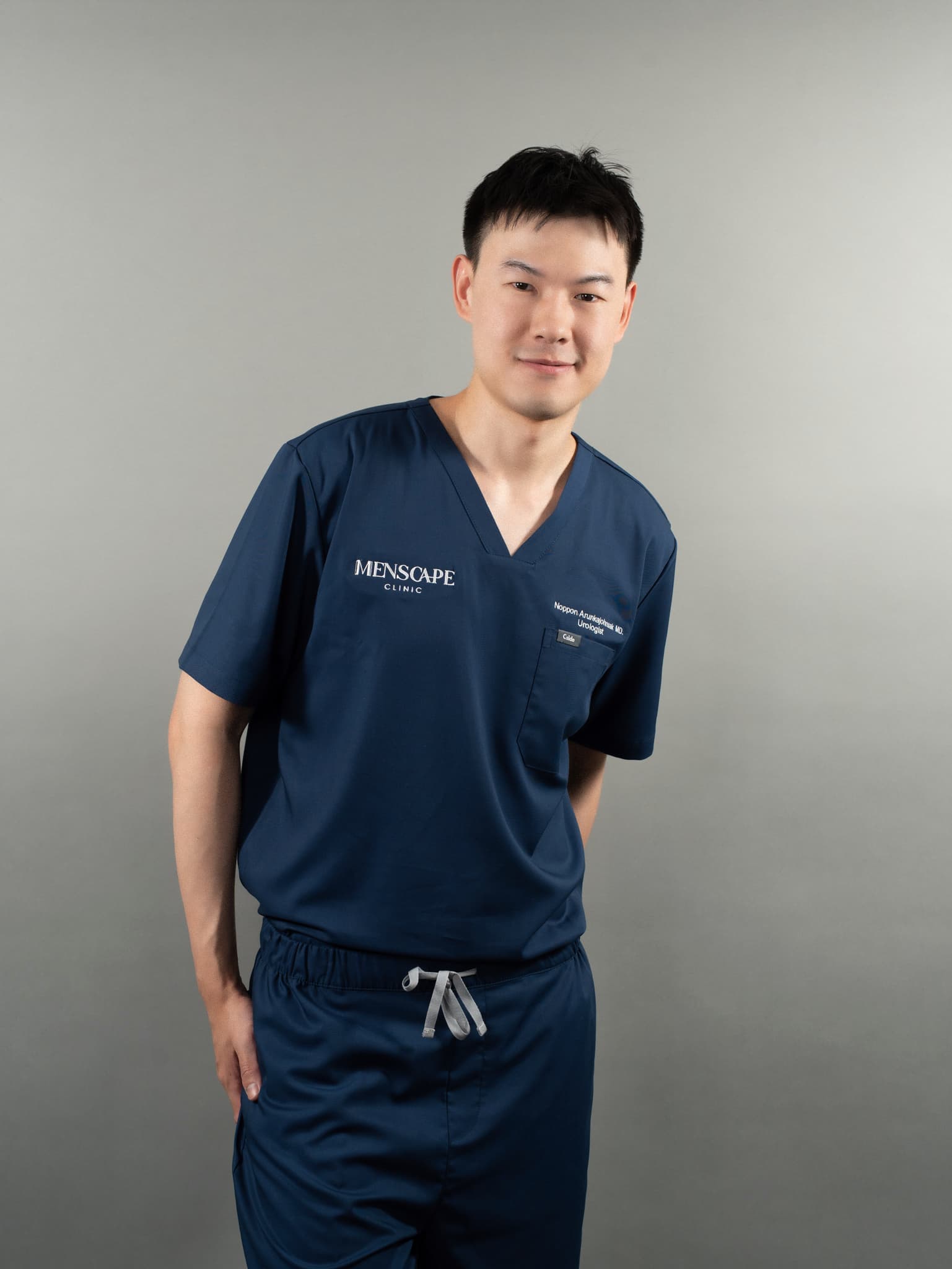
At Menscape, the urology pathway is built around a clear assessment first: a consultation, a review of your CT KUB, and a frank discussion of whether ESWL is genuinely the best route for your stone or whether laser ureteroscopy or another option would serve you better. We treat international patients regularly, so records can be reviewed ahead of travel, the plan is explained in plain English, and the quote is itemised rather than vague.
ESWL is a medical procedure that requires a consultation and, in practice, a prescription-level decision by a urologist after imaging. We will not price a stone we have not assessed, and we will tell you honestly if shockwave treatment is not the right choice for you.
Book an ESWL consultation in Bangkok
If you have a diagnosed kidney stone, or symptoms that point to one, the next step is an assessment so you can see a real, itemised quote and a treatment plan matched to your stone. Book a urology consultation with Menscape Bangkok, or message us with your scan to discuss your options before you travel. You can also read our companion guides on kidney stone treatment costs and procedures and ureteric stone treatment costs.
*This article is general information, not medical advice. ESWL requires an in-person urology consultation, imaging and a clinician's prescription-level decision. Prices are indicative for planning and should be confirmed at consultation.*
Frequently Asked Questions
How much does ESWL cost in Bangkok?
A single ESWL session at a mid-tier private hospital in Bangkok typically runs about THB 30,000 to 80,000 (roughly USD 910 to 2,450). JCI-accredited international hospitals often quote THB 120,000 or more, though simpler single-session packages can start nearer THB 85,000. On top of the procedure, budget for pre-procedure imaging (a CT KUB and labs, about THB 5,000 to 20,000) and consultation and follow-up visits. Every figure is indicative; your real quote should follow a urology consultation and a CT scan.
Is ESWL in Bangkok cheaper than in the US or UK?
For self-paying patients, usually yes. The US average for lithotripsy is around USD 12,800 (commonly USD 7,250 to 16,450), and UK private fees tend to sit around GBP 3,000 to 5,000. A mid-tier Bangkok session at THB 30,000 to 80,000 (about USD 910 to 2,450) is well below both, and even a premium JCI hospital often comes in under US pricing. Many patients still save after adding flights and accommodation, though the right clinical choice should lead over price alone.
How many ESWL sessions will I need?
Many stones clear in a single session, but a meaningful minority need a second or occasionally a third. In published series, roughly 59 percent of patients were stone-free after one session and about 77 percent cumulatively after two, with little added benefit from a third. Most urologists cap retreatment at about three sessions. Each session is priced separately, so ask in advance what a second sitting would cost.
What size kidney stone can ESWL treat?
ESWL works best on stones roughly under 20 mm (2 cm), and especially well on stones 10 mm or smaller, where stone-free rates can approach 99 percent. Above about 20 mm, or for staghorn stones, success drops sharply and ureteroscopy or percutaneous surgery (PCNL) usually clears more in one go. Very dense stones, such as some cystine or brushite stones, also resist shockwaves regardless of size.
Does ESWL hurt, and what is recovery like?
ESWL is done under light sedation or deeper anaesthesia, so the procedure itself is generally comfortable; if lightly sedated you may feel a tapping sensation along your side. Afterward, expect some flank soreness and pink-tinged urine for a few days and intermittent colicky pain as fragments pass. Most people return to normal activities within a few days, with fragments continuing to clear over one to four weeks.
Who should not have ESWL?
ESWL is generally avoided in pregnancy, in people with untreated bleeding disorders or unmanaged blood-thinner use, with an active untreated urinary infection, with an obstruction below the stone, or with poorly controlled high blood pressure or a significant abdominal aortic aneurysm. It is also a poor choice for very large, staghorn or very hard stones. The pre-procedure assessment exists specifically to screen for these situations.
What are the risks of ESWL?
Most side effects are mild and short-lived: blood in the urine for a few days, flank soreness and bruising, and crampy pain as fragments pass. Less commonly, fragments can line up and block the ureter (steinstrasse, about 3 percent of cases) or bleeding can occur around the kidney (roughly 1 to 4.6 percent). Seek urgent care for fever or chills, heavy bleeding, severe pain not controlled by medication, or inability to pass urine.
What is included in an ESWL quote in Bangkok?
A comprehensive quote usually covers the urology consultation, the ESWL procedure and use of the lithotripter, sedation or anaesthesia, recovery-room observation, and follow-up imaging to confirm clearance. Pre-procedure imaging such as a CT KUB may be quoted separately. Always ask explicitly what is included, what is excluded, and what a second session would cost, and get it in writing.
Do I need a consultation and scan before ESWL?
Yes. ESWL cannot be responsibly planned or priced without a urology consultation and a recent CT KUB scan that shows the stone's size, density and position. Those details determine whether ESWL is suitable at all, how many sessions are likely, and the final cost. Be cautious of any clinic that quotes a firm price before reviewing your imaging.
)
/)
/)
/)
/)
/)