/)
A defined jawline has become one of the most requested aesthetic goals among men, and Bangkok has grown into a serious destination for it. The city combines experienced injectors and surgeons, internationally accredited hospitals, and pricing that is often a fraction of what the same work costs in the United States, the United Kingdom or Australia. That mix is attractive, but it also makes the market noisy, and price alone is a poor way to choose where to put a needle or a scalpel near the nerves of your face.
This guide lays out what jawline contouring for men actually costs in Bangkok in 2026, in Thai baht with US dollar equivalents, alongside the parts that matter just as much: which technique suits which face, who should not have it, what recovery really looks like, the risks worth taking seriously, and how to tell a safe clinic from a dangerous one. Pricing here is indicative and meant for planning. Your exact quote depends on your anatomy and goals and should be confirmed at an in-person consultation.
What "jawline contouring" actually means for men
Jawline contouring is an umbrella term, not a single procedure. For men it usually targets the lower third of the face: the angle of the jaw (the gonial angle), the projection and width of the chin, the sharpness of the line where the jaw meets the neck, and the amount of fat sitting under the chin and along the jaw. The goal in male patients is typically a stronger, more angular, slightly wider lower face, which is different from the softer, more tapered shaping many female patients ask for.
That sex difference is not cosmetic folklore. The gonial angle tends to sit a little sharper in men, and male facial proportions read as more masculine when the jaw is wider and the chin projects well. It is worth noting that more is not automatically better. Research on perceived attractiveness suggests a threshold effect, where slightly above-average masculinity tends to be preferred and very extreme masculinisation is not (Ekrami et al., 2020). In practice that means a good result usually looks like a sharper version of your own face, not a cartoon. A surgeon who understands male aesthetics is aiming for balance, not maximum angularity.
The tools to get there fall into two broad camps.
Non-surgical contouring uses injectable filler to add structure along the jaw and chin. It is fast, has little downtime, and is partly or fully reversible depending on the product. It adds volume and definition but cannot remove bone or large amounts of fat.
Surgical contouring changes the underlying framework. Chin and jaw-angle implants add permanent projection and width. Genioplasty repositions the chin bone itself. Liposuction removes fat under the chin and jaw. Buccal fat removal slims the mid-to-lower cheek. These produce bigger, lasting changes but involve anaesthesia, real recovery, and a higher risk profile.
Most men are candidates for one camp or the other, and some benefit from a staged combination. The only way to know which applies to you is an assessment of your jaw width, chin projection, skin and fat distribution, and bone structure.
Jawline contouring prices in Bangkok (2026)
The tables below reflect typical Bangkok ranges gathered from clinic price lists, hospital package pages and medical-tourism platforms in late 2025 and early 2026. USD figures use an approximate rate of 32-34 THB to 1 USD (calculated here at 33) and will move with the exchange rate. Treat every number as indicative and confirm at consultation, because the final price depends on the number of syringes, implant size, surgeon seniority and the level of facility.
Non-surgical (injectable) jawline contouring
Option | Price (THB) | Approx. USD | Notes |
Hyaluronic acid (HA) filler, per syringe | 10,000 - 22,000 | ~300 - 665 | Reversible; most men need 2-6 syringes for a full jaw and chin |
Calcium-based filler (e.g. Radiesse), per syringe | 15,000 - 26,000 | ~455 - 790 | More structural, longer-lasting; not reversible with hyaluronidase |
Full non-surgical jaw + chin (typical course) | 25,000 - 90,000 | ~760 - 2,725 | Depends on syringe count and product; price scales with volume |
Surgical jawline contouring
Procedure | Price (THB) | Approx. USD | Notes |
Chin implant (alloplastic) | 35,000 - 90,000 | ~1,060 - 2,725 | Often sold as a package (~40,000-49,000 THB) with 1 night stay |
Jaw / mandibular angle implants | 80,000 - 250,000 | ~2,425 - 7,575 | Adds width and angularity; technically demanding. Custom CT-designed implants from premium surgeons sit at the top of this range |
Sliding genioplasty (chin bone surgery) | 90,000 - 250,000 | ~2,725 - 7,575 | Repositions the chin bone; bigger change than an implant. Top surgeons price toward the upper end |
Chin / neck liposuction | 25,000 - 60,000 | ~760 - 1,820 | Removes submental fat; sharpens the jaw-neck line |
Buccal fat removal | 25,000 - 50,000 | ~760 - 1,515 | Slims lower cheeks; use cautiously in men |
Full surgical jawline package (combination) | 120,000 - 300,000+ | ~3,635 - 9,090+ | Multiple procedures in one plan |
How Bangkok compares with the US, UK and Australia
Procedure | Bangkok (USD) | US / UK / Australia (USD, typical) | Indicative saving |
Jawline filler (per syringe) | ~300 - 665 | ~700 - 1,200 | ~40-60% |
Chin implant | ~1,060 - 2,725 | ~3,000 - 7,000 | ~50-65% |
Jaw angle implants | ~2,425 - 7,575 | ~6,000 - 15,000 | ~50-70% |
Submental liposuction | ~760 - 1,820 | ~2,500 - 5,000 | ~50-65% |
Savings vary by surgeon, facility and your home market, and these comparisons exclude flights and accommodation. Even so, the gap is large enough that many men travel specifically for it. The sensible way to read this is that Bangkok lets you buy a more experienced surgeon and a better facility for the same money, not simply a cheaper version of the same thing.
What drives the cost
Two men can get the same procedure name and pay very different prices. The main reasons:
Technique and volume. Filler is priced per syringe, so a man who needs six syringes pays roughly three times one who needs two. For surgery, larger or custom implants and longer operating time cost more.
Surgeon experience. A surgeon with a long track record in male facial work and a portfolio of before-and-after results charges more, and is usually worth it for a permanent change to your face.
Facility level. A JCI-accredited hospital with a full surgical theatre and anaesthesia team costs more than a small clinic. For anything surgical, that overhead is a safety feature, not a markup to resent.
Product and implant choice. Premium HA fillers, calcium-based products and higher-grade implant materials (medical silicone, ePTFE, porous polyethylene) all sit at different price points.
Complexity and revisions. Significant asymmetry, a heavy or sagging neck, a previously operated jaw, or correcting someone else's work all add time and cost.
Package inclusions. A quoted surgical package may or may not include the implant, anaesthesia, hospital stay, medications, garments and follow-up. Always ask what is and is not in the number.
Who is a good candidate, and who is not
Good candidates for non-surgical filler contouring are generally men with reasonable skin quality who want added definition along the jaw or more chin projection, who prefer little downtime, and who are comfortable with a result that is temporary and may need maintenance. Filler is also a useful way to preview the kind of change an implant would make, without committing to surgery.
Good candidates for surgical contouring are men in good general health who want a permanent change to bone structure or fat, who have realistic expectations, and who can take the recovery time. Liposuction works best when the issue is fat rather than loose skin; chin and jaw implants suit men whose underlying projection or width is genuinely deficient.
This is not for everyone. Filler and surgery are generally not advised, or need careful individual assessment, in the following situations:
Active skin infection, acne or inflammation over the treatment area.
A known allergy to the filler material, anaesthetic, or implant material.
Bleeding disorders or use of blood thinners that cannot be safely paused.
Poorly controlled diabetes or other conditions that impair healing (relevant for surgery).
Pregnancy or breastfeeding, where elective injectables and surgery are usually deferred.
Body dysmorphic concerns or expectations that no procedure can realistically meet. A responsible clinic will decline rather than operate.
For buccal fat removal specifically, men who are lean or have naturally narrow faces, because removing cheek fat can cause a gaunt, prematurely aged look later. This is a procedure to approach conservatively.
A proper consultation should screen for all of the above. If a clinic is willing to inject or operate without taking a medical history, that is a problem in itself.
Step-by-step: what each procedure involves
Filler contouring is an outpatient visit. The injector assesses your face, marks key points along the jaw and chin, cleans the skin, and usually applies a numbing cream or uses filler that contains local anaesthetic. Product is placed in small amounts, often down to the bone along the jaw angle and chin, then moulded. The whole thing typically takes 30-60 minutes and you walk out the same day.
Chin or jaw implant surgery is done under general or deep sedation. The surgeon makes an incision, usually inside the mouth or under the chin, creates a precise pocket on the bone, places and fixes the implant, then closes. Operating time is roughly one to two hours depending on whether one or both jaw angles are addressed. Most chin implants involve a one-night stay or day surgery; jaw-angle work more often warrants an overnight.
Submental liposuction is done under local or general anaesthesia through tiny incisions under the chin. The surgeon removes fat with a thin cannula to sharpen the jaw-neck transition. A compression garment is fitted afterwards.
Sliding genioplasty is a bone procedure: the surgeon cuts and repositions the chin bone, then fixes it with small plates. It is more involved than an implant but avoids a foreign material and can move the chin in directions an implant cannot.
Whatever the plan, surgical jawline contouring requires a prescription and must be performed by a licensed surgeon in an accredited facility. It is not something to arrange casually or to buy purely on price.
Recovery, staged by procedure
After filler: Most men have mild swelling, tenderness and occasional small bruises for a few days. You can usually return to desk work the next day. Strenuous exercise, heat (saunas, hot yoga) and alcohol are best avoided for 24-48 hours to limit swelling and bruising. The final shape settles over one to two weeks as any swelling resolves.
After a chin or jaw implant:
*Days 1-3:* Noticeable swelling and tightness, managed with cold compresses, head elevation and prescribed medication. A soft diet if the incision is intraoral.
*Week 1:* Sutures and any tape often removed around day 5-7. Bruising starts to fade. Many men return to non-physical work near the end of this week.
*Weeks 2-4:* Most visible swelling subsides. Light activity resumes; avoid contact sports and anything that could strike the face.
*Weeks 6-12+:* Residual swelling continues to settle and the result refines. The implant feels progressively more natural and the area less tight.
After liposuction: Expect a compression garment for several weeks, swelling and firmness that ease over one to three months, and a return to the gym typically around two to four weeks depending on the surgeon's guidance. The sharpest line is visible once swelling fully resolves.
Healing varies between individuals. Follow your surgeon's specific instructions over any generic timeline, including this one.
What results to expect, and how long they last
Filler gives an immediate change you can see on the table, with the final look settling within one to two weeks. Longevity is the part most often oversold. Manufacturers and many clinics quote 12-18 months for HA jaw filler, and a 12-month prospective case series did find that improvement in jawline and chin scores was largely maintained through one year with few adverse events (JPRAS Open, 2025). A systematic review of chin filler similarly reported durations averaging around 13 months, ranging from a few months to over 18 (Cureus, 2023). Interestingly, MRI work suggests small amounts of HA can linger far longer than the visible cosmetic effect, with filler detectable years after injection even once it no longer holds its shape (PRS Global Open, 2024). The practical takeaway: budget for a top-up every 12-18 months to maintain the look, while knowing the material itself may persist longer than that.
Implants and genioplasty are designed to be permanent. The change is stable once healed, which is exactly why surgeon selection and implant sizing matter so much. A well-placed chin or jaw implant should give a lasting, natural strengthening of the lower face.
Liposuction results are long-lasting because removed fat cells do not return, although significant weight gain can still change the area. The sharper jaw-neck line is usually permanent if your weight stays stable.
Have a question about your treatment?
Message our Bangkok clinic on WhatsApp and a doctor replies within minutes during clinic hours.
Risks and side-effects
Every option here carries risk. Most issues are minor and temporary, but a few are serious and worth understanding before you commit.
Common, usually temporary: swelling, bruising, tenderness, redness, temporary numbness, and minor asymmetry that settles as swelling resolves. These apply to both filler and surgery in varying degrees.
Filler-specific serious risks: The one that matters most is vascular occlusion, where filler blocks or compresses a blood vessel. It is uncommon but can cause skin death or, very rarely, vision loss, and it is a medical emergency. Published guidance stresses recognising it early: sudden or escalating pain out of proportion to the injection, skin that blanches white and then turns a mottled or dusky purple, and any change in vision are all warning signs that require immediate treatment, usually with the enzyme hyaluronidase (J Clin Aesthet Dermatol, 2021). This is a major reason to choose an injector who is trained to manage complications and keeps hyaluronidase on hand, not whoever is cheapest. Other filler risks include infection, nodules, and the Tyndall effect (a bluish tint if placed too superficially).
Surgery-specific serious risks: Implant procedures carry the recognised risks of infection, implant malposition or shifting, the need for revision or removal, and nerve-related problems such as temporary or, rarely, lasting numbness or altered sensation in the lip and chin from irritation of the mental nerve. A systematic review of chin implant materials found overall complication rates that were low (around 3-5% for common materials like silicone and ePTFE), but not zero, with malposition, infection and dissatisfaction among the issues recorded (PRS Global Open, 2022). Long-term, implants can also cause some bone remodelling underneath. Genioplasty and liposuction add their own risks including bleeding, contour irregularity and, for liposuction, asymmetry.
Seek urgent medical care if you develop any of the following after a procedure: severe or worsening pain not controlled by your prescribed medication, the skin near a filler injection turning pale then dusky or developing blisters, any change or loss of vision, spreading redness with fever or pus (signs of infection), or sudden significant swelling on one side. These are not "wait and see" situations. Contact your treating clinic or go to an emergency department immediately.
How to choose a safe clinic in Bangkok
Bangkok has excellent surgeons and injectors. It also has operators who will inject filler in a back room or do surgical contouring outside a proper facility. Use these criteria to separate them:
Accreditation and setting. For surgery, insist on a licensed hospital or accredited surgical facility, ideally JCI or an equivalent standard, with a qualified anaesthesia team. Filler should be done in a clean clinical setting by a medical professional, not a spa.
Credentials you can verify. A board-certified plastic or maxillofacial surgeon for bone and implant work; a qualified, experienced doctor for injectables. Ask to confirm their registration, not just see a framed certificate.
Genuine male before-and-after photos. Ask specifically for results in male patients, since male and female jaw goals differ. Be wary if a clinic can only show female cases or stock images.
Complication readiness. For filler, the clinic should keep hyaluronidase and know the vascular-occlusion protocol. For surgery, ask how complications and revisions are handled and who you call after hours.
A real consultation. A proper assessment measures jaw width, chin projection and facial proportions, takes a medical history, and discusses what suits you, including saying no when a procedure is not appropriate.
Transparent, itemised pricing. You should get a written quote that spells out inclusions. Vague all-in numbers that change later are a warning sign.
Red flags that should make you walk away
Pricing that is dramatically below everyone else, which usually means cut corners, inexperienced hands, or counterfeit product.
No male-specific experience or portfolio.
Pressure to decide today, or upselling you into procedures you did not come for.
Surgical contouring offered outside a hospital or accredited theatre.
Reluctance to discuss risks, complications or who manages them.
Injectors who will not confirm what product they are using or its origin.
Comparison: which option fits which goal
Filler | Chin implant | Jaw angle implants | Submental liposuction | |
Best for | Quick definition, previewing an implant | Weak chin projection | Narrow or weak jaw angle | Fat under the chin/jaw |
Permanence | Temporary (top-ups) | Permanent | Permanent | Long-lasting |
Downtime | Minimal (1-2 days) | 1-2 weeks visible | 1-3 weeks visible | 1-3 weeks, garment |
Anaesthesia | Topical / in-product | General or sedation | General or sedation | Local or general |
Reversible | HA: yes; calcium-based: no | Removable, but surgery | Removable, but surgery | No |
Bangkok cost (THB) | 25,000 - 90,000 | 35,000 - 90,000 | 80,000 - 250,000 | 25,000 - 60,000 |
Main risk to know | Vascular occlusion | Malposition, infection | Malposition, nerve issues | Asymmetry, contour |
Many men start with filler to test the look, then move to surgery if they want it permanent. There is no single right answer; the best plan is the one matched to your anatomy and goals at consultation.
Booking a consultation
The honest first step is an in-person assessment. Photographs and price lists can only take you so far, because the right procedure depends on the structure of your specific face, your health, and what you actually want to change. A consultation lets a clinician measure your proportions, talk through the realistic options and their costs, and flag anything that makes a given procedure unsuitable.
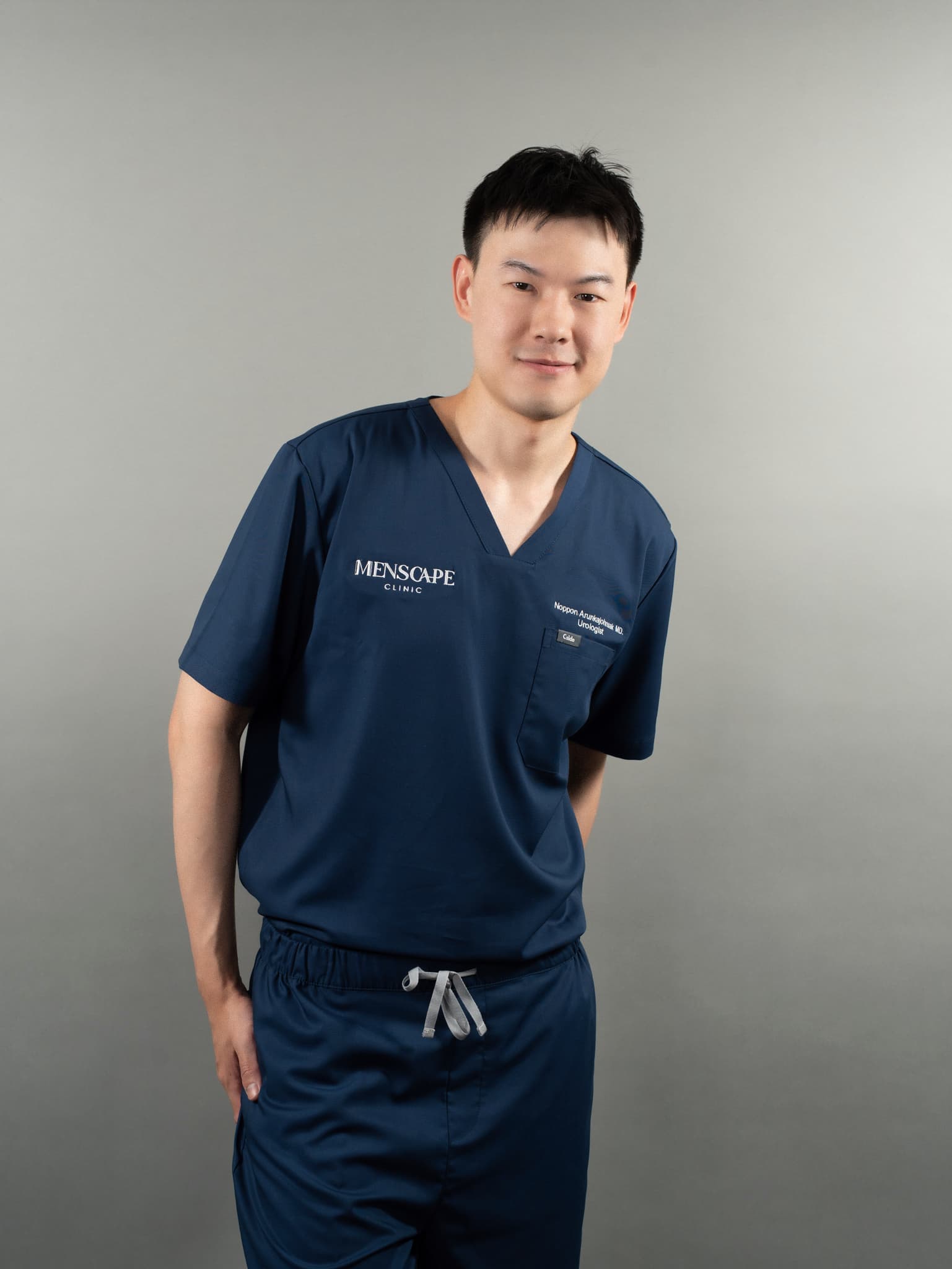
If you would like to explore jawline contouring, book a consultation with Menscape for a male-focused assessment and a transparent, itemised quote. Note that all of these treatments require a medical consultation, and the surgical options require a prescription and a licensed surgeon, so plan for an evaluation before any procedure is scheduled. You can also read more about men's aesthetic treatments to see how jawline work fits alongside other options.
Frequently Asked Questions
How much does male jawline contouring cost in Bangkok?
As a rough guide for 2026, non-surgical filler contouring runs about 25,000-90,000 THB depending on how many syringes you need, a chin implant about 35,000-90,000 THB, jaw angle implants about 80,000-250,000 THB (custom CT-designed implants sit at the top of that range), and a combined surgical package 120,000-300,000+ THB. These are indicative ranges; your exact quote depends on your anatomy, the surgeon and the facility, and should be confirmed at consultation.
Is jawline filler or a jaw implant better for men?
Neither is universally better. Filler is fast, low-downtime, partly or fully reversible, and good for adding definition or previewing a change, but it is temporary and adds volume rather than removing fat or bone. Implants and genioplasty give a permanent, structural change for men whose chin or jaw angle is genuinely underprojected, at the cost of surgery and recovery. Which suits you depends on your anatomy and goals, decided at consultation.
How long does jawline filler last?
Most hyaluronic acid jaw filler maintains its cosmetic effect for roughly 12-18 months, and chin filler studies report an average around 13 months. Calcium-based products can last somewhat longer. Plan on a top-up every 12-18 months to keep the look, although imaging studies show small amounts of filler material can persist in the tissue for longer than the visible effect lasts.
Is jawline filler reversible?
Hyaluronic acid (HA) fillers are reversible: an injector can dissolve them with the enzyme hyaluronidase if you dislike the result or in an emergency such as vascular occlusion. Calcium-based fillers like Radiesse are not reversible in the same way, which is one reason to choose your injector and product carefully.
How long is recovery after a chin or jaw implant?
Most men return to non-physical work within about a week, when sutures and tape typically come out. Visible swelling largely settles over two to four weeks, and the result continues to refine for up to three months as residual swelling resolves. Avoid contact sports and blows to the face during early healing, and follow your surgeon's specific guidance.
What are the most serious risks of jawline contouring?
For filler, the most serious risk is vascular occlusion, where filler blocks a blood vessel; it is uncommon but can cause skin death or, rarely, vision loss, and is a medical emergency. For surgery, the notable risks are infection, implant malposition or shifting, the need for revision, and temporary or rarely lasting numbness in the lip and chin. Choosing a skilled provider in an accredited setting markedly lowers these risks.
When should I seek urgent care after a procedure?
Seek urgent medical care if you have severe or worsening pain not controlled by your medication, skin near a filler injection that turns pale then dusky or blisters, any change or loss of vision, spreading redness with fever or pus, or sudden one-sided swelling. These can signal vascular occlusion or infection and need immediate attention. Contact your clinic or go to an emergency department right away.
Is buccal fat removal a good idea for men?
It can help men with genuinely full lower cheeks who want a slimmer, more sculpted look, but it should be approached conservatively. Removing cheek fat from a lean or naturally narrow face can cause a hollow, prematurely aged appearance years later. A responsible surgeon assesses whether your face has fat to spare and will advise against it when it does not.
Do I need a consultation, or can I just book the procedure?
You need an in-person medical consultation first. The right procedure depends on your jaw width, chin projection, fat distribution, skin quality and general health, none of which can be judged from price lists or photos alone. Surgical options additionally require a prescription and a licensed surgeon in an accredited facility, so an evaluation always comes before any procedure is scheduled.
)
/)
/)
/)
/)
/)