/)
A firm or puffy chest that will not flatten no matter how lean you get is one of the most common reasons men come to a clinic for body contouring. The frustrating part is that for most of these men, the gym was never going to fix it. True gynecomastia is enlarged glandular tissue, not fat, and gland does not shrink with diet, cardio, or chest day. Surgery is the only consistently effective correction.
This guide walks through the surgical options for men, what each technique actually does, transparent Bangkok pricing in both Thai baht and US dollars, who is and is not a good candidate, what recovery looks like week by week, the real risks, and how to tell a safe clinic from a cheap one. It is written for the man weighing whether to have this done, and where.
If you want the clinical background first, our companion piece on the gynecomastia surgery procedure for men covers causes, diagnosis, and what happens in the operating room in more detail. This article focuses on choosing between options and understanding cost.
Gynecomastia, briefly: why exercise does not fix it
Gynecomastia is the enlargement of breast tissue in men. It is extremely common. Reviews of the condition report that a large share of men have at least some palpable breast tissue, and prevalence rises again with age, with one endocrinology reference citing roughly 36-57% in men over 60 (Swerdloff & Ng, Endotext, 2023).
The important distinction for surgery is what the lump is made of:
True (glandular) gynecomastia is firm, rubbery tissue sitting directly behind and around the nipple. It is driven by the balance between testosterone and estrogen, and almost any condition or drug that raises estrogen relative to androgen can trigger it.
Pseudogynecomastia is fatty tissue spread more diffusely across the chest, typical in men carrying extra weight. It is soft rather than firm.
Mixed chests, which are the most common presentation in clinic, have both gland and fat.
This matters because fat can sometimes be reduced with weight loss and liposuction, but glandular tissue cannot. Once gland is established, it stays. An endocrinology review notes that after roughly six months the tissue becomes fibrotic and regression is unlikely, which is why long-standing gynecomastia that has not responded to medical management is referred for surgery (Swerdloff & Ng, Endotext, 2023). If your chest is firm under the nipple and has not changed in a year despite getting leaner, gland is the likely reason, and an operation is the realistic fix.
A quick but important caveat: a new, tender, or rapidly changing breast lump in a man should be assessed medically before anyone talks about cosmetic surgery, because a small number of cases point to an underlying hormonal or medical issue that needs treating in its own right.
The surgical options for men
There are three core approaches. Most men do not choose between them in isolation; the surgeon recommends one based on how much is gland versus fat and how much skin is involved.
1. Liposuction alone
Best for chests that are mostly fat with little firm glandular tissue (pseudogynecomastia, or mild mixed cases). Through one or two tiny incisions at the edge of the chest or in the fold, the surgeon suctions out fat and sculpts the contour to follow the natural lines of the pectoral muscle.
Energy-assisted versions (such as VASER ultrasound-assisted or power-assisted liposuction) help break up denser tissue and can tighten skin modestly as they go, which suits the fibrous male chest.
Scars are minimal, often a few millimetres and easily hidden.
It does not remove firm gland. If there is real glandular tissue, liposuction alone tends to leave a residual disc behind the nipple, which is a common reason men need a revision.
2. Gland excision (the puffy-nipple correction)
Best for the classic firm or "puffy nipple" presentation, where there is a button of gland directly under the areola. The surgeon makes a small incision along the lower edge of the areola (the periareolar approach), removes the glandular tissue, and feathers the edges so the chest sits flat.
Directly addresses what liposuction cannot.
The scar follows the natural border of the areola and usually fades well.
Used alone, excision has historically carried a higher rate of bleeding-related complications than the other approaches, which is part of why most surgeons now pair it with liposuction (more on this below).
3. Combined liposuction plus gland excision
This is the workhorse for most men, because most chests are mixed. Liposuction debulks and contours the fatty component and the surrounding chest, then a small areolar incision removes the firm gland. The two together produce a flat, even, masculine result that neither does as reliably on its own.
Crucially, the combined approach is also the safest in the published evidence. A systematic review of 94 studies and 7,294 patients found the lowest overall complication rate in the combined-technique group at 11.76%, compared with 30.64% for surgical excision alone and 14.87% for aspiration (liposuction) techniques alone (Innocenti et al., *Aesthetic Plastic Surgery*, 2022). The authors concluded that combining excision with aspiration appears to reduce complications versus excision alone.
Skin tightening for severe or post-weight-loss cases
When gynecomastia is severe, or follows major weight loss, there can be loose skin that will not retract on its own. In those cases the surgeon may need to remove skin as well, which means a longer scar (sometimes around or below the areola, occasionally more). This is the smallest group of patients but the most complex, and it sits at the top of the price range.
What it costs in Bangkok: THB, USD, and savings versus the West
Pricing depends mostly on how much work the chest needs: a pure puffy-nipple excision is at the lower end, while a severe gland-plus-fat-plus-skin case is at the top. The table below reflects typical Bangkok ranges from clinic price lists as of 2026. Figures are indicative; confirm your exact quote at consultation, because it is set by your grade, technique, and the operating facility. USD is converted at roughly THB 36 to the dollar.
Case type / technique | Bangkok price (THB) | Approx. USD | Typical US price (USD) | Indicative saving vs US |
Mild, fat-dominant (liposuction only) | 55,000-90,000 | ~1,530-2,500 | 4,250-9,500 | ~55-75% |
Moderate / mixed (lipo + gland excision) | 80,000-130,000 | ~2,220-3,610 | 4,250-9,500 | ~45-65% |
Severe or gland-dominant (+ skin tightening) | 130,000-180,000 | ~3,610-5,000 | 6,000-10,600 | ~40-55% |
VASER / energy-assisted upgrade | 90,000-160,000 | ~2,500-4,440 | 5,500-11,000 | ~45-60% |
For reference points behind these ranges: published Bangkok averages sit around USD 2,000 for a straightforward case, with major hospitals quoting roughly THB 71,000 for a simple gland removal up to THB 160,000 with VASER liposuction, and clinic packages commonly landing in the THB 120,000-135,000 band for combined work. By contrast, gynecomastia surgery in the United States is widely cited at roughly USD 4,250-9,500 (averaging near USD 7,000 once facility and anaesthesia are added), and in the UK typically £3,500-6,000+. Even after flights and a hotel, the gap is the main reason men travel.
A note on what "the price" should include. A transparent quote covers the surgeon's fee, the operating room and anaesthesia, the compression garment, medications, and follow-up visits. Ask explicitly whether all of those are bundled, because a low headline number that excludes anaesthesia or the facility fee is not actually cheaper.
What drives the cost up or down
How much is gland versus fat. More firm tissue means more excision and more operating time.
Technique. Energy-assisted liposuction (VASER, BodyTite-type devices) costs more than standard liposuction.
Skin removal. Tightening loose skin adds time, complexity, and scarring, and raises the price.
Surgeon experience. Surgeons who do male chest work in volume generally charge more, and for this operation that experience genuinely shows in the result.
Facility. A fully accredited hospital operating room with a dedicated anaesthesia team costs more than a small day-surgery clinic, and for anything beyond the mildest case that is usually money well spent.
Who is a good candidate, and who is not
Gynecomastia surgery tends to work best for men who:
have a firm or puffy chest that has not changed for at least 12 months,
are at or near a stable weight,
are in good general health and are non-smokers or willing to stop well before and after surgery,
understand the scar trade-offs, and
want a one-time correction rather than to keep chasing it in the gym.
It is a poor fit, or should wait, if you:
have a new, tender, hard, or one-sided lump that has not been medically evaluated (this needs a diagnosis first),
still have significant weight to lose, since losing fat afterwards can change the result and gaining it back can undo a fat-dominant correction,
are an active anabolic steroid user, because steroids are a well-documented driver of gynecomastia and operating while the cause is ongoing invites recurrence (one multicentre study identified anabolic steroids as the cause in 13.9% of adult cases, Costanzo et al., *BioMed Research International*, 2018), or
are still in the early, hormonally active phase of recent-onset gynecomastia, where medical management or simply waiting may be tried first.
Contraindications to take seriously
Surgery may be unsafe or need to be deferred if you have uncontrolled bleeding or clotting problems, an active infection, poorly controlled diabetes or heart disease, or an untreated underlying cause of the gynecomastia (for example significant hypogonadism, thyroid disease, or liver disease) that should be worked up first. Smoking meaningfully raises the risk of poor healing and skin or nipple complications, so most surgeons require you to stop for several weeks on either side of the operation. This is exactly the kind of thing a proper consultation is for, and why this procedure is prescription-only and cannot be booked like a haircut.
The procedure, step by step
Consultation and assessment. The surgeon examines the chest to judge how much is gland versus fat, checks skin quality and nipple position, and screens for any underlying cause. Photographs and a plan are agreed, and you get a firm quote. This step is mandatory; a remote price is not a surgical plan.
Anaesthesia. Mild, liposuction-only cases can sometimes be done under local anaesthetic with sedation. Combined or larger cases are usually done under general anaesthesia.
Liposuction (if used). Through one or two tiny incisions, fat is suctioned and the chest contour is shaped to follow the pectoral border.
Gland excision (if used). A small incision along the lower areolar edge gives access to remove the firm glandular button, with the edges feathered so the chest sits flat and even.
Skin tightening (only if needed). In severe or post-weight-loss cases, excess skin is removed; this is what adds longer scars.
Closure and dressing. Incisions are closed, a compression garment goes on, and you are monitored before going home the same day or after one night.
Most uncomplicated cases take roughly one to two hours.
Recovery, week by week
Recovery is generally manageable, and the milestones below are typical, though your surgeon's specific instructions always take priority.
First 72 hours. Expect swelling, bruising, tightness, and some soreness controlled with simple pain medication. A compression garment is worn essentially around the clock; many clinics specify roughly 24 hours a day for the first three days.
Week 1. Desk-based or light work is often possible within a few days to a week. Wound checks happen during this period, and non-dissolving sutures are typically removed around day 7.
Weeks 2-4. Swelling starts to settle and the chest begins to look flatter. Light exercise (walking, gentle lower-body work) is commonly allowed from about two weeks. The compression garment is usually stepped down to part of the day for several weeks to a few months.
Weeks 4-6. Most men resume more normal activity. Strenuous training is often cleared from around four weeks, with direct chest workouts (heavy pressing) typically held until about six weeks, on surgeon sign-off.
Months 2-6. Residual swelling continues to resolve and scars fade and soften. The final contour settles over several months.
Wearing the garment as instructed, avoiding nicotine, and not rushing back to heavy lifting are the three things most within your control that protect the result.
Results: what to actually expect
For men with true glandular gynecomastia, results are usually permanent, because once the gland is removed it does not grow back. The American Society of Plastic Surgeons describes the outcome of gynecomastia surgery as a flatter chest with enhanced contours. The main exception is if an underlying driver returns: the literature is clear that if the original cause was a medication, anabolic steroids, or significant weight gain and that cause comes back, so can the gynecomastia.
In terms of patient experience, gynecomastia correction is consistently one of the higher-satisfaction body procedures for men, largely because the change is visible immediately and lets men do things they had been avoiding, going shirtless, wearing fitted shirts, swimming, without the self-consciousness. What it does not do is build a pectoral muscle; it removes what should not be there and reveals the chest underneath, which is why pairing surgery with training afterwards gives the best-looking result.
Recurrence after well-executed surgery is uncommon. In the 7,294-patient systematic review, revision or recurrence was recorded in roughly 1.2% of cases overall (Innocenti et al., 2022).
Have a question about your treatment?
Message our Bangkok clinic on WhatsApp and a doctor replies within minutes during clinic hours.
Risks and side effects
Gynecomastia surgery is generally safe in trained hands, but it is still surgery. Most men experience normal, temporary effects; a smaller number have true complications.
Common and expected (usually settle on their own):
swelling and bruising,
temporary numbness or altered sensation around the nipple and chest (the review recorded sensory changes in about 2.3% of patients as a reported complication, and milder transient numbness is more common than that),
tightness and mild discomfort,
small areas of firmness or unevenness during healing.
Less common complications:
Hematoma (a collection of blood), the single most frequently reported complication in the literature and the main reason surgeons favour the combined technique and careful control of bleeding,
seroma (fluid collection),
contour irregularities, dimpling, or a residual disc if gland was under-removed,
asymmetry between the two sides,
noticeable or raised scarring,
infection.
Seek urgent medical care if you notice: rapid or marked swelling of one side, especially with increasing pain and a tense, firm chest (possible hematoma); fever, spreading redness, warmth, or pus (possible infection); the skin or nipple turning dark, dusky, or blistering (a circulation warning sign); chest pain or shortness of breath; or a calf that is swollen, hot, and painful (a possible clot). These are not the routine soreness of a normal recovery and warrant a call to your surgeon or an emergency visit the same day.
How to choose a safe clinic, and the red flags
The difference between a good and a poor outcome for this specific operation is mostly the surgeon. A few things to verify:
A surgeon who does male chest work in volume. Ask directly how many gynecomastia cases they perform, and whether they do both liposuction and gland excision (you want someone who can do whichever your chest needs, not only the one they happen to offer).
Male before-and-after photos of men with a body type like yours. Generic galleries are not enough; you are looking for flat, even, scar-discreet male results.
The right technique offered. For a firm or puffy nipple, the plan should include gland removal, not liposuction alone.
A properly accredited facility with a licensed anaesthesia team and real sterilisation protocols, not a back-room setup.
A clear aftercare plan covering the compression garment, scar care, follow-up schedule, and who to contact out of hours.
Red flags worth walking away from:
pricing that is far below everyone else (for surgery, suspiciously cheap usually means corners cut on the operating room, anaesthesia, or the surgeon),
no male-specific before-and-after results,
a plan that skips gland removal when there is clearly firm tissue,
a general practitioner rather than a qualified plastic or cosmetic surgeon doing the operation,
pressure to book immediately or pay in full before a real consultation, and
vague or evasive answers about complications and revision policy.
Getting the surgeon wrong is how men end up with the outcomes nobody wants: a crater or dished area from over-aggressive liposuction, persistent gland from under-treatment, visible asymmetry, or a chest that looks feminised rather than masculine.
Comparing the three options at a glance
Liposuction only | Gland excision only | Combined (lipo + excision) | |
Best for | Fat-dominant / soft chest | Firm "puffy nipple" disc | Mixed gland-and-fat (most men) |
Removes firm gland | No | Yes | Yes |
Contours surrounding chest | Yes | Limited | Yes |
Scarring | Minimal (tiny ports) | Small areolar scar | Small areolar scar + ports |
Complication rate in literature* | ~14.9% | ~30.6% | ~11.8% (lowest) |
Handles loose skin | No | No | Add skin excision if needed |
Relative Bangkok cost | Lowest | Mid | Mid-high |
*Overall complication rates by technique group from Innocenti et al., *Aesthetic Plastic Surgery*, 2022 (94 studies, 7,294 patients). Rates reflect pooled literature, not any single clinic.
Why men choose Bangkok, and Menscape
Bangkok has a deep bench of surgeons doing high volumes of body-contouring and male chest work, modern energy-assisted equipment, and pricing that runs roughly 40-65% below US and UK clinics even before you factor in that a short recovery fits neatly into a trip. For an operation where the result is mostly down to surgical experience, that combination is hard to beat.
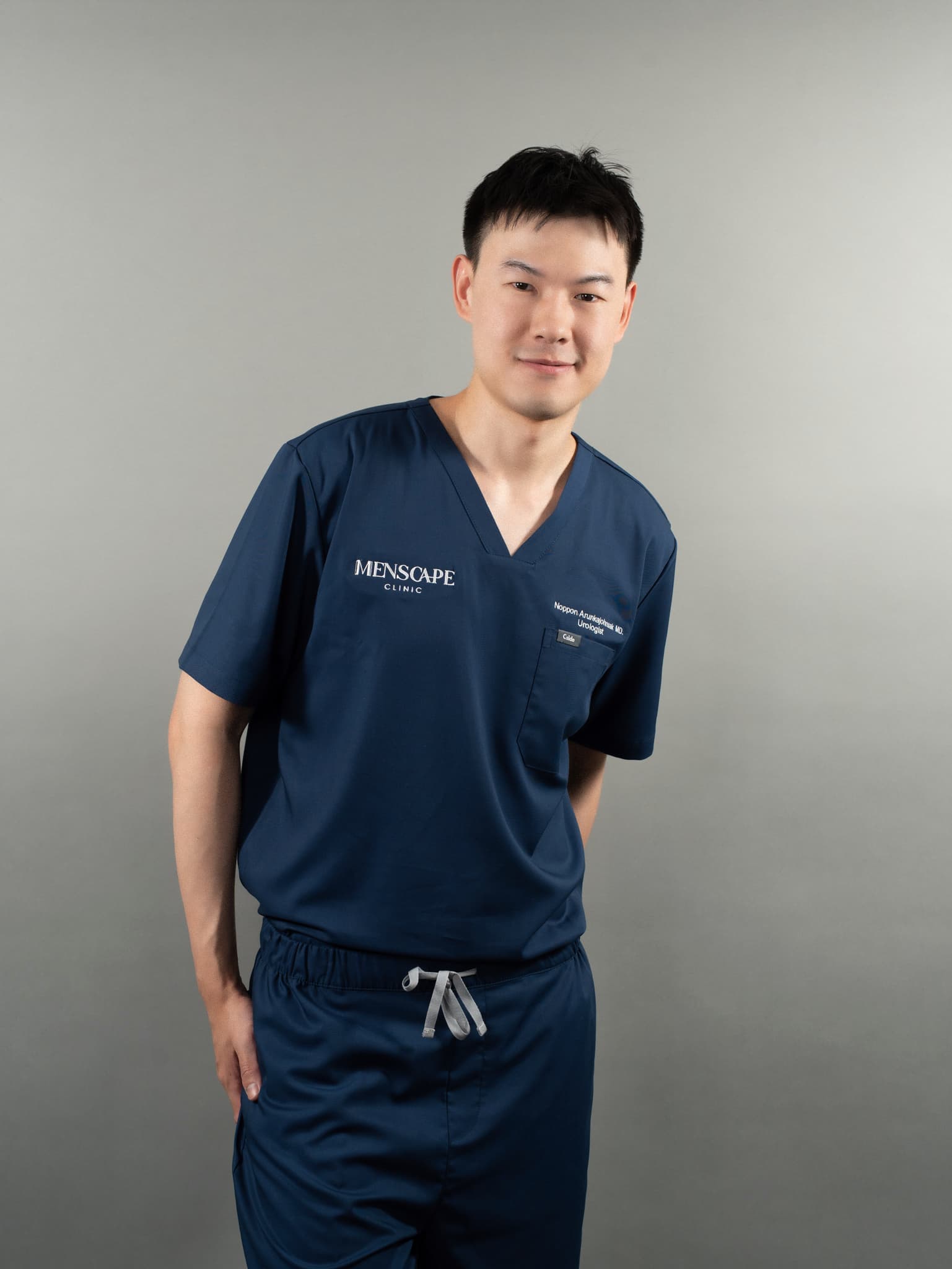
Menscape is built specifically around men's health and male aesthetics, which for gynecomastia matters more than it sounds: the whole assessment is framed around a masculine, athletic chest result and avoiding the feminised or over-resected look. We offer a personalised surgical plan after an in-person assessment, transparent pricing with the inclusions spelled out, a private and discreet environment, and structured aftercare and follow-up. If your concern is more fat than gland across the chest and flanks, our guides to liposuction for men and the related male liposuction cost in Bangkok may also be useful background.
A necessary note before you book
Gynecomastia surgery is a medical procedure that requires an in-person consultation and is performed under prescription by a qualified surgeon. No reputable provider can confirm your candidacy, your exact technique, or a firm price without examining your chest and reviewing your health history, and a new or changing breast lump should always be medically assessed first. Use this guide to understand your options, then get a proper assessment before deciding.
If a flatter, firmer chest is something you have been putting off, the next step is a confidential consultation to find out which option fits your chest and what it would cost. Book a consultation with Menscape Bangkok to get a personalised plan.
Frequently Asked Questions
Will exercise or weight loss get rid of gynecomastia without surgery?
Not if it is true glandular gynecomastia. The firm tissue behind the nipple is gland, not fat, and it does not respond to diet or training. Getting leaner can reduce the fatty (pseudogynecomastia) component and will make the chest look better overall, but it tends to leave a firm disc behind the nipple more visible. If your chest is soft and fatty, weight loss may help; if it is firm under the nipple and unchanged for a year, surgery is the reliable fix.
How much does gynecomastia surgery cost in Bangkok?
Roughly THB 55,000-180,000 (about USD 1,500-5,000) depending on grade and technique. Mild fat-dominant cases done with liposuction alone sit at the lower end; combined liposuction plus gland excision typically falls around THB 80,000-130,000; severe cases needing skin tightening or VASER are higher. These are indicative ranges, so confirm your exact quote at consultation, and check it includes the surgeon, operating room, anaesthesia, garment, and follow-up.
How much cheaper is Thailand than the US or UK?
Substantially. Gynecomastia surgery in the United States is commonly cited at roughly USD 4,250-9,500 (often averaging near USD 7,000), and in the UK at about £3,500-6,000 or more. Comparable surgery in Bangkok generally runs around 40-65% less, which is the main reason many men travel even after adding flights and accommodation.
Will the gynecomastia come back after surgery?
Usually not. Once glandular tissue is removed it does not regrow, and in a large review of more than 7,000 patients the revision or recurrence rate was about 1.2%. The main exception is if the original cause returns, for example resuming anabolic steroids, certain medications, or significant weight gain, which can bring back the fatty component or trigger new gland.
Is the scar noticeable?
For most men it is small and discreet. Liposuction leaves only a few millimetre port incisions. Gland excision is done through an incision along the lower border of the areola, where it tends to blend into the natural colour change and fade over months. Only severe or post-weight-loss cases that need skin removal involve longer scars, and your surgeon should show you where they would sit before you agree to anything.
When can I work out and lift again?
Light activity such as walking is usually fine within a few days, and light exercise from around two weeks. More strenuous training is often cleared from about four weeks, with heavy chest work (pressing, dips) typically held until around six weeks. Follow your surgeon's specific clearance, since returning to heavy lifting too early raises the risk of bleeding and swelling that can affect the result.
Will I lose feeling in my nipples?
Temporary numbness or altered sensation around the nipple and chest is common after surgery and usually recovers over weeks to a few months. Permanent change in sensation is uncommon; in the pooled literature, lasting sensory changes were reported in roughly 2% of cases. Your surgeon can talk you through the specific risk for your case.
Can both the gland and the fat be removed in one operation?
Yes, and for most men that is exactly the plan. Because the majority of male chests are a mix of gland and fat, surgeons most often combine liposuction (to contour the fat and surrounding chest) with a small areolar excision (to remove the firm gland). This combined approach also has the lowest complication rate in the published evidence.
Do I really need an in-person consultation, or can I just book from the price?
You need an in-person consultation. Gynecomastia surgery is a prescription medical procedure, and no one can responsibly confirm your candidacy, the right technique, or a firm price without examining your chest and reviewing your health history. A consultation also screens for any underlying hormonal or medical cause, which matters because a small share of cases point to a treatable condition that should be addressed first.
)
/)
/)
/)
/)
/)