/)
A slack neck is often the first thing that ages a man's face, sometimes years before the eyes or forehead. The skin under the jaw loosens, fat settles beneath the chin, and the two vertical neck muscles drift apart into visible bands. The result is a blurred jawline, a soft "double chin" and what many men describe as a permanently tired look, even after a good night's sleep.
A male neck lift is designed to reverse that. By tightening the deep neck muscle, removing excess fat and redraping loose skin, the operation restores a clean line between the jaw and the neck. Done well, the change is structural rather than cosmetic: a sharper, more defined jaw and a tighter neck, achieved without the over-pulled, feminised look that men rightly want to avoid.
Bangkok has become a practical place to have this done. Several hospitals and clinics here combine board-certified facial surgeons, accredited operating theatres and pricing that is a fraction of US or UK fees. This guide walks through how the procedure works, who it suits and who it does not, realistic local costs, recovery week by week, the genuine risks, and how to tell a safe clinic from a risky one.
This article is educational. A neck lift is a surgical procedure performed under anaesthesia and requires an in-person medical consultation and assessment before it can be planned or booked.
What a male neck lift actually does
"Neck lift" is an umbrella term. The procedure is usually a combination of techniques tailored to what is driving the problem in a particular neck. Most male neck lifts address some mix of the following:
A lax platysma muscle. The platysma is a thin sheet of muscle that runs across the front of the neck. With age its supporting fascia weakens and the medial edges separate, producing the vertical "bands" you can see when you tense your neck. Current thinking is that this banding reflects muscle laxity and hyperactivity rather than skin sagging alone, which is why tightening the muscle (a platysmaplasty) is central to a durable result, according to a StatPearls clinical review.
Excess submental fat. Fat that collects under the chin blunts the angle between the jaw and the neck. In men this is often the single most ageing feature.
Loose skin. Once the muscle and fat are corrected, redundant skin is redraped and, where needed, trimmed.
The goal in a male patient is specific: re-establish a defined cervicomental angle (the corner between the underside of the chin and the front of the neck, commonly cited as ideal at around 105 to 120 degrees) and a straight, defined jawline, while keeping the neck looking natural rather than tight. Surgeons treating men generally aim for less skin elevation and a more angular contour than they would in a female patient, and they take care not to place tension where it would distort beard growth or the natural neck crease.
If your main concern is a heavy jaw or a weak chin rather than the neck itself, related procedures may serve you better or be combined with a neck lift. It is worth reading about jawline contouring for men and chin augmentation for men before you decide, and discussing the combination at consultation.
Technique options compared
Not every man needs the most extensive operation. The right technique depends on skin quality, the amount of fat and how lax the platysma is. The table below summarises the main approaches.
Approach | What it addresses | Incisions | Best suited to | Typical durability |
Submental liposuction alone | Excess fat under the chin, good skin elasticity | One small hidden incision under the chin | Younger men, mainly a fat problem, skin that retracts well | Long-lasting if weight stable |
Platysmaplasty (muscle repair) | Separated neck bands, weak chin-neck angle | Under-chin incision, sometimes behind the ears | Visible bands, moderate laxity | Several years |
Full neck lift (platysmaplasty + skin redraping) | Muscle, fat and loose skin together | Under the chin plus behind/around the ears | Moderate to advanced laxity, jowling | Commonly 7 to 10 years |
Deep-plane or extended neck lift | Deeper structural descent, advanced ageing | Around the ears, under the chin | Significant sagging, older patients | Among the longest-lasting |
Minimally invasive / suture-suspension techniques | Mild banding, early laxity | Tiny percutaneous punctures | Early changes, men wanting less downtime | Variable; less robust than open repair |
Minimally invasive options are appealing because of the short recovery, and published series are encouraging. A multicentre study of a light-guided percutaneous technique that divides the platysma bands through tiny punctures reported high success with mostly minor complications across 391 patients in the Aesthetic Surgery Journal. They suit a narrower group, though, and are not a substitute for an open neck lift when there is real skin excess.
If you would rather avoid surgery altogether, energy-based skin tightening can help very mild laxity. It will not reproduce a surgical result, but it is a reasonable starting point for some men; see non-surgical facelifting devices for men.
Male neck lift cost in Bangkok (THB and USD)
Pricing depends on the technique, whether a facelift is combined, the surgeon's seniority, the hospital and the anaesthesia used. The figures below are indicative ranges based on current Bangkok market pricing and should be confirmed at consultation, where you will get a fixed quote for your specific plan.
Procedure | Bangkok price (THB) | Approx. USD | Typical US/UK price (USD) |
Submental liposuction only | 35,000 – 70,000 | 1,050 – 2,150 | 3,000 – 6,000 |
Platysmaplasty (neck band repair) | 80,000 – 140,000 | 2,450 – 4,300 | 6,000 – 10,000 |
Full neck lift (muscle + skin) | 110,000 – 200,000 | 3,350 – 6,100 | 8,000 – 15,000 |
Neck lift combined with lower facelift | 180,000 – 320,000 | 5,500 – 9,800 | 15,000 – 30,000 |
USD figures use an approximate rate of 32.7 THB to 1 USD and will move with the exchange rate.
The savings are the reason most international patients look at Bangkok in the first place. For context, the American Society of Plastic Surgeons puts the average surgeon's fee for a neck lift at 7,885 USD, and that figure is the surgeon alone. Once you add anaesthesia, the operating facility and pre-operative tests, total US costs commonly land between 9,000 and 15,000 USD. A full neck lift in Bangkok frequently comes in 50 to 70 percent below an equivalent US or UK procedure, even before you factor in that local quotes are often packaged.
For a deeper breakdown of what is and is not included, and how to compare quotes line by line, see our companion guide on male neck lift costs in Bangkok.
What drives the price
Technique and extent. Liposuction alone is the cheapest option; an open neck lift with muscle repair and skin removal costs more, and combining it with a facelift more again.
Surgeon experience. A senior facial plastic surgeon with a large male caseload commands a higher fee, and for structural neck work that experience is worth paying for.
Anaesthesia. Procedures done under general anaesthesia with a dedicated anaesthetist cost more than those under local anaesthesia with sedation, but allow more extensive work.
Hospital versus clinic. An internationally accredited hospital carries higher overheads than a day-surgery clinic; the trade-off is infrastructure if anything goes wrong.
Package inclusions. Some quotes bundle the garment, follow-ups, medications, lab tests and even hotel nights or airport transfers; others quote the surgery bare. Always ask what is included.
Who is a good candidate, and who is not
A neck lift works best when the problem is genuinely the neck and jaw rather than overall facial ageing or excess weight. You are likely to be a reasonable candidate if you:
have a blurred jawline, a soft "double chin" or visible neck bands;
are bothered by loose skin or fat under the chin that diet and exercise have not shifted;
have reasonable skin elasticity and a roughly stable weight;
are a non-smoker or willing to stop well before and after surgery;
are in good general health and have realistic expectations.
The StatPearls review notes that ideal candidates typically fall in the 40 to 60 age range and have a poorly defined chin-neck angle with small to moderate jowl and neck fat, without major mid-face changes that would call for a fuller facelift instead.
Who it is not for
A neck lift is the wrong choice, or needs to wait, if you:
are significantly overweight and hoping the operation will substitute for weight loss (it will not, and the result is less predictable);
expect one procedure to reverse every sign of facial ageing;
have very poor skin quality or extensive sun damage that limits redraping;
are an active smoker unwilling to stop, given the real impact on wound healing.
Contraindications
The same clinical sources are clear that certain situations make surgery unsafe or unwise. These include uncontrolled medical conditions, a bleeding or clotting disorder, active or heavy smoking, recent or current use of isotretinoin or other drugs that impair wound healing, and untreated psychiatric conditions or body-image disorders. Many of these are not permanent barriers, but they have to be managed first. This is exactly what an in-person consultation and a full medical history are for.
The procedure, step by step
A neck lift is usually a day procedure or involves one overnight stay. A typical sequence looks like this:
Consultation and planning. Your surgeon assesses skin, fat and muscle, photographs the neck and jaw, reviews your health and medications, and agrees a plan. Routine blood tests and sometimes imaging are arranged.
Anaesthesia. Depending on extent, the operation is done under general anaesthesia or under local anaesthesia with sedation.
Incisions. A small incision is made under the chin. For skin removal, additional discreet incisions are placed behind and around the ears, where they heal as hidden scars.
Fat removal. Excess submental fat is removed, usually by liposuction, and deeper fat compartments are sculpted where needed.
Muscle repair. The separated edges of the platysma are stitched together in the midline, and bands are released. This is the step that recreates a firm, defined chin-neck angle.
Skin redraping. Loose skin is smoothed, redraped and, where there is excess, trimmed. The aim in men is to avoid over-tightening.
Closure and dressing. Incisions are closed and a supportive compression garment is fitted around the chin and neck.
Most full neck lifts take roughly one and a half to three hours, depending on whether skin is removed and whether other procedures are combined.
Recovery, week by week
Recovery is gradual, and the early swelling is always more dramatic than the final result. The timeline below is typical, though it varies with the extent of surgery and the individual.
Days 1 to 3.Expect bruising, swelling and a tight or firm sensation under the chin. The compression garment is worn almost continuously. Sleep propped up and keep the head improved. Discomfort is usually manageable with prescribed medication.
Week 1. Dressings and any non-dissolving sutures are typically removed. Bruising peaks and begins to fade. Many men feel well enough for light desk work toward the end of this week, though the neck still looks swollen.
Weeks 2 to 3. Most visible bruising resolves. The garment is often stepped down to night-time use. A sleeker contour starts to emerge. Cleveland Clinic notes that, after this type of surgery, bruising and swelling generally last about two to three weeks.
Weeks 4 to 6. Strenuous exercise and heavy lifting can usually resume around this point, on your surgeon's clearance. The jawline looks markedly more defined.
Months 2 to 3. Residual swelling settles and the neck "feels normal" again. The final contour is now apparent.
Shaving over the incision and garment areas usually has to wait until the skin has healed, which your surgeon will time for you. Final scar maturation continues quietly over several months.
Results: what the evidence shows
A well-executed neck lift produces a clear, lasting improvement rather than a subtle tweak. The published outcomes are reassuring. A 2026 series of 177 patients, of whom 78 were men, reported that 96 percent were satisfied or very satisfied, with a good or excellent chin-neck angle achieved in 98 percent of cases.
In practical terms, men can expect:
a sharper, more clearly defined jawline;
a tighter neck with the "bands" and loose skin reduced;
a restored chin-neck angle and a stronger side profile;
results that commonly last in the region of 7 to 10 years, in line with Cleveland Clinic's stated facelift longevity.
No surgery stops ageing. The neck continues to change slowly afterward, and weight gain, heavy sun exposure and smoking all shorten how long the result holds.
Have a question about your treatment?
Message our Bangkok clinic on WhatsApp and a doctor replies within minutes during clinic hours.
Risks and side effects
A neck lift is generally safe in experienced hands, but it is real surgery and carries genuine risks. Being clear-eyed about them is part of giving informed consent.
Common and usually temporary:
bruising and swelling;
a tight or firm feeling under the chin;
temporary numbness of the neck or earlobe skin;
minor contour irregularity that settles as swelling resolves.
The most discussed specific risk is injury to the marginal mandibular branch of the facial nerve, which can cause temporary lower-lip weakness. Reassuringly, in published series this is uncommon and almost always transient: the multicentre percutaneous study recorded it in about 1 percent of 391 patients, all of whom recovered, and the larger open series saw full recovery within about six weeks in the affected patients.
Less common but more serious:
hematoma (a collection of blood under the skin) that may need drainage, the most common early complication that requires intervention;
seroma (fluid collection);
infection;
poor scarring or, rarely, persistent nerve weakness;
over-removal of fat producing a hollow, "skeletonised" neck.
When to seek urgent care
Contact your surgeon or seek emergency care promptly if you develop any of the following after surgery, which mirror the warning signs flagged by major clinical bodies:
rapidly increasing swelling or tightness on one side of the neck, especially with pain (a possible expanding hematoma);
bleeding that soaks through the dressing;
fever, spreading redness, or pus or foul discharge from an incision;
severe or worsening pain not controlled by your medication;
any difficulty breathing or swallowing.
How to choose a safe clinic in Bangkok
The single biggest determinant of a good outcome is the surgeon and the facility, not the price. Bangkok has excellent options and some to avoid, so apply the same scrutiny you would at home.
Look for:
a surgeon who is board-certified in plastic or facial plastic surgery and who performs neck lifts regularly, ideally with a meaningful male caseload;
a facility that is accredited (for example JCI for hospitals, or a recognised national standard for clinics) with proper anaesthesia cover and resuscitation capability;
a genuine in-person consultation with a physical examination, not a price quoted from a photo;
before-and-after photographs of the surgeon's own male patients, not stock images;
a written, itemised quote that spells out what is and is not included;
clear arrangements for follow-up and complications, including who you call and where you go if something is wrong after hours.
Treat these as red flags:
pressure to book immediately or pay in full to "lock in" a discount;
a quote with no in-person assessment;
reluctance to name the operating surgeon or show their credentials;
prices that are dramatically below the local market, which usually signals a shortcut somewhere;
no clear plan for managing complications, particularly relevant if you are flying home soon after.
If you are travelling for surgery, build in enough time on the ground. A sensible plan allows for the consultation, the procedure, suture removal and at least one follow-up before you fly, which generally means staying around 10 to 14 days.
How a neck lift compares with the alternatives
Treatment | What it fixes | Downtime | Result duration | Roughly suits |
Male neck lift (surgery) | Loose skin, neck bands, submental fat, weak jaw angle | 1 to 3 weeks | About 7 to 10 years | Moderate to advanced laxity |
Submental liposuction only | Fat under the chin (skin must retract) | About 1 week | Long-lasting if weight stable | Younger men, fat-driven fullness |
Energy-based skin tightening | Very mild laxity, early skin looseness | Minimal | Months to a couple of years | Early, subtle changes |
Fat-dissolving injections | Small pockets of submental fat | Days, with swelling | Variable | Minor "double chin", good skin |
Lower facelift + neck lift | Jowls, mid-face and neck together | 2 to 3 weeks | Among the longest | Combined facial ageing |
For men whose concern is really the front-of-neck fat and the chin profile rather than skin laxity, it is worth reading about chin and neck liposuction for men. And if you are weighing a neck lift against a broader facial procedure, our guide to male facelift surgery covers how the two overlap and when they are combined.
Booking a consultation
If a sharper jawline and a tighter neck are what you are after, the next step is a proper assessment. A surgeon needs to examine your skin, fat and muscle in person to tell you which technique fits, what it will realistically achieve and what it will cost for your case specifically.
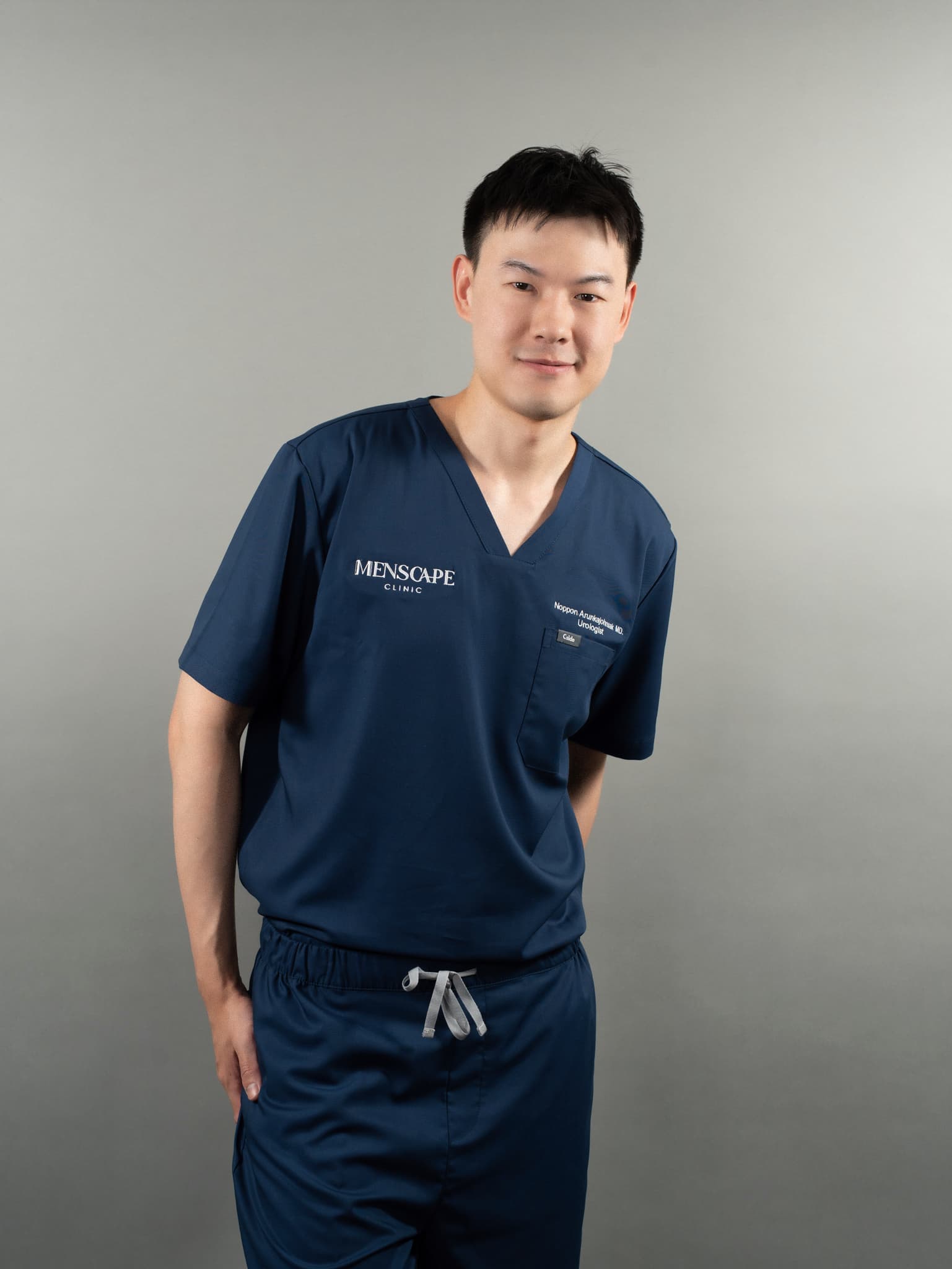
Menscape's clinicians focus on men's aesthetics and can guide you from the first consultation through surgery and recovery, with honest advice about whether a neck lift, a less invasive option or a combined procedure makes the most sense for you. You can book a consultation to discuss your goals and get a personalised, itemised quote.
Any surgical plan, the choice of anaesthesia and any prescriptions involved require an in-person medical consultation and assessment by a qualified clinician.
Frequently Asked Questions
Will a male neck lift make my neck look feminine or over-tightened?
It should not, when the surgeon works to a male aesthetic. Techniques for men aim for a straighter, more angular jawline with less skin elevation and deliberately avoid the excessive tension that creates an unnatural, pulled look. Choosing a surgeon who regularly operates on men and can show you before-and-after photos of male patients is the best safeguard.
How much does a male neck lift cost in Bangkok?
As an indicative guide, a full neck lift in Bangkok commonly runs about 110,000 to 200,000 THB (roughly 3,350 to 6,100 USD), with submental liposuction alone cheaper and a combined neck-and-facelift more. That is frequently 50 to 70 percent below comparable US or UK pricing. These are ranges only; you will get a fixed, itemised quote at consultation once your plan is set.
Are the scars visible?
They are designed to be discreet. The main incision sits in the natural crease under the chin, and any additional incisions are placed behind and around the ears where they are hidden. Scars usually fade over several months, though final appearance varies between individuals and depends partly on how you care for them during healing.
How long do the results last?
For most men the improvement lasts in the region of 7 to 10 years, consistent with longevity figures cited by major clinical bodies for this type of surgery. The neck continues to age slowly afterward, and stable weight, sun protection and not smoking all help the result last longer.
Does a neck lift fix a double chin?
It can, particularly when the double chin is caused by a combination of fat and loose skin. Submental liposuction removes the fat, and tightening the platysma muscle and redraping skin restores the chin-neck angle. If the issue is purely a small fat pocket with good skin, a less invasive option such as liposuction alone or fat-dissolving injections may be enough.
How painful is the recovery, and when can I go back to work?
Most men describe tightness and discomfort rather than severe pain, and it is usually well controlled with prescribed medication. Bruising and swelling are most noticeable in the first two to three weeks. Many men return to desk work within about a week, while strenuous exercise typically waits four to six weeks until cleared by the surgeon.
Is general anaesthesia always required?
No. Less extensive procedures, such as liposuction or a limited platysmaplasty, can often be done under local anaesthesia with sedation. More extensive neck lifts that involve skin removal are commonly done under general anaesthesia. Your surgeon and anaesthetist will recommend the safest option for your specific plan and health.
Can a neck lift be combined with a facelift or jaw procedure?
Yes, and it often is. Combining a neck lift with a lower facelift addresses the jowls, mid-face and neck together, and some men also combine it with chin augmentation or jawline work for a stronger profile. Combining procedures can reduce overall downtime and cost compared with separate operations, but it lengthens a single surgery and recovery, so it has to be planned carefully at consultation.
How do I know if a Bangkok clinic is safe?
Check that the operating surgeon is board-certified in plastic or facial plastic surgery and performs neck lifts regularly, that the facility is accredited with proper anaesthesia and emergency cover, and that you get a genuine in-person examination rather than a price quoted from a photo. Be wary of pressure to pay immediately, prices far below the local market, or any clinic that will not show credentials or explain how complications are handled.
)
/)
/)
/)
/)
/)