/)
A lot of men come in saying the same thing in different words: they train hard, their body fat is low, but their face still looks soft and round. Photos from certain angles show full lower cheeks that blur the jawline and read younger or heavier than they feel. For a subset of these men, the issue is not skin or weight at all. It is the buccal fat pad, a deep cushion of fat that sits in the hollow of the cheek and does not respond to diet or exercise.
Buccal fat removal, also called bichectomy or cheek fat reduction, takes out a measured part of that pad to slim the mid-face and let the cheekbone and jaw show through more clearly. It is one of the more talked-about facial procedures of the last few years, partly because it photographs well and partly because the recovery is short. It is also one of the easiest to get wrong, because removing too much can leave a man looking gaunt and prematurely aged in his forties and fifties. The honest version of this procedure is about taking a little, not a lot.
This guide covers what the procedure actually does, who it suits and who it does not, transparent Bangkok pricing in THB and USD with a comparison against Western costs, the step-by-step technique, a realistic recovery timeline, what results to expect and how durable they are, the risks worth knowing, and how to vet a clinic. Buccal fat removal is a surgical procedure, so nothing here replaces an in-person consultation. A surgeon needs to look at your face, assess your fat distribution and skin, and tell you honestly whether this will help or harm your long-term appearance.
What buccal fat removal actually does
The buccal fat pad is a discrete, deep fat compartment that sits between the buccinator muscle and the masseter, filling the hollow of the cheek. It has a central body and several extensions that reach toward the temple, the eye socket, and the jaw. It is not the same as the superficial fat just under the skin, and it is not the fullness you would lose by leaning out. Its job in younger faces is partly to give the cheek a smooth, full contour.
Removing part of this pad reduces volume in the lower and mid cheek. The visible effect is a slight inward shadow below the cheekbone and a cleaner transition from cheek to jaw, which is why men associate it with a sharper, more angular look. According to a StatPearls review of buccal fat pad reduction, the safest access is through the mouth, and surgeons typically tease out only about 3 to 5 cubic centimetres of fat per side (see citations). That is a small volume by design.
A point that gets lost in the social-media version of this procedure: the buccal fat pad is one of the structures that holds youthful fullness in the upper cheek. Take too much, or take it from the wrong part of the pad, and you risk accelerating the hollow, drawn look that normally comes with age. A 2023 study by Kubo on resected position found that removing only the lower portion of the pad preserves upper-cheek fullness, while removing the whole extension reduces volume more evenly and can over-hollow faces that are already starting to deflate. The lesson is that where the fat is taken matters as much as how much.
The male angle: definition, not narrowing
Men and women usually want different things from this operation, and a surgeon who treats every face the same way produces results that look wrong on a man.
The typical female request is a slimmer, softer, more tapered cheek. The typical male goal is structural: keep the face looking strong and masculine, with definition along the cheekbone and jaw rather than a narrow, scooped-out cheek. An overly aggressive reduction that might pass as elegant on a woman tends to read as gaunt or unwell on a man, because male faces are expected to carry more soft-tissue width and a squarer lower third.
In practice this means a conservative, often asymmetric-by-design approach: removing enough to break up obvious lower-cheek fullness while protecting the upper-cheek volume that keeps a man from looking drawn. It also means buccal fat removal alone is frequently not the whole answer for the jawline. A weak chin or a soft jaw angle limits how much definition you can gain from cheek slimming, which is why the procedure is often discussed alongside jawline contouring for men, chin augmentation, or masseter Botox. One reassuring detail for men: the incision is inside the mouth and the work is deep to the cheek, so it does not disturb the beard line, facial-hair pattern, or the skin where you shave.
Bangkok pricing: THB, USD, and how it compares
Cost is usually the first question, so here it is up front. The figures below are indicative ranges for Bangkok based on current clinic and medical-tourism pricing; the actual quote depends on the surgeon, the facility, the anaesthesia plan, and whether you combine the procedure with anything else. Always confirm the all-in number at your consultation. USD conversions use an approximate rate of 32 THB to 1 USD and will move with the exchange rate.
Item | Bangkok (THB) | Bangkok (USD approx.) | Typical US all-in (USD) |
Buccal fat removal, both sides (surgeon + facility + local anaesthesia) | 28,000 - 70,000 | 875 - 2,190 | 4,000 - 6,500 |
Add light IV sedation | 8,000 - 20,000 | 250 - 625 | often bundled |
Combined with chin or jaw contouring (indicative add-on) | 30,000 - 120,000+ | 940 - 3,750+ | 3,000 - 12,000+ |
Follow-up review and suture check | usually included | included | varies |
The headline: a straightforward bilateral buccal fat removal in Bangkok commonly lands somewhere in the high-five-figure to low-six-figure THB range, which is roughly 50 to 80 percent less than a comparable all-in price in the United States. For reference, the American Society of Plastic Surgeons lists an average US surgeon fee of 3,142 USD for this procedure, and that figure explicitly excludes anaesthesia, the operating facility, and other costs, so the real US total is meaningfully higher. Thailand-published ranges for the procedure cluster around 1,000 to 2,500 USD all-in, consistent with the THB figures above.
A few honest caveats. Very low quoted prices (well under 25,000 THB) sometimes reflect a junior injector, a high-volume package mill, or local-only anaesthesia with minimal aftercare, and the cheapest quote is rarely the right way to choose facial surgery. Conversely, a premium hospital with a well-known facial surgeon can run higher than the ranges above. Medical-tourism patients should also budget separately for flights, accommodation, and a few days of recovery time in the city.
What drives the price
The surgeon. A surgeon who does facial contouring regularly and understands male aesthetics costs more than a generalist, and for an operation this dependent on judgment, that premium is usually worth it.
Facility and accreditation. An accredited hospital or licensed surgical clinic with proper monitoring costs more than a basic treatment room, and that difference buys you safety margin.
Anaesthesia. Local anaesthesia alone is cheaper than local plus IV sedation; sedation adds comfort and an anaesthesia provider's fee.
Combination procedures. Adding chin, jaw, or neck and chin liposuction work raises the total but can be more cost-effective than separate sessions.
Single visit versus revision. A clean primary procedure is cheaper than fixing an over-resection later, which is difficult and sometimes requires fat grafting.
Who is a good candidate, and who is not
The single most important thing a good consultation does is screen out men who should not have this procedure. Buccal fat removal is genuinely helpful for some faces and genuinely harmful for others.
You are more likely to be a good candidate if you:
Have full, round lower cheeks that persist even when your body fat is low.
Are at a stable, near-goal weight (significant future weight loss changes the result).
Have reasonably good skin tone and elasticity, with no significant sagging.
Are typically in your twenties to forties, when the face still carries enough fullness to spare.
Have realistic expectations: subtle refinement and better photos, not a dramatic new jaw.
This procedure is usually a poor choice, and a careful surgeon will say no, if you:
Have a naturally thin, narrow, or already-defined face. Removing fat here risks a gaunt result.
Are older with noticeable skin laxity or mid-face deflation. You may need volume or a lifting procedure, not subtraction; in that situation a male facelift or neck lift addresses the actual problem.
Have a tendency to lose facial volume with age (look at older male relatives).
Are chasing a look that is really driven by a weak chin or jaw angle, which cheek fat removal will not fix on its own.
Are at an unstable weight or have body-image expectations that no surgery will satisfy.
Contraindications
Beyond aesthetic fit, the procedure may be deferred or declined for medical reasons. These include active infection in the mouth or cheek, uncontrolled bleeding disorders or anticoagulant use that cannot be safely paused, poorly controlled diabetes or other conditions that impair healing, significant immune compromise, and any situation where you cannot safely undergo the chosen anaesthesia. Heavy smoking impairs healing and is a relative contraindication. All of this is assessed at consultation, which is why an in-person medical evaluation is required before the procedure can be booked.
How the procedure works, step by step
Buccal fat removal is a short outpatient operation. A representative sequence looks like this:
Consultation and planning. The surgeon examines your face, assesses fat versus skin, marks the target, and agrees with you on how conservative to be. Photographs are taken.
Anaesthesia. Most cases use local anaesthesia, sometimes with light IV sedation for comfort. General anaesthesia is uncommon for an isolated buccal fat removal but may be used if combined with larger procedures.
Intraoral incision. A small incision, roughly one to two centimetres, is made on the inside of the cheek near the upper molars, positioned away from the parotid (Stensen's) duct to avoid injuring it. Nothing is cut on the outside of the face.
Locating and delivering the pad. The surgeon spreads gently through the buccinator muscle to reach the fat pad. Light external pressure on the cheek helps deliver the yellow fat into the incision.
Measured removal. Only the intended portion is teased out, commonly around 3 to 5 cc per side per the StatPearls technique, and excised. The surgeon avoids excessive traction to protect surrounding nerves and vessels and to prevent taking more than planned.
Symmetry check and closure. Both sides are compared, then the incisions are closed with dissolvable sutures. There is no external dressing.
Total operating time is usually about 20 to 45 minutes for buccal fat removal on its own. You go home the same day.
Recovery, staged week by week
Recovery is one of the easier parts of this procedure, but the final result takes patience because swelling can briefly make the cheeks look fuller before they look slimmer.
Days 1 to 3. Mild swelling and tightness inside the cheeks, sometimes light bruising. You eat soft foods, avoid hot liquids, and use any prescribed antiseptic mouth rinse. Discomfort is usually manageable with simple analgesics. Counterintuitively, your face may look puffier than normal at this stage.
Days 4 to 7. Swelling starts to settle. Most men return to desk work and normal daily activity within a few days to a week. Chewing becomes more comfortable. Strenuous exercise is typically held back.
Weeks 2 to 4. The intraoral sutures dissolve and the inside of the cheek heals. Early slimming becomes visible as swelling resolves, though it is not the final shape yet.
Weeks 4 to 8. Contours sharpen as residual swelling clears. Most of the visible change is apparent by this point.
Months 2 to 3. The result settles into its final form. This is the right time to judge the outcome and discuss any further contouring.
Follow your surgeon's specific aftercare instructions on diet, oral hygiene, and when to resume training, since these vary by case and by whether other procedures were combined.
What results to expect, and how long they last
Realistic expectations matter here more than with almost any other facial procedure, because the change is meant to be subtle. What men typically notice is a cleaner shadow under the cheekbone, a smoother line from cheek to jaw, a slightly slimmer mid-face, and an improved three-quarter and side profile in photographs. It is refinement, not transformation. If your jawline definition is mostly limited by a recessed chin or a soft jaw angle, buccal fat removal will help only modestly, which is the honest reason these procedures are often planned together.
On durability, the evidence is reasonably encouraging but not unlimited. A systematic review of buccal fat pad excision for cheek refinement reported that 84.6 percent of patients felt their facial contour was much improved and the remaining 15.4 percent felt it was improved, with a measured volume reduction in the order of 3 mL. Because the fat pad does not regenerate once removed, the slimming effect is generally considered long-lasting. The same review is candid that the published evidence is limited in quality and that long-term follow-up data are scarce, so claims of a permanent, fixed result should be read with some caution. Just as important, removing the pad does not stop your face from aging. Over the following decades the mid-face still loses volume and the skin still changes, and a result that looked ideal at 30 can contribute to a more hollow look at 55, which is precisely why a conservative removal is the safer long-term choice.
Risks and safety
For most healthy patients in skilled hands, buccal fat removal is considered a relatively low-risk procedure, but it is still surgery near important structures, and the risks are worth understanding before you decide.
Common and usually self-limiting effects include swelling, mild bruising, temporary tightness or difficulty fully opening the mouth, and short-term changes in chewing comfort. Most resolve within a couple of weeks.
Less common complications are documented in the literature. The StatPearls review cites overall complication rates in the range of roughly 8 to 18 percent across reported series, which can include injury to the parotid (Stensen's) duct, hematoma, trismus, temporary nerve-related weakness, and infection. A separate systematic review reported a lower weighted complication rate of about 3 percent across 134 procedures, with the most frequent issues being transient trismus and temporary, usually self-resolving facial-nerve weakness. The honest summary is that serious complications are uncommon but not zero, and that surgeon experience and anatomical care are the main things that keep the rate low.
There are also two aesthetic risks specific to this procedure. The first is over-resection, which produces a hollow, gaunt, prematurely aged look that is difficult to reverse and may require fat grafting to correct. The second is asymmetry, where one cheek ends up slimmer than the other. Both are largely avoidable with a conservative, symmetry-checked technique, and both are far more likely with an inexperienced operator chasing a dramatic result.
Have a question about your treatment?
Message our Bangkok clinic on WhatsApp and a doctor replies within minutes during clinic hours.
When to seek urgent care
Most aftercare is uneventful, but contact your surgeon or seek medical care promptly if you develop any of the following:
Increasing, spreading swelling or pain after the first few days rather than steady improvement.
Fever, pus, a bad taste, or other signs of infection at the incision.
Significant bleeding from inside the mouth that does not settle with gentle pressure.
A rapidly enlarging, firm, painful swelling in the cheek (possible hematoma).
Persistent inability to open the mouth, new facial weakness or droop, or numbness that is worsening rather than improving.
A clear, painful swelling near the cheek when eating, which can suggest a salivary-duct problem.
These are uncommon, but they are the situations where early review changes the outcome.
Choosing a safe clinic in Bangkok
Bangkok has genuinely excellent facial surgeons and a long track record in cosmetic medicine, alongside cheaper operators where the savings come out of your safety margin. Because the result of this particular procedure depends so heavily on judgment, surgeon selection matters more than price.
What to look for:
A surgeon with specific, demonstrable experience in facial contouring and a portfolio of male results, not just a general cosmetic list.
A licensed hospital or accredited surgical facility with proper anaesthesia and monitoring, rather than a basic treatment room.
A consultation that includes the surgeon examining your face in person, discussing how conservative to be, and being willing to advise against the procedure if you are not a good candidate.
Clear, itemised pricing that states what is and is not included, with no pressure to decide on the day.
Before-and-after photos of comparable male patients, and a frank discussion of risks and limitations.
Red flags worth walking away from: a quote that seems too cheap to be safe, a clinic that promises a dramatic jawline from cheek fat removal alone, anyone unwilling to show credentials or real male before-and-afters, high-pressure sales or same-day-only discounts, no in-person surgeon assessment before booking, and a brush-off when you ask about complications and revision policy. A surgeon who is candid about what the procedure cannot do is usually a better sign than one who promises everything.
How buccal fat removal compares to other options
Cheek and jaw definition can be approached in several ways, and buccal fat removal is only one tool. The table below sets it against common alternatives so you can see where it fits. The right choice depends on your anatomy and goals and should be decided at consultation.
Option | What it targets | Invasiveness | Permanence | Best suited to |
Buccal fat removal | Deep lower-cheek fullness | Minor surgery, intraoral | Long-lasting (fat does not regrow), face still ages | Younger to middle-aged men with genuinely full cheeks |
Fat under the chin and jaw | Minor surgery | Long-lasting | Submental fullness, double-chin appearance | |
Wide, bulky jaw muscle | Non-surgical injection | Temporary, 4-6 months | Square, muscular jaw from clenching | |
Weak chin or jaw projection | Non-surgical injection | Temporary, 12-24 months | Adding definition without surgery | |
Recessed or weak chin | Surgery (implant) | Permanent | Structural chin deficiency | |
Sagging skin and laxity | Surgery | Several years | Older men with loose skin, not fullness |
A practical way to read this table: if your problem is too much fat, buccal fat removal or liposuction fits. If your problem is a weak underlying structure, fillers or an implant fit. If your problem is loose skin, a lifting procedure fits. Many men have a mix, and the best plans combine a small amount of the right things rather than over-relying on any single procedure.
Booking a consultation
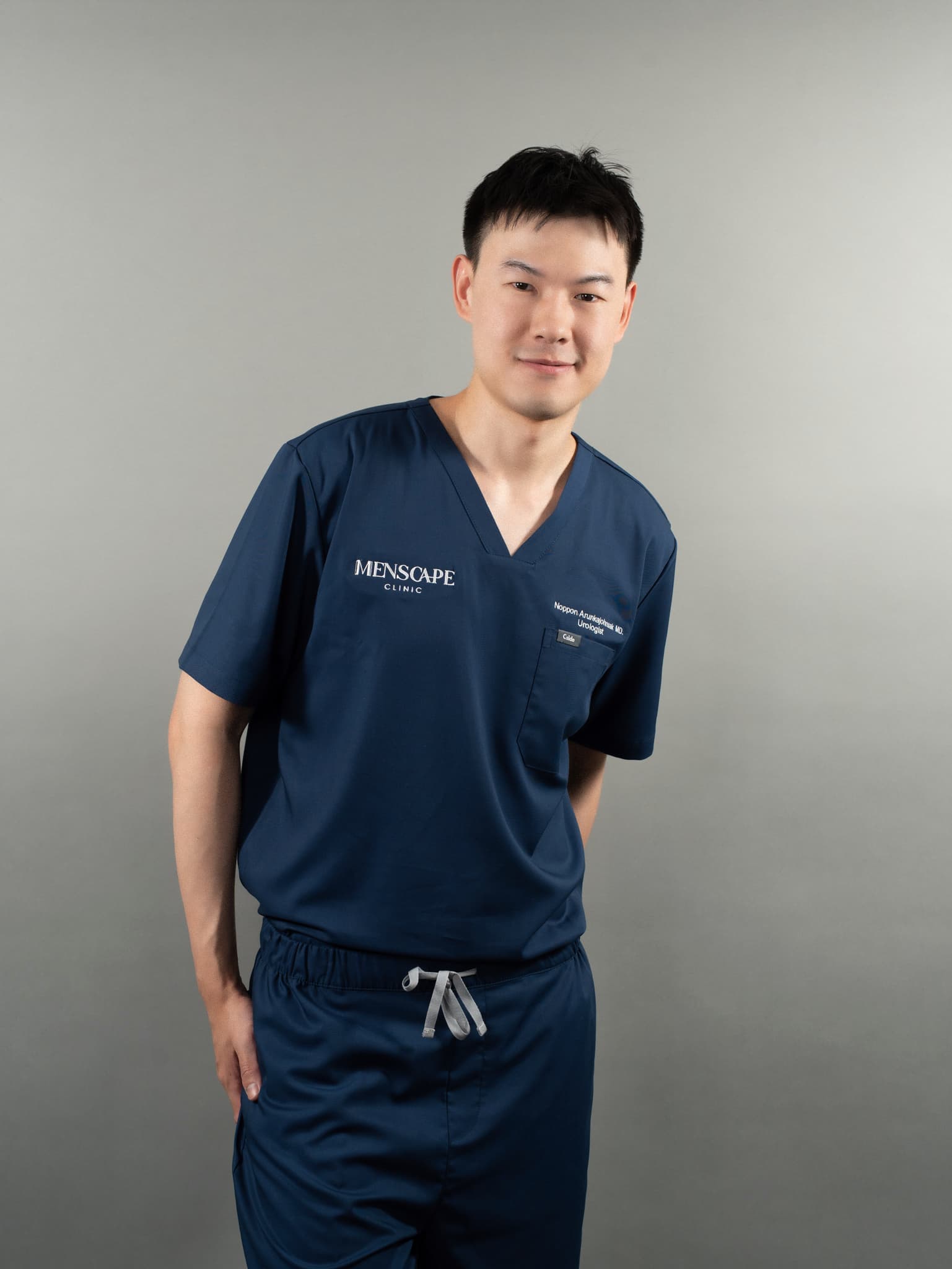
If you think your full cheeks are genuinely fat rather than weight or structure, the next step is an assessment. At Menscape in Bangkok, a consultation focuses on whether buccal fat removal will actually improve your face long-term, how conservative to be for a masculine result, and whether combining it with chin or jaw work makes sense for your goals. You will get an honest read, including being told if subtraction is the wrong approach for your anatomy.
Buccal fat removal is a surgical procedure that requires an in-person medical consultation and assessment before it can be recommended or booked. The information here is educational and is not a substitute for individual medical advice.
Frequently Asked Questions
Will buccal fat removal make me look older as I age?
It can if too much is removed. The buccal fat pad helps hold youthful fullness, and over-resection, especially from the upper part of the pad, can accelerate a hollow, drawn look later in life. A conservative removal that takes only the lower portion is much safer for long-term appearance, which is why surgeon judgment matters more than the price. Men who tend to lose facial volume with age, or who already have thin faces, are often advised against the procedure for exactly this reason.
Is the result permanent?
The slimming effect is generally long-lasting because the fat pad does not regrow once it is removed. That said, the published evidence has limited long-term follow-up, so it is more accurate to call the result durable than strictly permanent. Removing the pad also does not stop normal aging, so your face will still change over the decades, which is another argument for taking only a small amount.
How much does buccal fat removal cost for men in Bangkok?
As an indicative range, a bilateral procedure in Bangkok commonly runs about 28,000 to 70,000 THB, roughly 875 to 2,190 USD, depending on the surgeon, facility, and anaesthesia. That is broadly 50 to 80 percent less than typical all-in US pricing of around 4,000 to 6,500 USD. These figures are indicative only; confirm an itemised, all-in quote at your consultation, and budget separately for travel and accommodation if you are coming from abroad.
Does it affect smiling, chewing, or my beard line?
The procedure works deep to the cheek and the incision is inside the mouth, so it does not cut the muscles that move your face for expression, and there are no external scars or disruption to the beard line or shaving skin. You may have temporary tightness or mild difficulty fully opening the mouth for a week or two, and chewing can feel a little different at first, but these settle as the swelling resolves.
Will this alone give me a sharp jawline?
Not by itself in most cases. Buccal fat removal slims the lower cheek and can make an existing jawline read more clearly, but if your jaw definition is limited by a recessed chin, a soft jaw angle, or fat under the chin, you will see only a modest change. That is why it is often planned alongside chin or jaw contouring, masseter Botox, or chin and neck liposuction. A consultation can tell you which combination, if any, actually addresses your specific anatomy.
How long is the recovery?
Most men return to desk work within a few days to about a week. There is mild swelling and tightness for the first few days, often with the cheeks looking briefly fuller before they look slimmer. Sutures inside the mouth dissolve over a couple of weeks, early slimming shows by weeks two to four, and the final shape settles over two to three months. Strenuous exercise is usually paused for a short period; follow your surgeon's specific timeline.
What are the main risks?
Common effects are swelling, mild bruising, and short-term tightness or chewing changes. Reported complication rates vary across the literature, from roughly 3 percent in one systematic review to a higher 8 to 18 percent range cited in a StatPearls review, and can include parotid-duct injury, hematoma, trismus, temporary nerve weakness, and infection. The two aesthetic risks specific to this procedure are over-resection (a gaunt look that is hard to reverse) and asymmetry, both largely avoidable with a conservative, symmetry-checked technique.
Am I too old for buccal fat removal?
There is no strict age cutoff, but the procedure suits younger to middle-aged men with genuinely full cheeks far better than older men. With age, the mid-face naturally loses volume and the skin loosens, so removing fat can make things worse rather than better. Older men whose concern is sagging usually benefit more from a lifting procedure or, in some cases, added volume, which is something to discuss honestly at consultation rather than defaulting to fat removal.
Do I need a consultation before booking?
Yes. Buccal fat removal is surgery, and whether it will help or harm your appearance depends on your specific fat distribution, skin quality, and underlying bone structure, none of which can be judged from photos alone. An in-person medical consultation and assessment are required before the procedure can be recommended or scheduled, and a good surgeon will decline to operate if you are not a suitable candidate.
)
/)
/)
/)
/)
/)