/)
/)
/)
/)
/)
HIFU · High-Intensity Focused Ultrasound for Prostate Cancer in Bangkok
HIFU is a non-invasive prostate cancer treatment that uses focused ultrasound waves to destroy a targeted area of the prostate · either the entire gland or just the tumor (focal therapy). For carefully selected patients with localized intermediate-risk prostate cancer, focal HIFU preserves erectile function and continence at rates significantly higher than prostatectomy or radiation, while delivering effective cancer control.
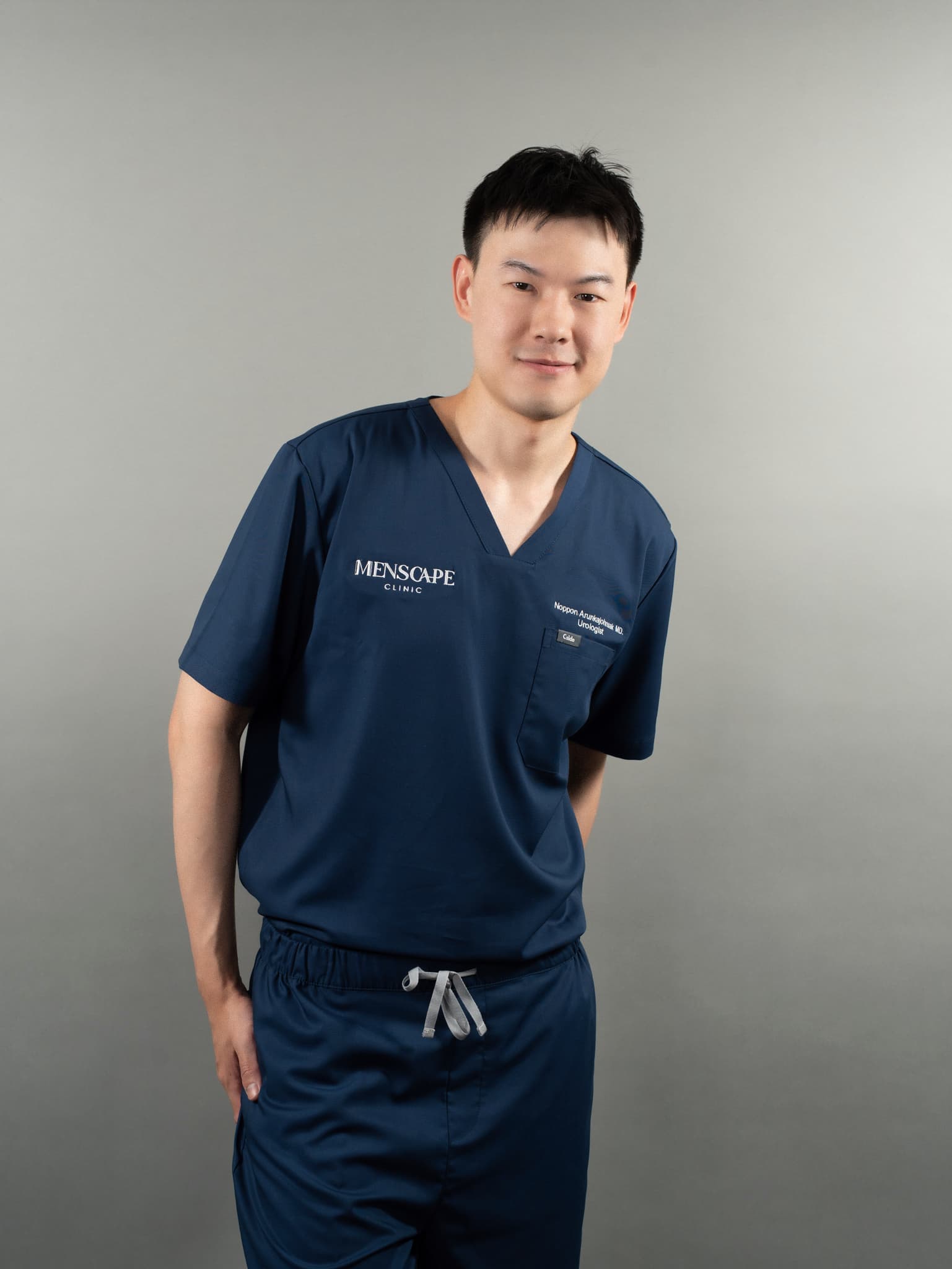
Medically reviewed by Dr. Noppon Arunkajohnsak (Win), Board-certified Urologist
9 years of experience
Our solutions
Why patients choose HIFU for Prostate Cancer
What Our Patients Say
Male Surgery
They treated only the spot where the cancer was, and I was home the next day. The catheter was the hardest part, but it came out as planned.
Wachirawit, 67
Male Surgery
I was dreading the idea of open surgery. In the end there were no incisions at all, and my follow-ups since have just been PSA tests and scans.
Khom, 64
Book your consultation today.
/)
How to Prepare for HIFU for Prostate Cancer
Multiparametric MRI
Pre-treatment MRI maps the lesion and guides focal targeting.Targeted biopsy confirmation
MRI-fusion biopsy confirms the lesion location, grade, and that no untreated significant disease exists elsewhere.PSA and staging
PSA, digital rectal exam, and clinical staging confirm localized disease appropriate for HIFU.Bowel preparation
Enema before treatment for clear transrectal probe placement.Stop blood thinners
5-7 days before treatment only if cleared by your prescribing doctor.Fast pre-procedure
No food or water for 6 hours before anesthesia.
/)
What Happens During HIFU for Prostate Cancer
Anesthesia
Spinal or general anesthesia.Catheter placement
A suprapubic or urethral catheter is placed for drainage during and after treatment.Transrectal probe positioning
A specialized HIFU probe is positioned in the rectum, aligned with the prostate.Treatment planning
Real-time MRI or ultrasound mapping defines the exact treatment volume · focal lesion or whole gland.Focused ultrasound delivery
High-intensity ultrasound waves are focused on each treatment voxel, raising tissue temperature to 80°C in milliseconds. Adjacent tissue (urethra, rectum, neurovascular bundles) is spared.Catheter and recovery
Catheter stays in place for 7-14 days during initial healing · removed in clinic. Most patients return to normal activity within 1-2 weeks.
/)
Explore Our Topics
About HIFU for Prostate Cancer
/)
Patient Selection First
HIFU is not for everyone · we use MRI, fusion biopsy, and risk stratification to identify the patients most likely to benefit. The right cancer treatment depends on the right diagnosis.
Focal HIFU Expertise
Focal therapy requires precise mapping and tumor localization · not just running a HIFU machine. Our process includes multidisciplinary review before recommending focal vs whole-gland treatment.
Active Surveillance Integration
Post-HIFU monitoring with PSA, MRI, and biopsy follows current focal-therapy guidelines · we don’t over-treat low-risk disease, and we monitor for any recurrence aggressively.
Private, Discreet Recovery
Confidential care, WhatsApp recovery support, English-language follow-up and surveillance scheduling.
Frequently asked questions
Am I a candidate for HIFU?
You are an ideal candidate for HIFU if you have localized intermediate-risk prostate cancer with a clearly visible lesion on MRI, no evidence of extracapsular extension, and a prostate volume typically under 40-50g. Your prostate must also be clearly visualized on transrectal ultrasound. Low-risk disease often benefits more from active surveillance, while high-risk or locally advanced disease usually requires more aggressive treatments like radical prostatectomy or radiation therapy. We'll assess your specific case thoroughly.
How does HIFU compare to prostatectomy or radiation?
HIFU offers significantly better preservation of erectile function and urinary continence compared to prostatectomy or radiation therapy for selected patients. Studies show continence rates over 95% and potency preservation around 80-90% for focal HIFU. While cancer control for focal HIFU is acceptable for intermediate-risk disease, its long-term efficacy is less established than traditional treatments. We will discuss all available options based on your specific risk profile and preferences.
What if the cancer comes back?
Should your prostate cancer recur after HIFU, several effective salvage options are available. These include a repeat HIFU procedure, radical prostatectomy, or radiation therapy. We monitor for recurrence with regular PSA blood tests and follow-up MRI scans. Early detection of any recurrence is crucial as it ensures a wider range of salvage treatment options remain available to you, maximizing your chances of successful long-term management.
How long is recovery?
Most patients experience a swift recovery, returning to normal daily activities within 1 to 2 weeks post-procedure. A urinary catheter is typically required for 7 to 14 days following treatment to aid healing. Sexual function gradually returns over 6 to 12 weeks, with high rates of potency preservation. Importantly, urinary continence is preserved in over 95% of focal HIFU patients, allowing you to quickly regain your quality of life.
How much does HIFU cost in Bangkok?
The cost of HIFU treatment in Bangkok varies depending on several factors. These include whether you require focal or whole-gland treatment, the necessity of pre-treatment MRI and biopsy, the length of your hospital admission, and any required follow-up imaging. To receive an accurate and personalized quote tailored to your specific treatment plan, we strongly recommend booking a comprehensive consultation with our specialists.
What are the success rates and long-term outcomes for HIFU for Prostate Cancer?
For carefully selected patients with localized intermediate-risk prostate cancer, focal HIFU demonstrates excellent short to medium-term cancer control, with disease-free survival rates around 80-90% at 5 years. Long-term data beyond 10 years is still emerging compared to traditional treatments. Our goal is to eradicate cancer while preserving quality of life, and we continuously monitor your PSA levels and conduct follow-up imaging to ensure the best possible long-term outcomes for you.
What anesthesia options are available for HIFU for Prostate Cancer?
HIFU for prostate cancer is typically performed under general anesthesia. This ensures you are completely asleep and comfortable throughout the entire procedure, which usually lasts between 1 to 3 hours depending on the extent of treatment. Our experienced anesthesiology team will discuss your medical history to determine the safest and most appropriate anesthetic plan for you, ensuring a pain-free and stress-free experience during your treatment.
What should I expect during my HIFU consultation?
During your consultation, you will meet with our expert urologist specializing in HIFU. We will review your medical history, previous biopsy results, and MRI scans. You may undergo a physical examination and additional diagnostic tests if needed. This comprehensive assessment allows us to confirm your candidacy for HIFU and discuss all treatment options, potential risks, and expected outcomes. You'll have ample opportunity to ask questions and make an informed decision about your care.
What are the medical-tourism logistics for international patients?
We recommend arriving in Bangkok at least 2-3 days before your procedure for pre-treatment assessments. You can typically fly home 2-3 days after your catheter is removed, usually 7-14 days post-treatment. We facilitate follow-up care via secure telemedicine platforms like WhatsApp for your convenience. Our international patient coordinator will assist with your travel arrangements, ensuring a smooth and stress-free experience from arrival to departure.
TARGETED PROSTATE CANCER TREATMENT · FUNCTION PRESERVED
TARGETED PROSTATE CANCER
TREATMENT · FUNCTION PRESERVED
/)
)
Dr. Noppon Arunkajohnsak (Win)
Board-certified Urologist
- Experience
- 9 years
Dr. Noppon is a board-certified urologist trained at Siriraj Hospital, Mahidol University. With over 9 years of experience, he focuses on urological consultation and men's health, providing discreet, evidence-based, patient-centred care.