/)
Eyelid surgery has quietly become one of the most requested cosmetic procedures among men, and it is easy to see why. The upper and lower eyelids are among the first parts of the face to show age. Skin thins and loosens, the small fat pads that cushion the eye start to bulge, and the under-eye area picks up shadows and puffiness. The effect is a face that reads as tired, heavy, or older than you feel, even on a good night's sleep. Blepharoplasty addresses those specific changes by trimming redundant skin, adjusting or repositioning fat, and tightening the supporting tissues around the eye.
For men, the goal is rarely a dramatic change. It is usually to look less worn down and more awake while still looking like themselves. Done well, the surgery sharpens the eye area and lifts the tired look without softening the masculine features that define a man's face. The American Society of Plastic Surgeons reports that blepharoplasty is now the top facial cosmetic surgery for men, and that interest among male patients keeps climbing. (ASPS)
Bangkok has become a practical place to have it done. The city has a deep bench of facial and oculoplastic surgeons, hospital-grade facilities, and pricing that is a fraction of what the same procedure costs in the US, UK, or Australia. This guide covers what the procedure involves, who it suits and who it does not, realistic Bangkok pricing in both Thai baht and US dollars, recovery, the risks worth knowing, and how to choose a clinic without getting burned. Eyelid surgery is a medical procedure, so none of this replaces an in-person assessment, but it should help you walk into a consultation knowing the right questions to ask.
What blepharoplasty actually does
Blepharoplasty is a surgical procedure that rejuvenates the upper eyelids, the lower eyelids, or both. The surgeon removes or repositions excess skin, manages the small orbital fat pads that create puffiness, and where needed tightens the muscle and supporting structures. It does not lift the brow, erase crow's feet, or treat dark pigmentation in the skin itself, those need different treatments. What it changes is the contour and skin envelope of the eyelids.
The American Society of Plastic Surgeons describes the typical targets as loose or sagging skin that disturbs the natural contour of the upper lid, fatty deposits that appear as puffiness, bags under the eyes, drooping lower lids, and excess skin or fine wrinkling of the lower lid. (ASPS)
There are three common versions of the procedure.
Upper blepharoplasty removes excess skin (and a conservative amount of muscle and fat) from the upper lid. This is the fix for hooding, where loose skin folds over the lash line and in heavier cases starts to crowd the field of vision. The medical term for that excess skin is dermatochalasis, and when the hooding interferes with the upper or outer field of view it can be a functional problem, not only a cosmetic one. (StatPearls)
Lower blepharoplasty addresses under-eye bags and puffiness caused by the lower-lid fat pads pushing forward, and in some men excess lower-lid skin and fine creping. The aim, in clinical terms, is to reduce or smooth out the bulges created by the medial, central, and lateral fat pads. (StatPearls)
Combined upper and lower treats both in a single anaesthetic session, which is common in men over 45 who have hooding up top and bags below. It is more rejuvenation in one recovery period rather than two.
What it costs in Bangkok (THB and USD)
Pricing depends on whether you treat the upper lids, the lower lids, or both, the technique used, the surgeon's seniority, and whether anaesthesia and follow-up are bundled into a package. The ranges below reflect what Bangkok clinics and hospitals typically quote. Treat them as indicative and confirm exact figures at your consultation, since your anatomy and the specific plan drive the final number.
Procedure | Bangkok price (THB) | Bangkok price (USD, approx) | Typical US price (USD) | Typical UK price (GBP) |
Upper blepharoplasty | 30,000 - 55,000 | $850 - $1,550 | $2,500 - $5,000 | £2,500 - £4,000 |
Lower blepharoplasty | 37,000 - 65,000 | $1,050 - $1,850 | $2,500 - $7,500 | £3,000 - £5,000 |
Combined upper + lower | 65,000 - 120,000 | $1,850 - $3,400 | $5,000 - $10,000+ | £4,000 - £7,000 |
USD conversions use an approximate rate of 35 THB to 1 USD and will move with the exchange rate. The US figures reflect surgeon-fee ranges for eyelid surgery; the ASPS puts the average surgeon's fee at roughly $3,359 for an upper or lower blepharoplasty, before facility and anaesthesia costs, and combined upper-and-lower surgery in the US commonly runs $5,000 to $10,000 or more once those are added. (ASPS, eyelid surgery cost)
The savings, in plain terms
A combined upper-and-lower eyelid procedure that might cost $5,000 to $10,000-plus in the United States, before you add the facility and anaesthesiologist, tends to land somewhere around $1,850 to $3,400 in Bangkok with those costs included. That is broadly a 50 to 75 percent reduction. Even after a round-trip flight and a week in a hotel, the all-in number for many men still comes out well below the surgeon's fee alone back home. The savings come from lower overheads and labour costs in Thailand, not from cutting corners on the surgery itself, which is why where you have it done matters as much as what you pay.
What drives the price up or down
Upper, lower, or both. Combined surgery costs more than a single area but less than two separate procedures booked apart.
Technique. A lower-lid correction done through the inside of the eyelid (transconjunctival) can be priced differently from one that also removes skin through an external incision.
Surgeon seniority. A senior oculoplastic or facial surgeon with a long track record commands higher fees than a general practitioner, and for surgery this close to the eye that premium is usually worth paying.
Anaesthesia. Local anaesthetic with light sedation costs less than general anaesthesia, which some men prefer for a combined procedure.
Package inclusions. Lower headline prices sometimes exclude pre-op labs, the facility fee, medications, or follow-up visits. A slightly higher all-inclusive quote can be the better deal.
Add-ons. Ptosis correction (a drooping lid muscle), brow work, or fat repositioning rather than simple removal can add to the total.
Techniques compared
The right technique depends on your anatomy, chiefly whether the problem is skin, fat, or both, and how much lower-lid laxity you have. This is a surgical judgement made at consultation, but understanding the options helps you follow the conversation.
Technique | Best for | Where the incision goes | External scar | Notes |
Upper lid skin-crease incision | Hooding, excess upper-lid skin | Along the natural upper eyelid crease | Hidden in the crease | Standard upper blepharoplasty; conservative muscle and fat handling |
Transconjunctival (lower) | Younger men with fat bulges but good skin tone | Inside the lower lid | None | No external scar; best when there is little excess skin or laxity |
Transcutaneous / subciliary (lower) | Bags plus excess lower-lid skin or laxity | Just below the lash line | Fine line below lashes, usually discreet | Allows skin removal and tightening as well as fat work |
Fat repositioning | Hollowing or a tear-trough groove | Via either lower-lid route | Depends on route | Moves fat to smooth the lid-cheek junction instead of just removing it |
For the lower lid, the dividing line is usually skin. The transconjunctival route is favoured in younger patients with isolated fat-pad prominence and without significant lower-eyelid laxity or skin redundancy, because it leaves no external scar at all. When there is genuine excess skin or the lid is lax, a route below the lash line that also lets the surgeon remove skin tends to give the better result. (StatPearls)
A note on the male angle: on the upper lid, experienced surgeons deliberately leave a little more skin in men than they would in women, so the lid does not get over-hollowed and start to look feminized. Men generally do not want an overly done, sculpted lid, and preserving a touch of fullness keeps the result masculine and natural. (ASPS)
Who is a good candidate, and who is not
Good candidates are generally men who are bothered by a specific, correctable change, and who are healthy enough for elective surgery. That usually means:
Loose or hooded upper-lid skin, with or without a tired look
Under-eye bags or puffiness from protruding fat
In some cases, upper-lid hooding heavy enough to clip the upper field of vision
Realistic expectations, looking for a fresher version of your own face rather than a different one
Good general health, non-smoking or willing to stop well before and after surgery
No active eye disease or uncontrolled medical conditions
When it is not the right call, or needs caution
A consultation exists partly to catch the situations where eyelid surgery is the wrong tool or carries extra risk. Some changes near the eye look like an eyelid problem but are not. Heavy, sagging brows can push skin down onto the upper lids and mimic hooding, in which case a brow procedure, not a blepharoplasty, is the real fix. Dark under-eye circles from pigmentation or thin skin will not improve from removing fat. And true lid droop from a weak levator muscle (ptosis) is a separate repair, though it can be done at the same time.
Clinically, a few conditions raise caution flags that a careful surgeon will screen for:
Significant dry eye. Severe dry eyes are a relative contraindication, because removing skin can leave the lids slightly less able to close and make dryness worse. (StatPearls)
Thyroid eye disease or a bulging eye (proptosis). These change the anatomy and the risk profile and warrant caution.
Bleeding or clotting disorders, or blood-thinning medication. These need to be managed before surgery to reduce bleeding risk.
Uncontrolled diabetes or hypertension. These affect healing and anaesthetic safety.
Unrealistic expectations or active smoking, which impairs healing.
The surgeon will also check practical things such as your levator (lid-lifting) muscle function and your Bell's phenomenon, the protective upward eye-roll on lid closure, because these affect how the eye is protected during healing. (StatPearls)
The procedure, step by step
Most upper blepharoplasty is done under local anaesthetic with the option of light sedation, while a combined procedure may use sedation or general anaesthesia depending on your preference and the surgeon's plan. A single-area procedure is usually quick, an upper blepharoplasty often takes around 45 to 60 minutes and a lower around 60 to 90, though combined surgery takes longer.
Marking and planning. With you sitting upright, the surgeon marks the upper-lid crease and the precise amount of skin to remove, taking more laterally where hooding is worst and keeping both sides symmetrical.
Anaesthesia. Local anaesthetic with a small amount of adrenaline is injected to numb the area and limit bleeding, often only a couple of millilitres per side. (StatPearls)
Upper lid. A fine incision is made along the marked crease. A measured strip of skin is removed, a conservative amount of muscle may be trimmed, the orbital septum is opened, and fat is removed or repositioned as planned. The pretarsal region is preserved to keep the lid functioning normally.
Lower lid. For fat-only correction in a younger man, the surgeon works through the inside of the lid (transconjunctival) with no external cut. Where skin needs removing too, a fine incision is placed just under the lash line. Fat is reduced or repositioned to smooth the lid-cheek transition.
Closure. Upper-lid incisions are closed with fine sutures hidden in the crease. Lower-lid skin incisions sit discreetly below the lashes. Transconjunctival incisions often need no visible stitches.
The guiding principle in good eyelid surgery is restraint, especially with fat. Knowing how much to remove, how much to preserve, and how much to reposition is what separates a natural result from a hollow, operated look. (StatPearls)
Recovery, week by week
Eyelid surgery is among the gentler facial procedures to recover from, but it is still surgery and the timeline is real. Swelling and bruising are at their most noticeable in the first few days and then steadily fade.
Days 1 to 3.Expect swelling, bruising, and a tight or gritty feeling. Cold compresses, keeping your head improved (including while sleeping), and the prescribed eye ointment and artificial tears help most. Vision can be a little blurry from ointment and swelling. Rest and avoid bending or straining.
Days 4 to 7. Bruising starts to turn and fade. Any non-dissolving sutures on the upper lid are usually removed around day 5 to 7. Many men feel presentable enough for low-key activity by the end of week one.
Week 1 to 2. Most men return to desk work and screen-based jobs around 7 to 10 days, often with sunglasses for comfort and to mask residual bruising. Avoid heavy lifting, intense exercise, alcohol, and anything that spikes blood pressure for the first couple of weeks.
Weeks 3 to 6. Residual swelling continues to settle and the eyelids look increasingly natural. Light exercise can usually resume, on your surgeon's advice. Scars are still maturing and may look slightly pink.
Around 3 months. Swelling has fully resolved and scars have softened and faded into the crease and lash line. This is when the final result is fair to judge. Numbness along the lid margin can linger for six to eight weeks and then recovers. (StatPearls)
If you are travelling to Bangkok for surgery, plan to stay at least 7 to 10 days after the procedure so your surgeon can remove sutures and check healing before you fly. Build in a buffer, and do not book the operation tight against a hard travel deadline.
What the results look like, and how long they last
Most men see a more rested, alert eye area, sharper definition of the upper lid, fewer or flatter under-eye bags, and smoother lid skin. Because the upper-lid scar hides in the crease and the lower-lid approach is often scarless or near-invisible, the change tends to read as "you look well" rather than "you had something done," which is exactly what most male patients want.
Longevity is good. Upper blepharoplasty results commonly last somewhere in the range of 7 to 10 years or more, and many men never need the upper lid redone. Lower-lid fat removal is often effectively permanent, because the fat that was removed does not come back, although the surrounding skin keeps ageing on its own schedule. The surgery does not stop the clock, your eyelids continue to age gradually, but it resets your starting point by many years. Sun protection and not smoking help the result last.
Have a question about your treatment?
Message our Bangkok clinic on WhatsApp and a doctor replies within minutes during clinic hours.
Risks and side effects
Blepharoplasty is generally safe in experienced hands, but every surgery carries risk and eyelid surgery is no exception. Most side effects are temporary and expected.
Common and usually temporary:
Swelling and bruising, most marked in the first week and settling over two to three weeks
Dry, watery, or gritty eyes, often for a few weeks
Temporary blurred vision from swelling and ointment
Reduced sensation along the lid margin for roughly six to eight weeks
Mild, usually self-correcting difficulty fully closing the eyes early on (lagophthalmos)
Tightness or a pulling sensation as healing settles
Less common:
Minor asymmetry between the two sides, sometimes needing a small revision
Visible or slow-to-fade scarring (uncommon given where incisions sit)
A lower lid that sits slightly low or pulls down (ectropion or retraction), more of a risk with the external lower-lid approach
Infection, which is uncommon but possible
Over-removal of fat leaving a hollow look, which is why conservative surgeons err on the side of leaving fat
Red flags: seek urgent care
One complication is a genuine emergency, and knowing it can protect your sight. Retrobulbar hemorrhage is bleeding behind the eye that raises pressure in the orbit. It is rare, with an incidence of roughly 0.055 percent (about 1 in 1,820) after blepharoplasty, but it can threaten vision if not treated fast. (StatPearls)
Get emergency care immediately if, in the hours or first day or two after surgery, you develop any of the following:
Severe, escalating pain behind or around the eye, out of proportion to normal soreness
A noticeably bulging or protruding eye (proptosis)
Sudden loss of vision, double vision, or rapidly worsening eyesight
Tense, hard swelling with severe pressure, sometimes with nausea or vomiting
Any severe pain after eyelid surgery should be treated as a possible retrobulbar hemorrhage until a doctor proves otherwise. The treatment is time-critical, an emergency procedure (lateral canthotomy and cantholysis) to release the pressure, so do not wait it out at home. (StatPearls) This is also a reason to have surgery somewhere with proper emergency cover and a surgeon who is reachable afterwards, not a pop-up clinic.
Choosing a safe clinic in Bangkok
Bangkok has excellent surgeons and facilities, and it also has cut-price operators who compete on headline price alone. For surgery this close to the eye, the choice of surgeon and facility matters more than saving a few thousand baht. A few things to look for:
A surgeon who does eyelids regularly. Oculoplastic surgeons and facial plastic or plastic surgeons who perform blepharoplasty routinely are what you want, not a generalist who does it occasionally. Ask how many they do and ask to see before-and-after photos of male patients.
Accredited facilities. Hospital or clinic accreditation (for example JCI at the hospital level, or recognised local standards) signals that anaesthesia, sterility, and emergency protocols are in place.
A real consultation and assessment. A proper consult examines your lids, brow position, tear film and dry-eye risk, levator function, and overall health, and sets out a specific plan. Be wary of anyone quoting a price and booking surgery without examining you.
Honest expectation-setting. A good surgeon will tell you what surgery can and cannot do, including when your concern is really a brow or pigmentation issue rather than an eyelid one.
Clear, itemised pricing. The quote should spell out what is and is not included: surgeon fee, facility, anaesthesia, labs, medications, and follow-up.
Aftercare and emergency cover. Confirm who you call if something goes wrong, especially relevant if you are flying in, and that the facility can handle an emergency.
Red flags to walk away from
Pressure to decide on the day, or "today only" discount pricing
No in-person examination before a surgical quote
A price that is dramatically below everyone else, with the inclusions left vague
Reluctance to share the surgeon's credentials, case volume, or genuine patient photos
No clear plan for follow-up or after-hours emergencies
Promises of zero risk or guaranteed perfect symmetry, which no honest surgeon makes
Why men choose Bangkok
Beyond price, Bangkok works for male patients for a few practical reasons. There is real depth of surgical experience, including surgeons who operate on men routinely and understand how to keep a result masculine rather than over-softened. Facilities range from boutique clinics to JCI-accredited hospitals. Recovery from eyelid surgery is short enough to fit a single trip, and the city is set up for international patients, from English-speaking coordinators to discreet, private care, which many men value when having cosmetic work done.
The one thing to plan around is the return-to-fly window. Give yourself 7 to 10 days minimum after surgery, build in a buffer for your post-op check and suture removal, and do not schedule the operation against a deadline you cannot move.
A medical procedure, not a walk-in service
Blepharoplasty is surgery on one of the most delicate areas of the face, and it requires an in-person consultation and assessment by a qualified surgeon before anything is decided. Whether it is right for you, which technique suits your anatomy, and what result is realistic can only be settled face to face. The pricing here is indicative and meant to set expectations, your exact quote depends on your anatomy and plan and should be confirmed at consultation.
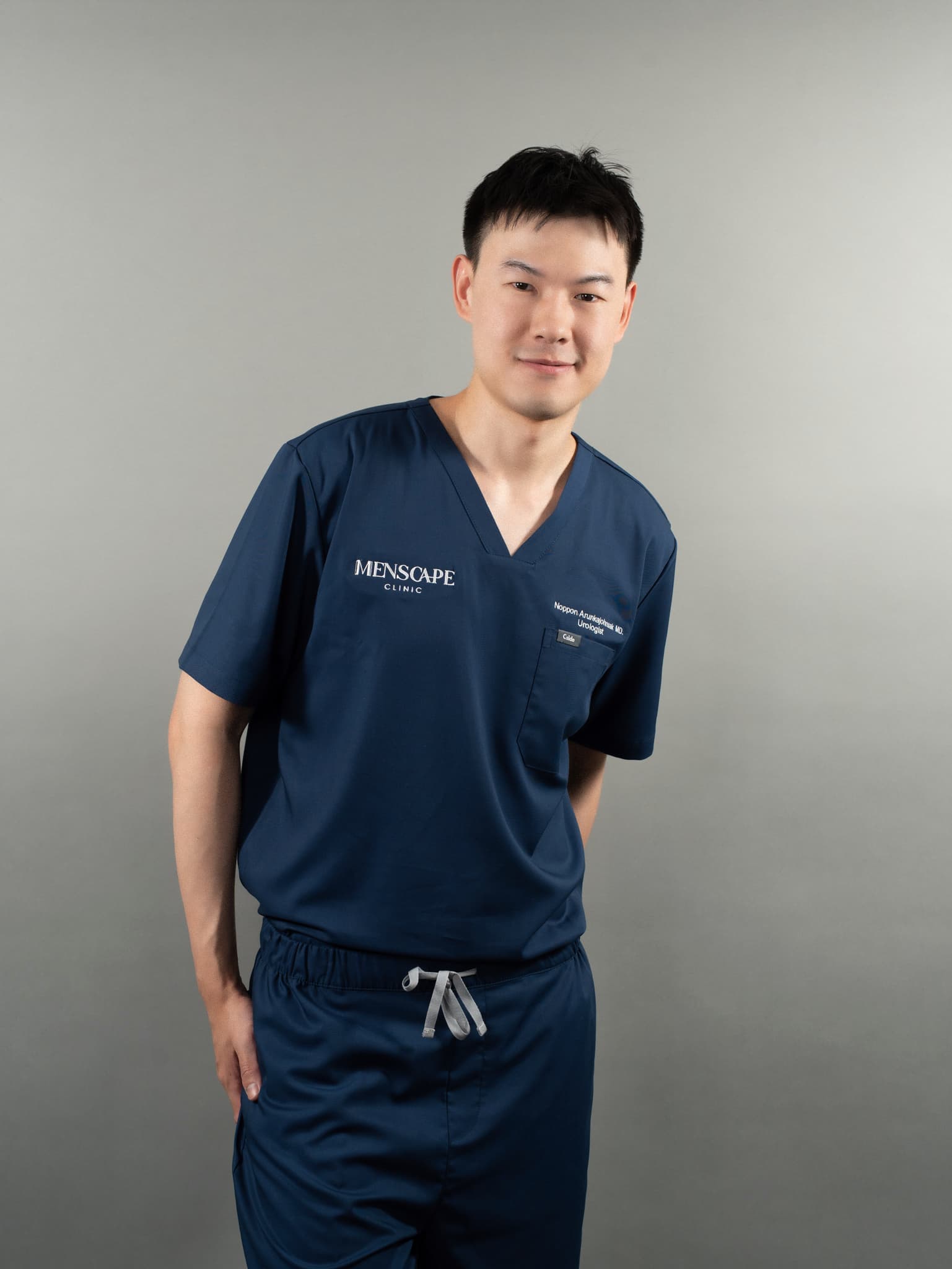
If you are considering upper or lower eyelid surgery, book a private consultation with Menscape Bangkok for a personalised assessment. You can also read more about our approach to men's facial procedures and how we keep results natural and masculine.
Frequently Asked Questions
Will eyelid surgery make my eyes look feminine?
It should not, when the surgeon plans for a male face. Experienced surgeons deliberately leave a little more skin on the upper lid in men than in women so the lid does not become over-hollowed, and they avoid the sculpted, overdone look that reads as feminine. The aim is a rested, alert eye that still looks like yours. Ask to see before-and-after photos of male patients to confirm the surgeon's style suits you.
How much does blepharoplasty cost in Bangkok?
As an indicative guide, upper blepharoplasty runs roughly 30,000-55,000 THB (about $850-$1,550), lower blepharoplasty about 37,000-65,000 THB ($1,050-$1,850), and a combined upper-and-lower procedure around 65,000-120,000 THB ($1,850-$3,400). That is often 50-75% less than the same surgery in the US or UK. Final pricing depends on your anatomy, the technique, the surgeon, and what the package includes, so confirm at consultation.
Will I have visible scars?
In most cases scars are very hard to see. Upper-lid incisions are hidden inside the natural eyelid crease. Lower-lid bags in younger men are often treated through the inside of the lid (transconjunctival), which leaves no external scar at all. When excess lower-lid skin has to be removed, the incision sits just under the lash line and usually fades to a discreet line over a few months.
How long do the results last?
Upper-lid results commonly last around 7-10 years or longer, and many men never have the upper lid redone. Lower-lid fat removal is often effectively permanent because the removed fat does not return. The surgery does not stop ageing, your eyelids keep changing slowly over time, but it resets your starting point by many years. Sun protection and not smoking help preserve the result.
Is the surgery painful?
Most men report only mild discomfort rather than real pain. Upper blepharoplasty is often done under local anaesthetic with optional light sedation, so you feel little during the procedure. Afterwards there is usually tightness, a gritty sensation, and soreness controlled with simple pain relief. Important exception: severe, escalating pain behind the eye is not normal and needs emergency care, as it can signal bleeding behind the eye.
When can I return to work?
Most men go back to desk or screen-based work around 7-10 days after surgery, often wearing sunglasses for comfort and to cover residual bruising. Avoid heavy lifting, intense exercise, alcohol, and anything that raises blood pressure for the first couple of weeks. Jobs that are physically demanding or very public-facing may warrant a slightly longer break.
What is the difference between upper and lower blepharoplasty?
Upper blepharoplasty removes excess, hooded skin (and a little muscle and fat) from the upper lid to open up a tired, heavy eye. Lower blepharoplasty targets under-eye bags and puffiness caused by the lower-lid fat pads, and sometimes excess lower-lid skin. Many men over 45 have both issues and choose a combined procedure, treating both in one operation and one recovery period.
What is the most serious risk of eyelid surgery?
The most serious complication is retrobulbar hemorrhage, bleeding behind the eye that raises pressure in the orbit. It is rare, around 0.055% of cases (roughly 1 in 1,820), but it can threaten vision and is a medical emergency. Warning signs in the first hours to days are severe escalating eye pain, a bulging eye, and sudden or worsening vision loss. If these occur, seek emergency care immediately rather than waiting, because treatment is time-critical.
Do I need a consultation before booking surgery?
Yes. Blepharoplasty is surgery on a delicate area, and an in-person consultation and assessment by a qualified surgeon is required before it is planned. The consult checks your eyelid anatomy, brow position, dry-eye risk, lid-muscle function, and general health, and confirms whether the issue is truly an eyelid problem or something like a heavy brow or pigmentation that needs a different treatment. Be cautious of any clinic that quotes and books surgery without examining you first.
)
/)
/)
/)
/)
/)