/)
A nose job is rarely about a single number. When men ask what male rhinoplasty costs in Bangkok, the honest answer is that it depends on what your nose actually needs: a small tip refinement and a full open reconstruction with rib cartilage are very different operations, and they are priced very differently. What does not change is why so many men look at Bangkok in the first place. The city has a deep bench of facial surgeons, modern accredited hospitals, and pricing that often lands well below what the same work would cost in the US or UK.
This guide lays out realistic 2026 price ranges in Thai baht and US dollars, shows roughly how much you save versus Western clinics, and explains what actually drives the cost. It also covers the parts that matter just as much as price: who is a good candidate (and who is not), how recovery unfolds week by week, the risks worth taking seriously, and how to tell a safe clinic from a cheap one. Rhinoplasty is surgery performed under anaesthesia, so none of this replaces an in-person assessment. Think of it as the briefing you want before you book a consultation.
Male rhinoplasty pricing in Bangkok (2026)
Below are indicative ranges drawn from current Bangkok clinic and hospital pricing. They cover the surgeon's fee plus the usual operating-room and anaesthesia components most clinics bundle, but inclusions vary, so always ask for a fully itemised quote. Figures are converted at roughly THB 33 to USD 1; the dollar column will drift with the exchange rate.
Procedure | Bangkok price (THB) | Approx. USD | What it addresses |
Tip refinement (closed) | 40,000 - 80,000 | $1,200 - $2,400 | Reshaping a bulbous or drooping tip with limited dorsal work |
Augmentation (silicone or Gore-Tex implant) | 60,000 - 120,000 | $1,800 - $3,650 | Building a higher, straighter bridge; common in Asian noses |
Open structural rhinoplasty | 100,000 - 180,000 | $3,050 - $5,450 | Full reshaping of bridge, tip and cartilage framework |
Rib (costal) cartilage rhinoplasty | 150,000 - 250,000 | $4,550 - $7,600 | Major augmentation or reconstruction using your own rib |
Revision rhinoplasty | 120,000 - 360,000 | $3,650 - $10,900 | Correcting a prior surgery; complexity drives the spread |
Septoplasty / breathing add-on | + 25,000 - 60,000 | + $750 - $1,800 | Straightening the septum or repairing a collapsed valve |
A few notes on reading this table. Prices climb sharply once you move from synthetic implants to your own rib cartilage, because rib harvesting adds operating time, a second surgical site, and more post-operative monitoring. Revision cases have the widest range of any procedure here: a minor touch-up sits near the bottom, while rebuilding a nose damaged by a failed first surgery can sit at the very top. And a functional breathing correction is usually quoted on top of the cosmetic fee, not instead of it.
How Bangkok compares with the US and UK
The savings are the reason most international patients look at Thailand, so it helps to see them plainly. In the United States, the average surgeon's fee for rhinoplasty was USD 7,637 in the most recent American Society of Plastic Surgeons figures, and that number explicitly excludes anaesthesia, the operating facility, and other costs. Once those are added, an all-in primary nose job commonly lands between USD 9,000 and USD 20,000 or more, and revision work runs higher still. In the UK, private rhinoplasty typically falls between GBP 6,500 and GBP 15,000, with London skewing toward the top.
Procedure | Bangkok (USD, all-in) | US (USD, all-in) | UK (GBP, all-in) | Typical saving vs West |
Primary rhinoplasty | $3,050 - $5,450 | $9,000 - $20,000 | £6,500 - £12,000 | ~50% - 75% |
Augmentation rhinoplasty | $1,800 - $3,650 | $8,000 - $15,000 | £6,000 - £10,000 | ~55% - 80% |
Revision rhinoplasty | $3,650 - $10,900 | $15,000 - $30,000+ | £9,000 - £20,000 | ~50% - 70% |
The takeaway is not that Bangkok is the cheapest option you can find anywhere. It is that you can have surgery performed by an experienced, board-certified facial surgeon in an accredited hospital for a fraction of US or UK private pricing. Chasing the rock-bottom quote in any market is how patients end up paying twice, once for the first surgery and again for the revision.
What actually drives the price
Two men can walk into the same clinic and leave with quotes that differ by a factor of three. These are the variables that explain the gap.
Complexity of the correction. A straightforward tip refinement on a structurally sound nose is quick. A crooked nose from an old sports or motorbike injury, a significant dorsal hump, or a nose that has lost support over time takes longer and demands more advanced technique, which raises the fee.
Open versus closed technique. Closed rhinoplasty works entirely through incisions inside the nostrils and suits smaller changes. Open rhinoplasty adds a small incision across the columella (the strip of skin between the nostrils) so the surgeon can see and rebuild the framework directly. Open cases generally cost more because they are more involved, and they are often the right call for the thicker skin and stronger cartilage common in male noses.
Surgeon experience. A surgeon who performs male rhinoplasty regularly and has a portfolio of natural, masculine results will usually charge more than a generalist. For a procedure this technically unforgiving, that premium is often the best money you spend.
Graft and implant material. Costs rise as you move from a silicone or Gore-Tex implant, to cartilage borrowed from the septum or ear, to your own rib. Rib cartilage gives the most structural support for large augmentations or reconstructions but adds a second surgical site and time.
Primary versus revision. Revision rhinoplasty is consistently the most demanding category. Scar tissue from the first operation, depleted cartilage, and altered anatomy all mean more time, more grafting, and a higher fee.
What the quote actually includes. A low headline price can hide a thin package. Confirm whether the figure covers the surgeon, anaesthesia, the facility, implants or grafts, follow-up visits, and any hospital nights. A transparent itemised quote is itself a quality signal.
Why men choose male rhinoplasty
Male rhinoplasty is not female rhinoplasty done on a man. The aesthetic goals are different, and a surgeon who treats them the same way tends to produce a nose that looks feminised and out of place on a male face. Men generally want a stronger, more balanced profile rather than a smaller, more upturned one.
Research backs the idea that the male profile has its own targets. A study in JAMA Facial Plastic Surgery on how people perceive the male nasal dorsum tested several profiles and found that the most attractive male contour had a nasofrontal angle of about 130 degrees where the forehead meets the nose and a nasolabial angle around 97 degrees. Interestingly, raters preferred a subtle, gently curved dorsal line over a dead-straight one, and both of those over a visible hump, which is a useful reminder that strong does not mean over-corrected. For comparison, women are typically more flattered by a slightly more rotated tip. The practical implication for men is that a male nose usually keeps more projection and a wider base, and a careful surgeon avoids over-reducing the bridge or over-rotating the tip into something that reads as feminine.
Beyond the profile, many men come to rhinoplasty for reasons that are partly functional: a deviated septum that makes one nostril hard to breathe through, or a nose knocked off line by an old injury. Combining the cosmetic and breathing work in one operation is common and often the more sensible path than treating them separately.
Technique options at a glance
Technique | Best for | Trade-offs |
Closed rhinoplasty | Tip and minor bridge changes | Less swelling and no external scar, but limited access for complex work |
Open rhinoplasty | Structural reshaping, crooked noses, revisions | Direct view of the framework; small, well-hidden columellar scar |
Augmentation (implant) | Adding bridge height, common in flatter noses | Quick and predictable, but implants carry a small long-term risk of infection or shifting |
Augmentation (own cartilage/rib) | Larger augmentation, reconstruction | Uses your own tissue with lower rejection risk; adds time and a donor site |
Septoplasty / valve repair | Blocked nasal breathing | Functional, frequently combined with cosmetic work |
Who is a good candidate (and who is not)
Good candidates are men who have finished facial growth, are in reasonable general health, do not smoke (or can stop well before and after surgery), and hold realistic expectations about what reshaping a nose can and cannot do. Cleveland Clinic frames the same criteria: candidates should be physically healthy, ideally non-smokers, and clear that the goal is improvement, not perfection.
Rhinoplasty is not the right move for everyone. You may need to wait or reconsider if you smoke and are unwilling to stop, since smoking impairs the healing of nasal tissue. The same applies if you have a bleeding disorder or an uncontrolled medical condition that makes general anaesthesia riskier, if your expectations are fixed on an exact look that your anatomy and skin thickness cannot deliver, or if you are looking for surgery to resolve distress that is really about body image rather than the nose itself. A careful surgeon will raise these issues honestly, and sometimes the right recommendation is not to operate.
Tell your surgeon about any history of nosebleeds, prior nasal surgery or trauma, sleep apnoea, blood thinners, or recreational drug use through the nose. These change the plan and, in some cases, the safety calculation.
Step by step: what the procedure involves
Most male rhinoplasty in Bangkok is performed under general anaesthesia and takes somewhere between one and a half and three hours, longer for complex revisions or rib grafting. The broad sequence looks like this.
Consultation and planning. The surgeon examines your nose inside and out, discusses your goals, and may use photos or 3D imaging to map the plan. Breathing is assessed at this stage, not as an afterthought.
Anaesthesia. You are put to sleep for the operation. An anaesthetist monitors you throughout.
Reshaping. Working through internal incisions (closed) or with a small columellar incision (open), the surgeon adjusts bone and cartilage: reducing a hump, building up the bridge with an implant or graft, refining the tip, and straightening the septum if needed.
Closing and support. Incisions are closed with fine sutures. A splint or cast is placed on the outside, and soft internal supports or light packing may be used briefly.
Recovery room. You wake up with the splint in place and are monitored before being discharged or moved to a room if an overnight stay is planned.
Recovery, stage by stage
Recovery from rhinoplasty is gradual, and the nose you see at one week is not the nose you keep. Planning enough time in Bangkok matters, especially since stitches and the external splint usually come out around the one-week mark.
Days 1 to 7:Expect swelling, bruising around the eyes, and congestion. The splint stays on. Keep your head improved and avoid bending or straining. Most men feel rough for the first few days and steadily better toward the end of the week.
Week 1: The splint, external sutures, and any internal supports are typically removed. Bruising starts to fade. This is the usual point at which travellers fly home, though many surgeons prefer you stay 7 to 10 days for primary work and longer for revision or rib cases.
Weeks 2 to 4: Most visible bruising resolves and you can generally return to desk work and light activity. Strenuous exercise, contact sports, and anything that risks a knock to the nose stay off the table.
Months 2 to 3: The nose looks much more natural. By around three months, roughly 90 percent of the swelling has settled, according to Cleveland Clinic.
Up to 12 months: The final result emerges as the last of the deep swelling resolves, particularly at the tip, which is the slowest area to settle. Full healing is usually complete around a year.
If you are flying long-haul, talk to your surgeon about timing. Air travel soon after surgery is common for medical tourists, but it should be planned, not improvised.
What results to expect
Rhinoplasty produces a permanent change to your nasal structure, but it is not instant and it is not infinitely precise. A realistic expectation is a nose that fits your face better, with a straighter profile, a refined tip, and, where relevant, easier breathing. For men specifically, a well-judged result keeps the nose looking masculine rather than carved down.
Some numbers help set expectations. Across the published literature, somewhere in the region of 5 to 15 percent of rhinoplasty patients eventually have a revision, and a large systematic review of more than 11,000 procedures found reoperation rates of about 2.73 percent for open and 1.56 percent for closed primary surgery. In other words, most men do not need a second operation, but a meaningful minority do, and you should choose your surgeon with that statistic in mind. If your nose involves an implant, note that the same evidence base puts the revision rate for synthetic dorsal implants at around 6.4 percent, with silicone slightly higher than Gore-Tex.
Have a question about your treatment?
Message our Bangkok clinic on WhatsApp and a doctor replies within minutes during clinic hours.
Risks and side effects
Every operation carries risk, and rhinoplasty is no exception. Most men recover without serious problems, but you should go in informed.
Common, expected effects include swelling, bruising, temporary numbness of the nasal skin and tip, congestion, and minor nosebleeds in the first days. These settle over weeks. Less common but recognised complications include infection, poor wound healing or scarring, a perforation of the septum, a temporary or lasting change in your sense of smell, and an aesthetic result you are not happy with. Where an implant is used, there is a small risk it can become infected, shift, or in rare cases work its way toward the skin (extrusion); pooled data put implant infection at roughly 1.9 percent and extrusion below 1 percent.
Some symptoms warrant urgent medical attention rather than waiting for a follow-up. Seek care promptly if you develop a fever with spreading redness or worsening pain around the nose, heavy bleeding that does not stop with gentle pressure, sudden severe swelling, pus or a foul discharge, or any breathing difficulty or chest symptoms after surgery. These can signal infection or another complication that is far easier to treat early.
How to choose a safe clinic in Bangkok
The single biggest determinant of a good outcome is the surgeon, not the price tag. Use these checks.
Pick a surgeon who does male rhinoplasty often. Male noses have thicker skin and stronger cartilage and call for different angles. Ask specifically about male case volume and look at before-and-after photos of male patients, not just female ones.
Confirm board certification and hospital accreditation. General anaesthesia must be administered in a properly equipped, accredited facility with anaesthetists and emergency capability. Thai hospitals holding JCI or comparable accreditation are a reassuring baseline.
Insist on a breathing assessment. A surgeon who never asks about your breathing or examines your septum is treating only half the nose. Functional evaluation should be part of any serious consultation.
Get a transparent, itemised quote. It should spell out the surgeon's fee, anaesthesia, facility, implants or grafts, and follow-up. Vagueness here is a warning sign.
Talk to the actual surgeon before committing. A consultation with the person who will operate, not only a sales coordinator, tells you a lot.
Red flags worth walking away from
Prices far below the local market, which usually means corners are being cut somewhere
A clinic that does not focus on or show male facial surgery results
Pressure to over-rotate or heavily reduce the nose toward a feminine shape
No functional breathing evaluation offered
No clear operating-room accreditation or anaesthesia cover
A push to use a silicone implant without first assessing whether it is the right choice for you
Example scenarios
These illustrate how the same procedure name maps to different real-world plans and budgets.
Dorsal hump, wants a stronger straight profile. A controlled reduction of the bump with the bridge kept masculine rather than scooped. Often an open structural case in the THB 100,000 to 180,000 range.
Crooked nose from an old injury, struggles to breathe on one side. A combined functional and cosmetic correction, straightening the framework and the septum together. Cosmetic fee plus a septoplasty add-on.
Flatter bridge, wants more height and definition. An augmentation, using a silicone or Gore-Tex implant or the patient's own cartilage, in the THB 60,000 to 250,000 range depending on material.
Booking a consultation
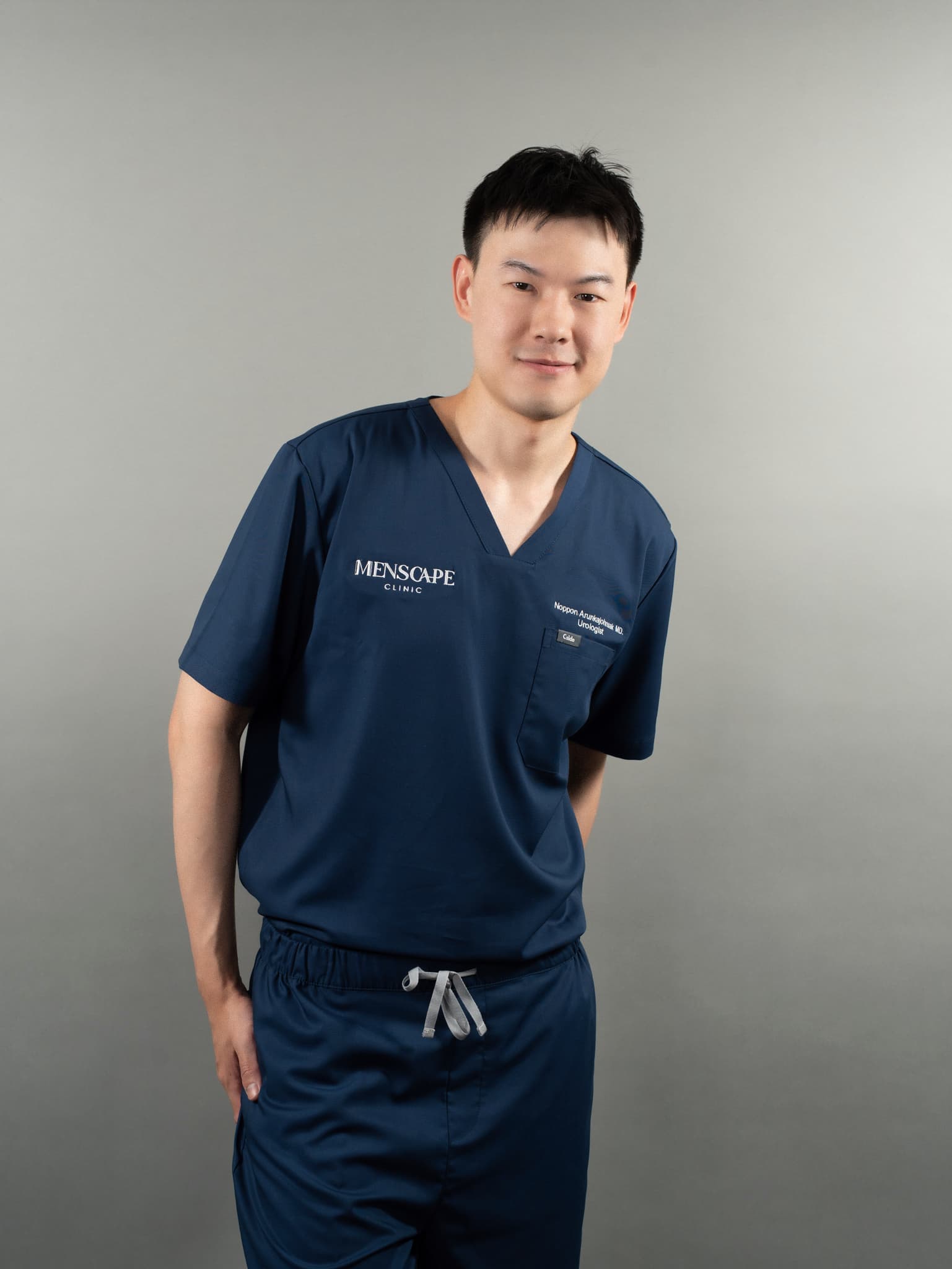
Because the right plan and the right price depend entirely on your anatomy, the only way to get a firm answer is an assessment with a surgeon who examines your nose and your breathing in person. At Menscape, consultations are built around male-focused, natural results and honest surgical planning, including telling you when surgery is not the answer. Rhinoplasty is a surgical procedure performed under anaesthesia and requires an in-person medical consultation before it can be planned or scheduled.
If you want a stronger, better-balanced nose that still looks like you, book a male rhinoplasty consultation to get an itemised quote and a plan matched to your anatomy. To understand the procedure itself in more depth, see our guide to masculine nose reshaping. Men weighing other facial work can also compare male facelift costs in Bangkok.
Frequently Asked Questions
How much does male rhinoplasty cost in Bangkok?
It typically ranges from about THB 40,000 to 250,000 depending on the procedure: roughly THB 40,000 to 80,000 for a tip refinement, THB 60,000 to 120,000 for an implant augmentation, THB 100,000 to 180,000 for open structural work, and THB 150,000 to 250,000 when your own rib cartilage is used. Revisions run higher, often THB 120,000 to 360,000. Treat these as indicative and confirm at a consultation, since the right figure depends on your anatomy and the technique.
How much cheaper is rhinoplasty in Bangkok than in the US or UK?
For comparable work it is broadly 50 to 80 percent less. The average US surgeon's fee alone was USD 7,637 in recent ASPS data, and an all-in US nose job commonly runs USD 9,000 to 20,000 or more. UK private rhinoplasty typically falls between GBP 6,500 and 15,000. A primary case in Bangkok with an experienced surgeon often lands in the USD 3,000 to 5,500 range all-in.
Is male rhinoplasty different from female rhinoplasty?
Yes. Men generally have thicker nasal skin and stronger cartilage, and the aesthetic goal is usually a stronger, more balanced profile rather than a smaller, more upturned one. A study in JAMA Facial Plastic Surgery on the male nose found the most attractive profile had a nasofrontal angle around 130 degrees and a nasolabial angle near 97 degrees, with raters favouring a subtle, gently curved dorsum over both a dead-straight line and a visible hump. A surgeon experienced in male cases avoids over-reducing or feminising the nose.
Can rhinoplasty fix my breathing?
Often, yes, when the problem is structural. A deviated septum is a common cause of one-sided nasal blockage, and the surgical fix is a septoplasty, which is frequently combined with cosmetic rhinoplasty in a single operation. A proper consultation should always assess your breathing, not just the appearance of your nose. Allergy-related congestion, by contrast, is usually managed with medication rather than surgery.
How long is the recovery, and when can I fly home?
The external splint, stitches, and any internal supports usually come out around one week, which is the typical point at which travellers fly home. Most visible bruising fades within two to three weeks, and you can generally return to desk work by then. Many surgeons prefer you stay in Bangkok 7 to 10 days for primary surgery and longer for revision or rib cases. Plan air travel with your surgeon rather than improvising it.
When will I see the final result?
Not immediately. About 90 percent of swelling settles by roughly three months, but the final result, especially at the tip, can take up to about a year as the last deep swelling resolves. The nose you see at one week is not the nose you keep, so patience is part of the process.
How likely is it that I will need a revision?
Most men do not, but a meaningful minority do. Across the published literature, around 5 to 15 percent of rhinoplasty patients eventually have a revision, and a large review of more than 11,000 procedures found reoperation rates near 2.73 percent for open and 1.56 percent for closed primary surgery. Choosing an experienced surgeon is the best way to land on the favourable side of those numbers.
Are silicone or Gore-Tex implants safe for the nose?
They are widely used and generally safe, but they carry a small long-term risk. Pooled data on synthetic dorsal implants put the overall complication rate near 2.75 percent, infection around 1.9 percent, and extrusion below 1 percent, with an overall revision rate around 6.4 percent (silicone slightly higher than Gore-Tex). Your own cartilage or rib avoids rejection risk but adds operating time and a donor site. The right material depends on your nose and goals.
Do I need a consultation before booking surgery?
Yes. Rhinoplasty is surgery performed under anaesthesia, and the plan, technique, materials, and price all depend on an in-person examination of your nose and your breathing. No reputable clinic can give you a firm, safe quote without one, and a good surgeon will also tell you honestly if surgery is not the right option for you.
)
/)
/)
/)
/)
/)