/)
A weak or recessed chin is one of the most common things men quietly notice in side-profile photos. It can make the jaw look soft, shorten the appearance of the neck, and throw off the balance between the nose, lips, and lower face. Chin augmentation corrects that by adding projection and definition to the lower third of the face, and for many men it is one of the highest-impact facial procedures relative to its cost and downtime.
Bangkok has become a practical place to have it done. The city combines experienced facial and maxillofacial surgeons, internationally accredited hospitals, and prices that are a fraction of those in the US, UK, or Australia. This guide lays out realistic Bangkok pricing in Thai baht and US dollars, explains how implants, fillers, and sliding genioplasty differ, walks through candidacy, recovery, and risks, and shows you how to separate a safe clinic from a cheap one. The figures here are indicative ranges from current market research; your exact quote depends on your anatomy and goals and should be confirmed at an in-person consultation.
What chin augmentation actually involves
"Chin augmentation" is an umbrella term for several different ways of building up the chin, and they are not interchangeable. The right one depends on how much projection you need, whether your bite is normal, and how much downtime you are willing to accept.
The three main routes for men are:
Alloplastic chin implant (implant-based augmentation). A pre-shaped, medical-grade implant, most often solid silicone but sometimes porous polyethylene or ePTFE, is placed over the chin bone through a small incision either inside the mouth or under the chin. It adds forward and sometimes lateral projection and is the most common cosmetic option. According to a StatPearls review of facial implants, these provide durable volume by augmenting the skeleton directly, without cutting the bone (Trillo & Smith, StatPearls, 2025).
Non-surgical chin filler. A hyaluronic acid (HA) filler is injected to add projection without surgery. It is temporary and reversible, which makes it useful for testing a stronger chin before committing to an implant.
Sliding (osseous) genioplasty. The surgeon cuts and repositions the chin bone itself, then fixes it with a small plate and screws. This is a larger operation, usually done by a maxillofacial surgeon, and is reserved for bigger corrections or cases where the bite and bone position also need adjusting.
A systematic review comparing the two surgical options found that implants tend to suit mild-to-moderate chin deficiency in men who want a simpler procedure, while osseous genioplasty handles most cases of significant or complex deficiency and offers more versatility, at the cost of being more invasive (Kauke-Navarro et al., Aesthetic Surgery Journal Open Forum, 2025).
The male-specific angle
Male and female chins are shaped differently, and this matters for the result. Men generally suit a chin that is wider, squarer, and projects to roughly the level of the lower lip in profile, with a defined transition into the jawline. A surgeon used to feminine aesthetics may select an implant that is too narrow or too pointed, which can leave a masculine face looking softer rather than stronger. Choosing a clinic that works regularly with men, and reviewing male before-and-after cases specifically, is one of the most important decisions you will make.
Male chin augmentation pricing in Bangkok (THB and USD)
The table below shows indicative all-in Bangkok pricing alongside typical Western costs so you can see the difference. USD conversions use an approximate rate near 36 THB to 1 USD and will move with the exchange rate. Western figures are surgeon or clinic ranges and, in the US case, often exclude anesthesia and facility fees.
Procedure | Bangkok (THB) | Bangkok (USD approx.) | Typical US / UK cost | Indicative saving in Bangkok |
Chin implant (silicone), all-in | 35,000 - 90,000 | ~1,000 - 2,500 | US surgeon fee avg ~$3,641 plus anesthesia/facility; UK £4,500 - 7,150+ | ~50-75% |
Chin filler (HA), per session | 12,000 - 30,000 | ~350 - 850 | US/UK ~$600 - 1,500+ | ~40-60% |
Sliding (osseous) genioplasty | 90,000 - 180,000 | ~2,500 - 5,000 | US ~$6,000 - 12,000+; UK from ~£3,000 - 7,800 | ~50-65% |
3D imaging / simulation (optional) | 1,000 - 4,000 | ~30 - 110 | Often bundled or higher | - |
Jawline or neck liposuction (add-on) | 25,000 - 70,000 | ~700 - 1,950 | US $3,000 - 8,000+ | ~50-70% |
The US surgeon-fee average of $3,641 comes from the American Society of Plastic Surgeons and, as ASPS states plainly, does not include anesthesia, operating-room facilities, or other related expenses (ASPS chin surgery cost). Once those are added, a US chin implant commonly lands in the $4,000-7,500+ range, which is why the Bangkok saving is real even after you factor in flights and a hotel. Treat every number above as indicative and confirm your personalised quote at consultation.
What drives the cost
Two men can get very different quotes for what sounds like the same procedure. The main reasons:
Implant material and type. Solid silicone is the most common and usually the most affordable. Custom or anatomically shaped implants, porous polyethylene, or ePTFE cost more. A systematic review of implant materials found that overall complications for primary chin augmentation are low and that equivalent satisfaction can be achieved with silicone, porous polyethylene, or ePTFE, so a higher material price does not automatically mean a better outcome (Liao et al., PRS Global Open, 2022).
Surgical approach. Placement through the mouth (intraoral, no external scar) versus under the chin (submental) can affect both price and the type of specialist required.
Surgeon experience and specialty. A surgeon who focuses on male facial contouring, or a maxillofacial surgeon for genioplasty, typically charges more than a generalist. For a procedure that permanently changes your profile, this is usually worth paying for.
Procedure complexity. A straightforward implant is cheaper than a sliding genioplasty, which involves bone cuts, fixation hardware, and a longer operation.
Combined procedures. Chin work is often paired with neck or jawline liposuction, buccal fat removal, or rhinoplasty to balance the whole face. Bundling changes the total.
Hospital or clinic grade. An internationally accredited hospital with a full operating theatre and overnight care costs more than a small day-clinic, and that difference largely reflects safety infrastructure.
Anesthesia. Filler needs only topical or local numbing. An implant may use local with sedation or general anesthesia; genioplasty almost always uses general. More anesthesia means more cost.
Who is a good candidate, and who is not
Chin augmentation works best for healthy men who have a specific, realistic concern about chin projection or jaw definition and stable expectations about what the procedure can do.
You may be a good candidate if you:
Have a chin that sits noticeably behind the ideal line in profile (microgenia) and a roughly normal bite.
Want a stronger, more masculine lower face and better balance with the nose and neck.
Are in good general health, do not smoke, or can stop well before and after surgery.
Understand that an implant is a foreign object placed for the long term.
Chin augmentation may not be right, or may need a different plan, if you:
Have a significant bite problem (overbite, underbite, jaw misalignment). In that situation an implant can be the wrong tool; orthognathic surgery or genioplasty assessed by a maxillofacial surgeon may be needed, and a simple implant could mask rather than fix the underlying issue.
Have an active infection in or around the mouth, teeth, or chin.
Have unrealistic expectations or signs of body dysmorphic concerns, where surgery is unlikely to satisfy.
Contraindications that typically rule out elective surgery, or require it to be deferred, include uncontrolled diabetes, bleeding or clotting disorders, certain autoimmune or immunosuppressed states, active local or systemic infection, and current smoking, which raises the risk of poor healing and implant problems. HA filler has its own cautions, including a history of severe allergy or anaphylaxis, active skin infection at the site, and pregnancy or breastfeeding, where treatment is generally avoided. None of this can be judged from a webpage. A consultation and medical history are required to decide what is safe for you, and surgery requires a prescription and pre-operative work-up.
The procedure, step by step
Chin implant
Consultation and planning. The surgeon assesses your profile, bite, and bone, often with photos or 3D imaging, and selects implant size and shape. Men are usually planned toward a squarer, wider implant than women.
Anesthesia. Local anesthesia with sedation, or general anesthesia, depending on the case and clinic.
Incision. A small cut is made either inside the lower lip (intraoral) or in the crease under the chin (submental). The intraoral route leaves no visible scar; the external route gives some surgeons more direct control. A review of surgical approaches found both can be done safely, with differences in scar visibility and access rather than dramatic differences in outcome.
Pocket and placement. A precise pocket is created over the chin bone, the implant is positioned and centred, and it may be fixed with a screw or suture to prevent shifting.
Closure. The incision is closed with dissolvable or removable sutures, and a supportive tape or dressing is applied.
The operation itself usually takes about 30-60 minutes for an isolated implant.
Sliding genioplasty
Genioplasty is done under general anesthesia, almost always through an intraoral incision. The surgeon cuts the lower part of the chin bone, slides it forward (or repositions it), and fixes it with a titanium plate and screws before closing. It takes longer, involves more swelling, and has a longer recovery than an implant, but it can achieve larger, more controlled changes and adjust the bone directly.
Chin filler
Filler is an office procedure. After numbing cream and sometimes local anesthetic, the injector places HA filler in measured amounts along the chin to build projection, moulding as they go. It takes around 15-30 minutes, with results visible immediately and no real downtime beyond possible minor swelling or bruising.
Recovery, stage by stage
Recovery depends heavily on which procedure you had. The timelines below are typical; your surgeon's instructions take priority.
Chin implant
Days 1-3: Swelling, tightness, and a stretched or numb feeling around the chin and lower lip are normal. A chin support tape is often worn. Discomfort is usually mild and managed with simple pain relief.
Days 4-7: Most swelling starts to settle. If sutures are external, they are typically removed around day 5-7. Many men return to desk work within a week, though the chin may still look fuller than the final result.
Weeks 2-4: Bruising resolves, and you look socially presentable. Numbness may persist as nerves recover.
Weeks 6-12: Residual swelling fades and the implant settles into its final position and feel. Strenuous exercise and contact sport are usually cleared in this window.
Sliding genioplasty
Expect more swelling and a longer course. A soft diet for a couple of weeks, more pronounced bruising, and a return to work often closer to 2 weeks are typical. Bone healing continues over several months, and final shape may take 3-6 months to fully appear.
Chin filler
Essentially no downtime. Mild swelling or a small bruise can occur and settles within days. You can usually return to normal activity the same day, avoiding heavy exercise and alcohol for 24-48 hours.
What results to expect
Done well, a chin implant gives a permanent improvement in projection and jaw definition that looks natural when the implant is correctly sized. In a study of custom ePTFE chin implants followed for an average of three years, all 38 patients were satisfied with the cosmetic result, with a mean satisfaction score of 8.1 out of 10 (Guo et al., Aesthetic Plastic Surgery, 2024). Systematic-review data likewise report high satisfaction across silicone, porous polyethylene, and ePTFE implants (Liao et al., 2022).
Filler results are immediate but temporary. Clinical trial data for the HA filler VYC-20L, a volumizing hyaluronic acid product (Juvederm Voluma XC) studied for chin augmentation, showed meaningful improvement maintained through 12 months, with the responder rate around 57-58% at one year and higher after a touch-up (Beer et al., Dermatologic Surgery, 2021). In practice, HA chin filler commonly lasts roughly 12-18 months before a top-up is needed, and it can be dissolved with hyaluronidase if you dislike the result, which is its key safety advantage over permanent options.
Genioplasty results are permanent and can be the most powerful, since they reposition the bone itself. The trade-off is the larger operation and recovery.
Have a question about your treatment?
Message our Bangkok clinic on WhatsApp and a doctor replies within minutes during clinic hours.
Risks and side effects
Every option carries risk. The good news is that for primary chin augmentation, serious complications are uncommon, but they are not zero, and men-specific factors like beard-area skin and smoking can affect healing.
Common, usually temporary:
Swelling, bruising, and tightness.
Temporary numbness of the chin and lower lip as the mental nerve recovers. In the ePTFE implant series, about 15.8% had temporary nerve-related numbness (Guo et al., 2024).
Mild asymmetry during healing that usually settles.
Less common but important (implant and genioplasty):
Infection. StatPearls reports a pooled infection rate of roughly 2-5% for facial implants overall (Trillo & Smith, 2025). For chin implants specifically, reported infection rates vary widely across studies, from 0% up to around 24% in some series, and an infected implant frequently has to be removed. The implant-versus-genioplasty review found infection risk runs higher for implants than for osseous genioplasty (where reported rates topped out around 5%), which is one reason approach and sterile technique matter (Kauke-Navarro et al., 2025).
Implant malposition or shifting, reported in roughly 1-3% of cases, sometimes needing revision.
Bone resorption under the implant over time, usually minor.
Persistent mental nerve injury, reported in around 2.4% of cases, causing longer-lasting altered sensation.
Need for revision or removal if the implant becomes infected, shifts, or the size is not right.
Filler-specific: injection-site tenderness and firmness are common and mild; serious events are rare. The most important rare risk is accidental injection into a blood vessel (vascular occlusion), which is why filler should be placed by an experienced injector who can recognise and treat it.
Seek urgent medical care if, after any of these procedures, you develop spreading redness, increasing pain, warmth or pus around the chin, fever, a foul taste or discharge inside the mouth, sudden severe or worsening pain, or, after filler, blanching (white) skin, dusky or blue discoloration, or skin that becomes cold and very painful. These can signal infection or, with filler, a vascular problem, and they need same-day assessment.
How to choose a safe clinic in Bangkok, and red flags
Price should be one of the last filters, not the first. Use this checklist:
A surgeon who works with men. Ask specifically to see male chin cases. Male and female chin aesthetics differ, and you want someone who routinely builds masculine, balanced results.
Right specialist for the procedure. A plastic or facial cosmetic surgeon for implants; a maxillofacial surgeon for genioplasty or any case involving the bite.
Accredited operating environment. Surgery should happen in a licensed, accredited hospital or surgical facility with proper anesthesia support, not a back-room treatment chair. International accreditation such as JCI, or recognised local hospital accreditation, is a strong signal.
Medical-grade, traceable implants. Confirm the implant is a branded, medical-grade device and ask what material and size are planned and why.
A real consultation. You should be examined, have your bite and goals assessed, be told who is genuinely a candidate, and hear the risks. Imaging or simulation is a plus.
Clear aftercare. Follow-up visits, a way to reach the team urgently, and a plan for the long-term monitoring an implant deserves.
Red flags to walk away from:
Prices that are dramatically below everyone else, which usually means corners cut on facility, anesthesia, or implant quality.
Unbranded or unspecified implant material.
Surgery offered outside an accredited facility, or pressure to decide quickly or pay a large deposit before a proper consultation.
No before-and-after evidence, especially for men, and no clear answer on who handles complications.
Filler being marketed as a permanent or "lifetime" chin solution. HA filler is temporary; "permanent fillers" carry materially higher long-term risk and are not recommended by most reputable clinics.
Implant vs filler vs genioplasty: a comparison
Feature | Chin implant | Chin filler (HA) | Sliding genioplasty |
How it works | Adds a solid implant over the bone | Injects gel to add projection | Cuts and repositions the chin bone |
Best for | Mild-to-moderate deficiency, wanting a permanent fix | Testing projection, subtle change, no downtime | Larger or complex deficiency, bite-related cases |
Permanence | Long-term, removable | Temporary (~12-18 months) | Permanent |
Reversible | Yes, by removal (surgery) | Yes, dissolves with hyaluronidase | Not easily |
Anesthesia | Local + sedation or general | Topical / local | General |
Downtime | ~1 week to look presentable | Minimal | ~2 weeks, longer full settling |
Bangkok cost (THB) | 35,000 - 90,000 | 12,000 - 30,000 / session | 90,000 - 180,000 |
Main risks | Infection, malposition, nerve numbness | Bruising, rare vascular event | Swelling, nerve, hardware-related |
Booking a consultation at Menscape
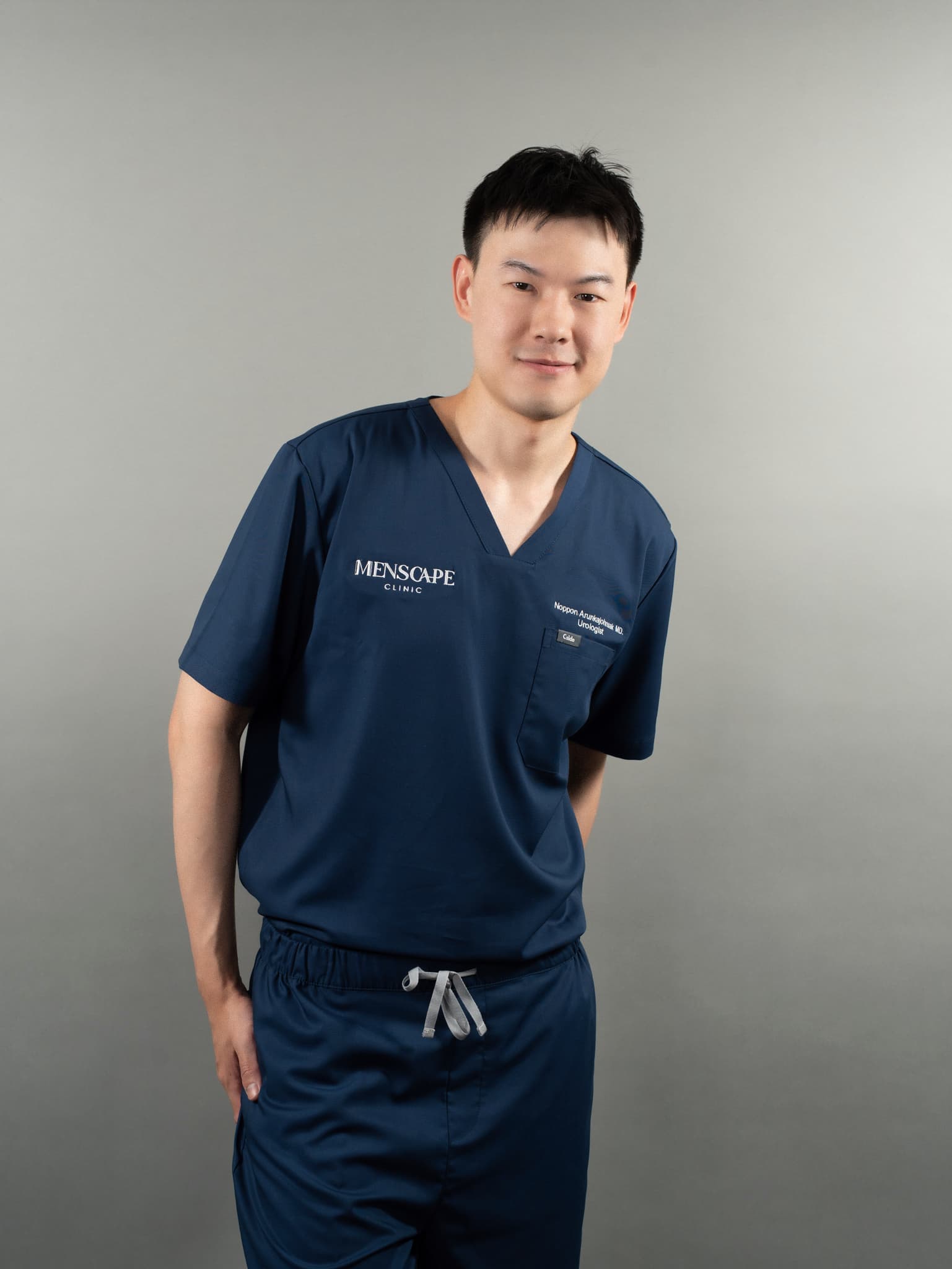
Menscape focuses on men's aesthetics in Bangkok, which means chin and jaw planning built around masculine proportion rather than a one-size-fits-all template, transparent pricing, accredited surgical settings, and discreet consultations. Because the right procedure depends on your bone, bite, and goals, the honest first step is an assessment, not a quote.
Chin augmentation is a medical procedure. Surgery requires an in-person consultation, a medical history, and a prescription and pre-operative work-up; filler requires assessment by a qualified injector. If you are weighing a stronger jawline and a more balanced profile, book a consultation to find out which option fits you, or read more about male jawline and facial contouring to plan a combined approach.
Frequently Asked Questions
How much does a male chin implant cost in Bangkok?
An all-in silicone chin implant in Bangkok typically runs about 35,000-90,000 THB, roughly 1,000-2,500 USD, depending on the implant, surgeon, anesthesia, and whether it is combined with other procedures. That is commonly 50-75% less than the US or UK. Treat this as indicative and confirm your exact quote at consultation.
Is a chin implant or filler better for a stronger jaw?
Filler is a good, reversible way to test more projection with no downtime, but it is temporary and lasts roughly 12-18 months. An implant gives a permanent, more defined result and is usually the better long-term choice for men wanting a noticeably stronger chin. Larger or bite-related corrections may instead call for sliding genioplasty. A consultation is the only reliable way to know which suits you.
Is the chin implant permanent? Can it be removed?
A chin implant is designed to be a long-term, effectively permanent result, but it is not irreversible. It can be removed or exchanged with a further procedure if it becomes infected, shifts, or you are unhappy with the size. Filler, by contrast, fades on its own and can be dissolved with hyaluronidase.
Does chin augmentation hurt, and how long is recovery?
Most men report tightness and mild discomfort rather than severe pain after an implant, controlled with simple pain relief. Expect to look presentable within about a week, with residual swelling settling over 6-12 weeks. Filler has essentially no downtime. Sliding genioplasty is a bigger operation with more swelling and a return to work often closer to two weeks.
Will a chin implant look natural and masculine?
Yes, when it is correctly sized and shaped for a male face. Men generally suit a wider, squarer implant that projects to around the lower-lip line. The most common reason a result looks 'off' is an implant chosen for the wrong shape or size, which is why seeing a surgeon's male before-and-after cases matters.
What are the main risks of chin augmentation?
For implants, the notable risks are infection (pooled facial-implant rates around 2-5%, though reported chin-implant rates vary widely and reach up to roughly 24% in some series and often lead to implant removal), implant shifting (about 1-3%), temporary chin and lip numbness, and rarely longer-lasting nerve changes (around 2.4%). Filler risks are mostly mild bruising, with a rare but serious risk of injection into a blood vessel. Seek urgent care for spreading redness, increasing pain, fever, or, after filler, pale, dusky, or very painful skin.
Why is chin augmentation so much cheaper in Bangkok than in the US or UK?
Lower facility, staffing, and overhead costs in Thailand, not lower quality at reputable clinics. In the US the surgeon's fee alone averages about 3,641 USD before anesthesia and facility charges, and UK implants often reach 4,500-7,150 GBP. A well-run Bangkok procedure at an accredited hospital can deliver comparable standards for substantially less, even after travel.
Do I need a consultation before booking surgery?
Yes. Chin augmentation changes your facial proportion and, for surgery, involves an implant or bone work, so it requires an in-person consultation, a medical history, and a prescription and pre-operative work-up. The consultation confirms whether you are a candidate, rules out issues like a bite problem or contraindications, and sets a realistic plan and price.
)
/)
/)
/)
/)
/)