/)
If you had paraffin, silicone, mineral oil, petroleum jelly, or an unknown "enhancement" filler injected into your penis or scrotum, and you are now dealing with hard lumps, swelling, pain, or a change in shape, you are looking at a condition called paraffinoma. It is more common than most men realise, and the men who have it often carry a lot of quiet distress about it. The good news is that it is treatable. The harder truth is that creams, antibiotics, and massage do not fix it, because the injected material is a foreign substance your body cannot break down or absorb. Removing it surgically and rebuilding the skin is the only reliable way to resolve the problem.
This guide explains what a paraffinoma is, why it happens, the surgical options used to correct it, who is and is not a good candidate, what recovery actually looks like, the realistic results based on published outcomes, and transparent pricing for Bangkok including how it compares to the US and UK. It is written for men, about a men's problem, in plain language. None of it replaces an in-person assessment. Paraffinoma repair is a surgical procedure that requires a medical consultation and is performed only on prescription after a doctor has examined you.
What a paraffinoma actually is
A paraffinoma, also called a sclerosing lipogranuloma or oleogranuloma, is a foreign-body granuloma. When an oily or semi-solid substance is injected under the skin of the penis or scrotum, the immune system recognises it as something it cannot dissolve. It walls the material off with inflammatory cells, scar tissue, and fluid. Over months and years this builds into firm, irregular masses, and the surrounding skin and soft tissue become thickened, tethered, and prone to ulceration or infection.
The substances behind this are almost always non-medical, injected by an untrained person or self-injected, usually with the goal of girth enlargement. Reported materials include:
Liquid paraffin and mineral oil
Silicone oil
Petroleum jelly, often known by the brand name Vaseline
Baby oil and various cooking or plant oils
Homemade or unlabelled "filler" preparations sold for enlargement
One feature that surprises men is the delay. Symptoms often appear long after the injection. A dermatology review described a patient who presented roughly eight years after his paraffin injections, and the literature notes that manifestations can surface years down the line (Indian Journal of Dermatology, Venereology and Leprology, 2017). So feeling fine for a while after an injection does not mean you are in the clear.
Symptoms men notice
The picture varies with how much material was injected and how long ago, but commonly includes:
Hard lumps or an irregular, rope-like mass under the skin
Swelling that does not settle, sometimes extending from the shaft into the scrotum
Redness, skin discolouration, or thickened skin
Pain at rest, during erection, or during sex
Visible deformity, curvature, or asymmetry
Skin breakdown, ulcers, or draining sinuses
A foreskin that will not retract (acquired phimosis)
In advanced cases, infection or difficulty passing urine
Symptoms tend to progress rather than improve, because the underlying driver, the foreign material, stays put and keeps provoking inflammation.
Why this needs surgery, not patience
It is worth being direct about this, because men understandably hope the lumps will settle if they wait. They will not. The injected oil or filler is not metabolised, so the granuloma does not regress on its own, and incomplete removal tends to let it recur. The dermatology literature is explicit that management means complete surgical excision of the foreign material and fibrotic tissue, and that incomplete excision frequently leads to recurrence (IJDVL, 2017).
There is also a safety argument for not ignoring it. Beyond the local problems of pain, deformity, and skin loss, injected genital filler has, in rare reported cases, caused serious systemic events. A case series in the Malaysian Journal of Medical Sciences described local complications such as infection, ulceration, migration of material, and invasion into the erectile bodies, and noted that foreign-body embolisation, organ infarction, and even death have been reported in the wider literature (Malaysian Journal of Medical Sciences, 2012). Those catastrophic outcomes are uncommon, but they are the reason doctors treat unsanctioned genital injections as a problem to correct rather than monitor indefinitely.
Surgical options and how they differ
There is no single operation called "paraffinoma repair." The right technique depends on how much tissue is affected, where it sits, and how much healthy skin remains. A surgeon decides only after examining you, and sometimes after imaging. The main approaches, drawn from the surgical literature, are below.
Limited excision with primary closure
For a small, focal mass where the surrounding skin is healthy, the granuloma can be removed and the skin edges sewn back together directly. In a published technique series this approach took on the order of two hours, left a linear scar, and did not shorten the penis (Malaysian Journal of Medical Sciences, 2019). This is the least invasive route and is realistic only when disease is genuinely localised.
Circumcision for foreskin-only disease
When the foreign material sits mainly in the foreskin, a circumcision that removes the affected sleeve of skin can be sufficient on its own. This is one of the simpler scenarios and is often part of a larger reconstruction when disease is more widespread.
Circumferential excision with a scrotal skin flap
When the granuloma wraps around the shaft, the surgeon removes the diseased skin and tissue all the way around, preserving the deeper fascia that covers the nerves and erectile bodies, then resurfaces the shaft with skin borrowed from the scrotum. The scrotum is a useful donor because it is close, well vascularised, and stretchy. In the technique series above, single-stage circumferential excision with a bilateral scrotal flap was the preferred option for circumferential disease, with an average operating time of around four and a half hours (Malaysian Journal of Medical Sciences, 2019).
Excision with a skin graft
As an alternative or complement to a flap, denuded areas can be covered with a full-thickness or split-thickness skin graft, harvested from a donor site such as the groin or inner thigh. A reconstruction using a full-thickness graft taken from the groin and anchored with spiral sutures reported a good cosmetic result with no contracture, curvature, or shortening at one year (Plastic and Reconstructive Surgery Global Open, 2022). Other series have resurfaced the shaft with a split-thickness graft harvested from the inner thigh (Malaysian Journal of Medical Sciences, 2012).
Staged (two-step) reconstruction
For extensive disease, surgeons may split the work into two operations. In the first, the granuloma is excised and the penile shaft is temporarily buried under scrotal skin to heal. After roughly three months, a second operation releases the shaft and completes the reconstruction (Malaysian Journal of Medical Sciences, 2019). Staging adds time and a second recovery but can give a more reliable result when there is not enough healthy local skin to close in one go.
Bangkok pricing in THB and USD
Pricing depends almost entirely on how much tissue is involved and whether reconstruction needs a flap, a graft, or two stages. The figures below are indicative ranges for Bangkok, intended to set expectations, not to quote your case. Confirm the exact figure at consultation, because only an examination can establish which operation you actually need. As a reference point, one Bangkok centre publishes paraffinoma removal at roughly 150,000 to 160,000 THB (about USD 4,550 to 4,850) inclusive of surgery, anaesthesia, and post-operative care (Rattinan Medical Center). USD conversions use an approximate rate of 33 THB to 1 USD (mid-2026) and will move with the exchange rate.
Procedure | Indicative Bangkok price (THB) | Approx. USD | Typical US / UK range (USD) | You may save |
Limited excision, focal nodule, primary closure | 60,000 – 110,000 | 1,800 – 3,350 | 6,000 – 12,000 | up to ~70% |
Circumcision for foreskin-confined disease | 25,000 – 60,000 | 750 – 1,800 | 3,000 – 7,000 | up to ~75% |
Full excision + scrotal flap or skin graft | 130,000 – 180,000 | 3,950 – 5,450 | 12,000 – 25,000 | up to ~75% |
Staged reconstruction (two operations) | 170,000 – 220,000+ | 5,150 – 6,700+ | 18,000 – 35,000 | up to ~75% |
These ranges are indicative only and not a quotation. Western prices for complex penile reconstruction vary widely by hospital, surgeon, and whether the work is done privately, and they frequently exceed USD 10,000 once theatre, anaesthesia, and surgeon fees are combined, which is the basis for the savings column above.
What drives the cost
How much tissue is involved. A single small nodule is far cheaper than circumferential disease that needs the whole shaft resurfaced.
Reconstruction method. Direct closure is least costly. Flaps and grafts add operative time, theatre cost, and a donor site.
One stage versus two. Staged reconstruction means two operations, two anaesthetics, and two recoveries.
Anaesthesia and admission. General anaesthesia and any overnight stay add to the bill. Ask whether these are included.
Pre-operative workup. Examination, blood tests, and ultrasound or other imaging may be billed separately.
Revision risk. Some men need a touch-up procedure, which is a possible additional cost worth asking about up front.
When you compare quotes, always check what is and is not included. A low headline figure that excludes anaesthesia, hospital stay, and follow-up is not really lower.
Who is a good candidate, and who is not
Most men with a symptomatic paraffinoma are candidates for surgery, because leaving the foreign material in place rarely improves anything. A typical candidate has hard lumps, deformity, pain, recurrent inflammation, skin changes, or functional problems such as a non-retracting foreskin, and is in good enough general health to undergo an operation under anaesthesia.
Surgery may need to be delayed, modified, or reconsidered if any of the following apply, which is exactly what the consultation is for:
Active, spreading infection. This usually needs to be controlled first, sometimes urgently, before planned reconstruction.
Very extensive disease with little healthy skin left. This does not rule out surgery, but it points toward a staged approach and a frank discussion about achievable results.
Uncontrolled medical conditions. Poorly controlled diabetes, bleeding disorders, or significant cardiac or respiratory disease raise anaesthetic and wound-healing risk and may need optimisation first.
Smoking. Nicotine impairs the blood supply that flaps and grafts depend on, so surgeons commonly ask you to stop well before and after surgery.
Unrealistic expectations. This operation is reconstructive. The goal is to remove harmful material, relieve symptoms, and restore a reasonably normal appearance and function, not to enlarge the penis. If your underlying wish is enlargement, that conversation needs to happen separately and honestly.
Contraindications to be aware of
There is no absolute contraindication unique to paraffinoma repair beyond the usual ones for any genital surgery under anaesthesia: active untreated infection at the operative site that cannot be controlled, an unstable serious medical condition, an uncorrected bleeding disorder, or inability to give informed consent. Pursuing further enlargement injections is strongly discouraged, since it is the original cause of the problem. Your surgeon will weigh your individual risks during assessment.
Step by step: what the procedure involves
Every case is planned individually, but the path usually looks like this.
1. Consultation and assessment. A men's-health or reconstructive surgeon takes your history (what was injected, when, by whom, and what symptoms you have), examines the genitals, and may order an ultrasound or other imaging to map how deep and how widespread the material is. You agree on a technique and discuss risks, costs, and recovery. This step is mandatory; surgery is not booked sight unseen.
2. Preparation. You may be asked to stop smoking, pause certain medications such as blood thinners on medical advice, and complete pre-operative blood tests. Antibiotics may be started around the time of surgery.
3. The operation. Most reconstructions are done under general anaesthesia. The surgeon excises the granuloma and affected skin while protecting the deeper fascia, nerves, and erectile bodies, then reconstructs using direct closure, a scrotal flap, or a skin graft as planned. Operative time ranges from roughly two hours for a focal excision to four hours or more for circumferential reconstruction, based on published technique data (Malaysian Journal of Medical Sciences, 2019). Dissolvable sutures and a supportive dressing are typically used.
4. Early aftercare. You go home with pain relief, often a short course of antibiotics, and dressing instructions. You will be advised to keep the area clean, avoid stimulation and erections as much as possible in the first weeks, and attend follow-up so the surgeon can check that flaps and grafts are taking well.
Recovery, stage by stage
Healing is gradual, and the timeline below is a general guide. Flap and graft reconstructions take longer to settle than a small excision, and a staged repair resets the clock for the second operation.
Days 1 to 7. Expect swelling, bruising, and soreness. Keep the dressing as instructed, take pain relief, rest, and avoid sexual stimulation. Watch the wound for warning signs (below).
Weeks 1 to 2. Swelling begins to subside and the wound starts to seal. Light daily activity is usually fine. Most men take one to two weeks off demanding physical work; desk work is often resumable sooner.
Weeks 3 to 6. Tissues continue to settle. Light exercise can typically resume on your surgeon's advice. Avoid sexual activity until you are cleared, usually around the six-week mark.
Weeks 6 to 12. Sexual activity is generally permitted once the surgeon confirms healing. The contour keeps refining and scars begin to soften and fade.
Three to six months. This is when the final aesthetic and functional result becomes clear. Grafts and flaps mature, colour evens out, and scar lines continue to improve.
Follow your surgeon's specific instructions over any general timeline, since they are watching how your particular reconstruction is healing.
Realistic results, with numbers
Men want to know two things: will it look acceptable, and will sex still work. The published evidence is cautiously encouraging on both, while being honest that this is significant surgery.
In a series of 49 men treated with a modified bipedicle scrotal-skin-flap reconstruction, all patients reported the ability to have sexual intercourse afterward, and about 90 percent of those who completed follow-up questionnaires reported a successful outcome (Journal of Urology, 2022).
A single-case full-thickness-graft reconstruction documented erectile function improving on a standardised score (IIEF) from 10 before surgery to 24 at one year, with no scar contracture, curvature, or shortening (Plastic and Reconstructive Surgery Global Open, 2022).
Technique series report satisfactory erectile function after both focal excision and scrotal-flap reconstruction (Malaysian Journal of Medical Sciences, 2019).
Most men can expect relief from pain and inflammation, a smoother and more natural appearance, restoration of a retractable foreskin where that was a problem, removal of the harmful material, and preserved or improved sexual function. Results depend heavily on how advanced the disease was and on the surgeon's experience with genital reconstruction.
Have a question about your treatment?
Message our Bangkok clinic on WhatsApp and a doctor replies within minutes during clinic hours.
Risks and side effects
This is real surgery in a sensitive area, and complications are not rare. In the 49-patient flap series, the overall complication rate was about 26.5 percent, including a small number of men with erectile dysfunction, pain on erection, premature ejaculation, or penile lymphoedema (Journal of Urology, 2022). Knowing this up front helps you choose an experienced surgeon and follow aftercare carefully.
Common and expected
Swelling, bruising, and soreness in the first weeks
Scarring, which surgeons place and design to be as discreet as possible
Temporary changes in sensation
Mild wound discharge in the early days
Less common but important
Partial graft or flap healing problems requiring dressing changes or, occasionally, a revision procedure
Infection
Persistent change in sensation
Penile curvature, shortening, or lymphoedema (swelling)
Erectile or ejaculatory changes
Recurrence if any foreign material was left behind, which is why complete excision matters (IJDVL, 2017)
Seek urgent medical care if you notice
Spreading redness, increasing pain, fever, or pus, which can signal infection
A graft or flap turning dark, dusky, or black
Heavy or persistent bleeding that does not stop with light pressure
Inability to pass urine
Rapidly worsening swelling
These are red flags. Do not wait for your scheduled follow-up; contact your surgeon or an emergency service promptly.
Choosing a safe clinic, and the red flags
Because outcomes hinge on surgical experience, who operates matters more than the headline price. Reasonable things to look for:
A surgeon with specific, demonstrable experience in genital and penile reconstruction, not just general cosmetic work
Willingness to examine you in person and order imaging before committing to a plan
A clear, written explanation of which technique they propose and why, with realistic expectations
Transparent pricing that states what is included (anaesthesia, hospital stay, follow-up, possible revision)
Proper accreditation, a real operating-theatre environment, and general anaesthesia delivered by an anaesthetist
Honest discussion of risks and recurrence, not just benefits
Walk away, or at least get a second opinion, if a provider does any of the following:
Quotes a fixed price or guarantees a result without examining you
Promises enlargement as part of the repair, or suggests more filler
Cannot or will not show relevant reconstructive experience
Is vague about anaesthesia, facilities, or what the price covers
Pressures you to book immediately
The same logic that makes unsanctioned injections dangerous, an untrained person doing an invasive procedure in an uncontrolled setting, applies in reverse here: you want a qualified surgeon in a proper facility (International Journal of Surgery Case Reports, 2023).
Comparison: which approach fits which situation
Approach | Best for | Stages | Recovery to intercourse | Indicative THB | Key trade-off |
Limited excision + primary closure | Small, focal nodule, healthy surrounding skin | 1 | ~6 weeks | 60,000 – 110,000 | Only suitable for localised disease |
Circumcision | Foreign material confined to the foreskin | 1 | ~4–6 weeks | 25,000 – 60,000 | Insufficient if disease extends onto the shaft |
Circumferential excision + scrotal flap | Disease wrapping around the shaft | 1 | ~6–12 weeks | 130,000 – 180,000 | Longer operation, scrotal donor site |
Excision + skin graft | Skin loss needing resurfacing | 1 | ~6–12 weeks | 130,000 – 180,000 | Graft take is not guaranteed |
Staged reconstruction | Extensive disease, limited healthy skin | 2 | Longer, reset by stage two | 170,000 – 220,000+ | Two operations, two recoveries |
Use this as a conversation starter with your surgeon, not a self-diagnosis. The examination decides which row you are in.
Why men consider Bangkok
Bangkok has become a practical option for this specific problem for a few reasons. There are surgeons here with genuine experience in complex genital reconstruction, including foreign-body removal, because the demand exists across the region. Costs are substantially lower than comparable private reconstruction in the US, UK, or Australia, while the facilities for this kind of work are modern. Care can be arranged discreetly, which matters a great deal to most men dealing with this. English-speaking, men's-health-focused clinics make the process easier to navigate from abroad. None of that changes the core requirement: a proper in-person assessment and a surgeon whose experience you have actually verified.
Talk to a doctor first
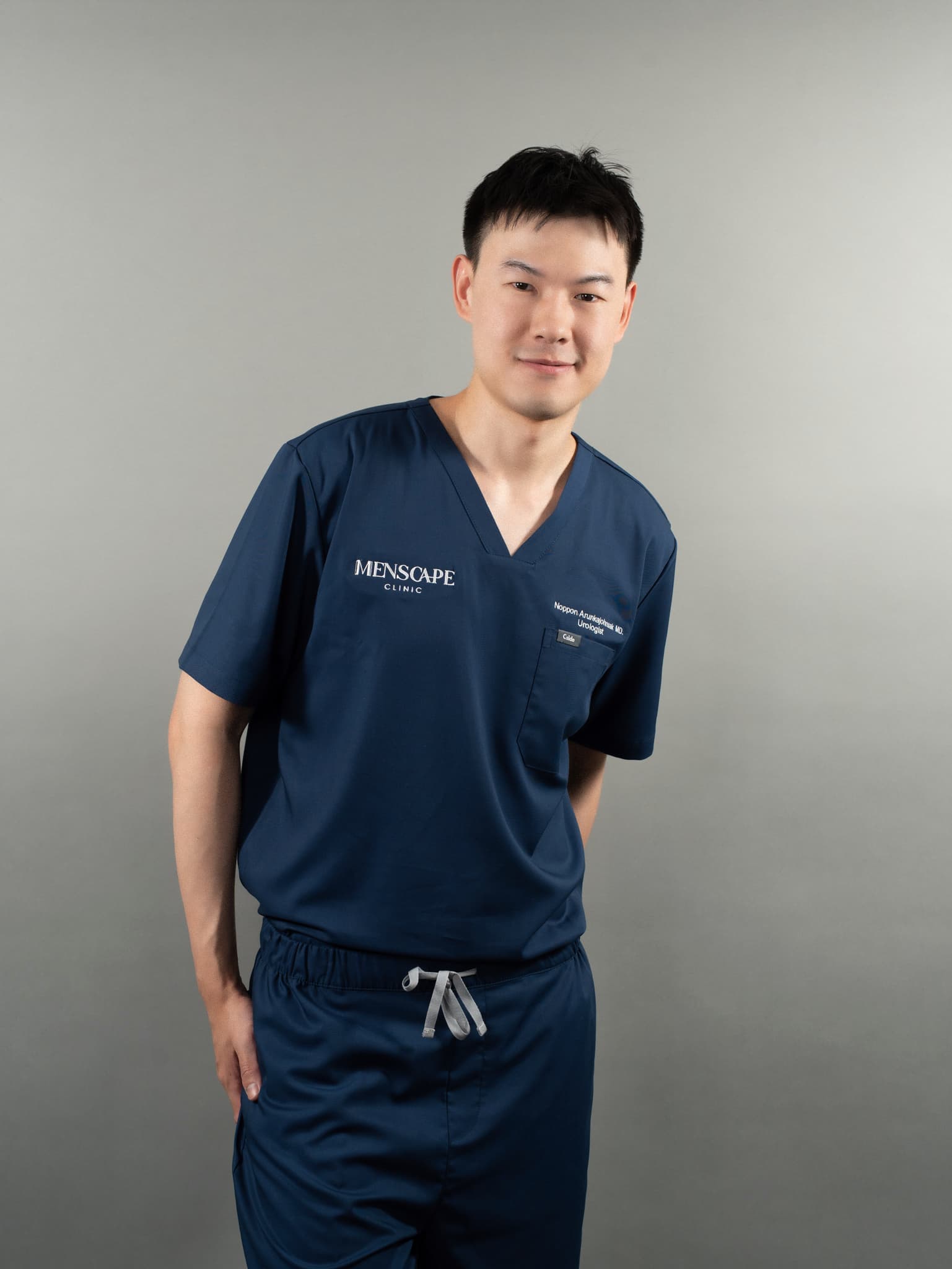
If you are living with hard lumps, deformity, pain, or skin problems after a penile or scrotal injection, the most useful next step is a confidential consultation with a clinician who treats this regularly. They can examine you, arrange any imaging, tell you which operation fits your case, and give you an accurate price rather than a range. Paraffinoma repair is a surgical treatment that requires a medical consultation and is carried out only on prescription after assessment. To discuss your situation privately, you can book a confidential consultation with the male surgery team at Menscape. It is also worth reviewing the related guidance on paraffinoma repair costs and safety in Bangkok and, if a foreskin procedure is part of the plan, the overview of circumcision.
Frequently Asked Questions
Can a paraffinoma go away on its own without surgery?
No. The injected paraffin, silicone, oil, or filler is a foreign material the body cannot absorb or break down, so the granuloma does not regress over time. Creams, antibiotics, and massage do not remove it. Published guidance is clear that complete surgical excision of the foreign material and fibrotic tissue is the definitive treatment, and that incomplete removal tends to let the problem recur.
Will paraffinoma repair affect my erections or sex life?
The aim of the surgery is to preserve and ideally improve sexual function by removing painful, restrictive tissue while protecting the deeper nerves and erectile bodies. In one 49-patient series using a scrotal-flap reconstruction, all men reported being able to have intercourse afterward, and a graft-based case reported erectile-function scores improving over a year. That said, a minority of men in published series experienced erectile or ejaculatory changes, so this is discussed individually before surgery.
How much does paraffinoma removal cost in Bangkok?
It depends on how much tissue is involved. Indicative Bangkok ranges are roughly 60,000 to 110,000 THB (about USD 1,800 to 3,350) for a limited excision, 130,000 to 180,000 THB (about USD 3,950 to 5,450) for full excision with a flap or graft, and 170,000 to 220,000 THB or more (about USD 5,150 to 6,700) for staged reconstruction. One Bangkok centre lists paraffinoma removal at about 150,000 to 160,000 THB (around USD 4,550 to 4,850) inclusive of surgery, anaesthesia, and post-operative care. These are indicative only; the exact price is confirmed at consultation after examination, and USD figures move with the exchange rate.
Why is it so much cheaper than in the US or UK?
Lower facility, anaesthesia, and surgeon costs in Thailand mean comparable reconstruction often runs well below Western private pricing, which frequently exceeds USD 10,000 for complex penile reconstruction. The savings reflect cost structure, not a lesser operation, provided you choose an experienced surgeon in a properly accredited facility. Always confirm what the quoted price includes, since anaesthesia, hospital stay, and follow-up are sometimes billed separately.
How long is recovery, and when can I have sex again?
Expect swelling and soreness for the first week or two, light activity within a couple of weeks, and clearance for sexual activity usually around six weeks, depending on the reconstruction. The final appearance settles over three to six months as grafts and flaps mature and scars fade. A staged (two-operation) repair takes longer overall. Follow your surgeon's specific instructions over any general timeline.
Will there be visible scars?
Yes, any excision leaves a scar, but surgeons plan incisions to keep them as discreet as possible, often along natural lines, and a limited excision may leave only a linear mark. Scars typically soften and fade over several months. The trade-off of removing harmful material and restoring a more normal shape is generally considered worthwhile, and published series report low rates of problematic scarring or contracture with experienced reconstruction.
Can the paraffinoma come back after surgery?
Recurrence is uncommon when the foreign material and affected tissue are completely removed, but it becomes a real risk if any material is left behind. This is why complete excision is emphasised and why an experienced reconstructive surgeon and adequate imaging matter. Critically, you should never have further enlargement injections, since that is the original cause of the condition.
Is paraffinoma repair done under general anaesthesia, and is it day surgery?
Most reconstructions are performed under general anaesthesia because the work can be extensive and may take from around two hours up to four or more for circumferential cases. Whether you go home the same day or stay overnight depends on the technique and your surgeon's protocol. This is decided during the consultation, and you should confirm whether anaesthesia and any hospital stay are included in your quoted price.
Do I really need a consultation before booking surgery?
Yes. Paraffinoma repair cannot be planned or priced accurately without an in-person examination, and sometimes imaging, to map how deep and widespread the material is and to choose the right technique. It is a surgical procedure performed only on prescription after assessment. Any provider offering a fixed price or guaranteed result without examining you is a red flag.
)
/)
/)
/)
/)
/)